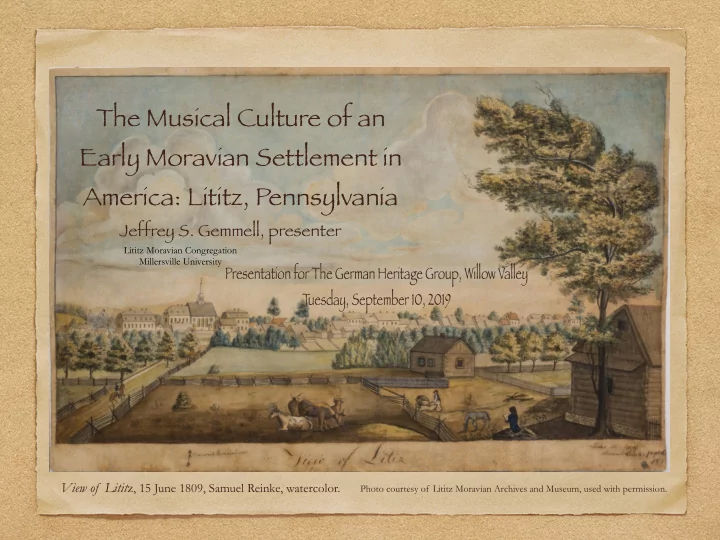
The Musical Culture of an Early Moravian Settlement in America: - - PowerPoint PPT Presentation

the musical culture of an early moravian settlement in
SMART_READER_LITE
LIVE PREVIEW

The Musical Culture of an Early Moravian Settlement in America: - - PowerPoint PPT Presentation

The Musical Culture of an Early Moravian Settlement in America: Lititz, Pennsylvania Jeffrey S. Gemmell, presenter Lititz Moravian Congregation Millersville University Presentation for The German Heritage Group, Willow Valley Tuesday,


slide-1
SLIDE 1

The Musical Culture of an Early Moravian Settlement in America: Lititz, Pennsylvania

Jeffrey S. Gemmell, presenter

View of Lititz, 15 June 1809, Samuel Reinke, watercolor.

Presentation for The German Heritage Group, Willow Valley Tuesday, September 10, 2019

Photo courtesy of Lititz Moravian Archives and Museum, used with permission. Lititz Moravian Congregation Millersville University

slide-2
SLIDE 2

A Lititz Anthem by Johannes Herbst (1735-1812)

Lobet den Herrn alle Seine Heerschaaren composed for dedication of Lititz Moravian sanctuary, August 13, 1787 Lititz Moravian Senior Choir and Millersville University Chorale, Bethlehem Conference, October 4, 2014

slide-3
SLIDE 3

Volume 3 Musical Treasures from Moravian Archives

  • Sarah Eyerly, general editor

Mark Knoll, managing editor

  • Editorial Board
  • Dr. Nola Reed Knouse,

Moravian Music Foundation, Winston-Salem

Olaf Nippe,

Unitätsarchiv, Herrnhut

Gwyneth Michel,

Moravian Music Foundation, Bethlehem

  • Dr. Paul Peucker,

Moravian Archives, Bethlehem

  • Published December 24, 2018. Available on Amazon!
slide-4
SLIDE 4

Matthaeus Gottfried Hehl

(1705-87):

  • Manuscript Congregational History of Lititz, vol. 1:

Historical Report of the Beginning and Continuation of the Little Congregation of the Brethren at Warwik and the Brethren’s Settlement Congregation LITIZ that Subsequently Arose There in Lancaster County, Pennsylvania, 1742–1779 (Moravian

Archives, Bethlehem, PA, call no. ChReg 75), 1.

Photo courtesy of Tom Wentzel, used with permission

slide-5
SLIDE 5

Signature of David Tanneberger (Tannenberg) from church document: Preliminary Conditions or Town Regulations, 1759 First line of Tannenberg’s 1804 Lebenslauf in the hand of Johannes Herbst. Note Herbst’s correction from “b” to “n” in order to retain Tannenberg’s preferred spelling as otherwise kept consistently throughout the document.

David T annenberg (1728-1804)

slide-6
SLIDE 6

This 1791 David Tannenberg

  • rgan was
  • riginally built of

the Moravian congregation in Graceham,

  • Maryland. It

currently resides in the chapel of the Brother’s House in Lititz.

Photo courtesy of the Lititz Moravian Congregation, used with permission

slide-7
SLIDE 7

Photo courtesy of Carl Shuman, used with permission

The 1787 David Tannenberg Organ was built for the “new” Lititz sanctuary and played by Johannes Herbst during the dedication Lovefeast service, when Herbst also led the debut

  • f his anthem Lobet den Herrn

alle seine Heershaaren. Modern restoration of this organ was completed in 1983, and it now resides in the church’s Fellowship Hall located immediately behind the Brother’s House.

slide-8
SLIDE 8

Signature of Bishop Hehl (1705-87) from church document: Preliminary Conditions or Town Regulations, 1759 Signature of Brother Grube (1715-1808) from church document: Preliminary Conditions or Town Regulations, 1759

T wo Pastors Credited for Establishing Strong T radition of Music in Lititz.

slide-9
SLIDE 9

Music Budget established in 1768

Church members established a fund for music and music supplies: “a small account was set up and taken for instruments, strings, etc.” Could this have been the beginning of the Lititz Collegium Musicum?

  • H. G. Hehl, Manuscript History
slide-10
SLIDE 10

Correct Use of Music - 1

December, 1771: “...solid and heartfelt discussion about the correct use of Music in the Congregation and that it should be never be treated in any but a liturgical heart.”

  • H. G. Hehl, Manuscript History
slide-11
SLIDE 11

Correct Use of Music - 2

March, 1772: “...necessary harmony and agreement of the hearts in singing and in the music, which remains without power and flavor when it does not have the influence of the spirit.”

  • H. G. Hehl, Manuscript History
slide-12
SLIDE 12

Correct Use of Music - 3

August, 1773: “...our Musicians had a happy Lovefeast during which we spoke about the correct usage of music and many other useful things were discussed and regulated.”

  • H. G. Hehl, Manuscript History
slide-13
SLIDE 13

Archives Committee member Tom Wentzel inspects contents of glass case in the Lititz Congregation Museum where the Franke Remarks document has been on display for

  • ver thirty years.

The Franke Remarks document as seen in relation to the other artifacts in the case, with brief description beside it that reads: “Some remarks concerning the singing and playing of our hymn tunes.” The copy of Tannenberg’s Lebenslauf in Herbst’s hand can also be found in this case, just to the left and out of photo.

Franke: Remarks

A Fortunate Find!

slide-14
SLIDE 14

First page of Etliche Anmerkungen unser Singen

und Spielen, Melodien und Choral-Buch betreffend

[Several Remarks Concerning our Singing, Playing, Tunes, and Chorale-Book]. Translation by Pastor Roy Ledbetter,

presbyter Fratrum, St. Louis, MO, December 2017.

Author’s signature from final page of document: H[errn]huth, M[onth of] April 1763. J[ohann]. Fr[iedrich]. Franke.

slide-15
SLIDE 15

Johann Friedrich Franke (1717-1780)

1746: Schreiber [secretary] for Count Zinzendorf (7 years) 1756: Schreiber...und bedient den Gemeingesang und die Musik [secretary and a director for singing choir and music] May 9, 1760: Zinzendorf dies April, 1761: Franke arrives in Herrnhut March, 1763: Franke authors “Remarks” treatise. March, 1765: Grube arrives in Lititz

slide-16
SLIDE 16

“...the voice of a Child of God, no matter how bad it is and not suitable to singing alone...it will certainly not ruin singing in a service. . . . sing more simply and softly.

  • J. F

. Franke

slide-17
SLIDE 17

“Since choral singing would be the chief purpose in this, there should be no selection and the worse voices should not be excluded.”

  • J. F

. Franke

slide-18
SLIDE 18

“...never to sing too loud or too fast....They would make this thus the rule and anything else would be the exception.”

  • J. F

. Franke

slide-19
SLIDE 19

“...our dear Lord may be in the Whirlwind, the Fire or the Earthquake, it is so certain that the Still, Small Voice is the actual and customary accompaniment of His dear presence . . . one can never be too careful in regards to loud our fast singing . . . .”

  • J. F

. Franke

slide-20
SLIDE 20

“Our Singing is most reliably beautiful when it is most simple and regulated, as the nature of the subject makes it accustomed . . . .”

  • J. F

. Franke

slide-21
SLIDE 21

Intense Feelings During Services

“...with melted, graceful hearts we followed our Suffering Saviour step by step in His Passion with a blessed feeling.” [I, 112] “...melting hearts and moist eyes....” [II, 117] “...holy trembling and awe went through this worship service.” [I, 109]

  • H. G. Hehl, Manuscript History
slide-22
SLIDE 22

Singing : Not a Frivolous Endeavor

“...during which the choir made heart-moving music.” [II, 117] “...blessedly considered and sung about.”[I, 163] “...contemplated with sensitive hearts and sung about.” [II, 70]

  • H. G. Hehl, Manuscript History
slide-23
SLIDE 23

Descriptions of Emotions and Singing

“...we sang with emotion...” [I, 231] “The Lovefeast was accompanied by a sweet musical cantata...expressing the entire purpose

  • f the matter and out hearts’ desire for it.” [I, 229]

“...was sung about musically and spoken about, concerning the joy of the Lord which the Holy Spirit excites, enlivens and informs.” [II, 87]

  • H. G. Hehl, Manuscript History
slide-24
SLIDE 24

The Trombone Choir had specific church- related duties and also performed at outdoor functions, such as the announcement of deaths and inauguration of special festival days from the church steeple, and burial and Easter morning services on God’s Acre.

This photograph from the early 20th-century displayed in Lititz Moravian Museum features the Trombone Choir playing from the church steeple.

1771: heard for first time on Christmas Eve 1774: new set of trombones purchased from Germany for Lititz by Christian Gregor 1777: trombones silenced during time the soliders were cared for in the Brothers’ House 1778: brass instruments heard again 1783: celebration of war’s end with music and illumination of Brothers’ House

slide-25
SLIDE 25
slide-26
SLIDE 26

Photo courtesy of Carl Shuman, used with permission.

John Antes Viola, 17??; Herbst manuscript; Ode with Herbst’s annotations

slide-27
SLIDE 27

Example of Printed Music in Lititz Collegium Musicum Collection

Title page for Violoncello part of Charles Stamitz (1746-1801): Deux Simphonies Concertantes

[LCM 48-49]

slide-28
SLIDE 28

Example of Hand-copied Music

  • r Manuscript

in Lititz Collegium Musicum Collection

First page for Clarinet II part of

  • J. C. Bechler (1784-1857):

“Allegro con spirito” from Parthia

[LCM 175]

slide-29
SLIDE 29

Title page of J. C. Bach’s

Sinfonia in D [LCM 32]

Lititz Collegium Musicum Copyist Johann Friderich Peter

slide-30
SLIDE 30

Violin I part, hand-copied by J. F. Peter Full score, ed. Gemmell Extracted Violin I part, ed. Gemmell

  • J. C. Bach (1735-1782)

“Sinfonia in D”[LCM 32]

slide-31
SLIDE 31

3. 1. 2.

Program design, Julie Barteau Gemmell Photos courtesy

  • f Wayne LeFevre,

used with permission Craig Kridel, serpentist Kristin Sims, soprano • Colin Brown, tenor

slide-32
SLIDE 32

For more information, check out my blog: gemmell-posts.com Email: jeff@lititzmoravian.org jeffrey.gemmell@millersville.edu

Photos by Tom Wentzel, used with permission.

slide-33
SLIDE 33

An Orchestral Selection from the Lititz Collegium Musicum Collection

  • J. C. Bach (1735-1782): Sinfonia in D [LCM 32] performed by the

Lititz Moravian Collegium Musicum, September 9, 2018