
SLIDE 1
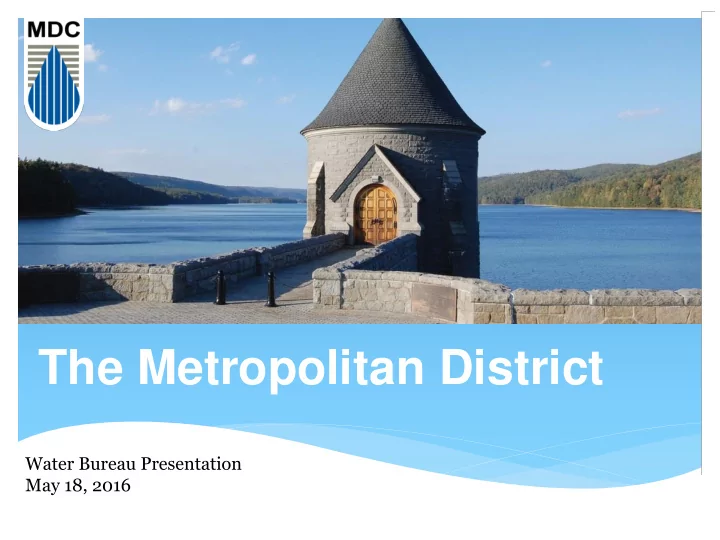
The Metropolitan District
Water Bureau Presentation May 18, 2016
The Metropolitan District Water Bureau Presentation May 18, 2016 - - PowerPoint PPT Presentation
The Metropolitan District Water Bureau Presentation May 18, 2016 TOPICS WATER SUPPLY SAFE YIELD DROUGHT WATERSHED MANAGEMENT 2 ACTIVE WATER SUPPLY SOURCES Nepaug Reservoir 9.5 BG completed in 1917 Barkhamsted
Water Bureau Presentation May 18, 2016
WATER SUPPLY SAFE YIELD DROUGHT WATERSHED MANAGEMENT
2
Nepaug Reservoir
9.5 BG completed in 1917
Barkhamsted Reservoir
30.3 BG completed in 1940
These reservoirs provide drinking water to a population of approximately 400,000 people
3
4
The MDC does not have contracts with any of its customers
within its exclusive service area. The MDC does have contracts for sale of excess water to customers outside of its exclusive service area.
Examples outside of service area:
Portland Unionville
5
The FARMINGTON RIVER WATERSHED has a DRAINAGE AREA of 609 SQUARE MILES. BARKHAMSTED RESERVOIR Watershed is 53.8 square miles (8.8% of River watershed). NEPAUG RESERVOIR Watershed is 31.9 square miles (5.2 % of River watershed). MDC DRINKING WATER RESERVOIRS TOTAL MDC Watershed 85.7 square miles (14 % OF TOTAL FARMINGTON RIVER watershed)
MDC Reservoirs Are All Rated Class Aa. Lake McDonough Is Rated Class A. The Farmington River Mainstem Is Rated Class B Under Connecticut Law “Class B” Waters Cannot Be Used For Drinking Water Supply Designation Of West Branch And Colebrook River Lake As “Potential Drinking Water” Sources Protects The West Branch From Future Industrial And Wastewater Discharges. The MDC does not make any withdrawals directly from The Farmington River 6
7
8
9
The CT DPH approved “SAFE YIELD” for the Barkhamsted/Nepaug Reservoir
System is 77.1 MGD
The MDC uses a more conservative approach (1960s drought) than the 1-in-100 year
drought analysis required of all water companies by the CT DPH.
Safe Yield using the CT DPH guidelines would be 83.9 MGD for Barkhamsted and
Nepaug reservoirs.
Safe yield calculation was developed and approved in 1996.DPH, DEEP, OPM and
PURA reviewed and approved the water supply plan in 2003 and 2012.
10
Factors Considered: STORAGE CAPACITY INFLOW:
Direct Rainfall Run-off from Watershed (Typically 55-70% of precipitation) Transfers from other reservoirs
OUTFLOW
Water Supply Withdrawals Spillage over spillway Downstream releases Losses (Evaporation + Seepage)
11
12
13
14
15
Average Daily Production (MGD) Total Annual Precipitation Nepaug Reservoir (inches) Precipitation Deficit (100 YR AVG 47” per year)
Reservoir Levels
Percent Capacity End of Year (Barkhamsted + Nepaug)
Volume in Storage End
(Billion Gallons)
Days Supply at Average Daily Demand (Days)
**Safe yield of 77.1 MGD is based on the extreme drought event of 1965
16
MDC’s reservoirs are
LARGE, Multi-Year Reservoirs.
Larger reservoirs have
sufficient storage to carry them through short term droughts (less than 1 year).
Large reservoirs with
storage ratios greater than 150 MG per Square mile are insensitive to short term droughts and have sufficient storage to last through multi year droughts such as 1960s.
Historic Drought of
Almost 16-inch rainfall
More Severe than 100
MDC’s analysis uses real
17
Why aren’t residents given priority over businesses in a drought?
A mandatory restriction on public water for commercial entities so residential
customers can wash their cars and water their lawns would effectively halt all commercial activity in the state, closing restaurants, manufacturing facilities, hospitals and alike.
CT DPH already has the discretion to prioritize water customers in the event of an
emergency under existing law.
As to residential use, the MDC’s drought contingency plan does not include
ANY restrictions on the use of water for drinking and sanitary purposes under any circumstances.
Historically, any time the MDC has requested a water use restriction in the last 50
years, it has been voluntary, including the severe drought of the 1960s.
In fact, actual data recorded at the MDC’s Nepaug Reservoir over the last 100 years has
shown that the annual precipitation has increased by almost 10% over that time period.
18
(MDC’s “DROUGHT CONTINGENCY PLAN” is approved by CT DPH and is based on “Connecticut Preparedness and Response Plan” created by CT DEEP, CT DPH, CT DPUC, CT OPM, and CT Office of Emergency Management). DROUGHT TRIGGERS:
Days of Water Supply Remaining in reservoirs. Percent of Reservoir Capacity.
DROUGHT STAGES:
Drought Advisory Drought Watch Drought Warning Drought Emergency
19
Reservoir Levels Precipitation Streamflows
20
Stream flow gages serve as real stream flow data confirmation that the safe yield calculations based on the drought of 1965 are still valid today. MDC uses the 1960s drought to calculate its safe yield as it is the worst on record in CT, with a 16 inch rainfall deficit.
21
22
10 20 30 40 50 60 70
1 2 3 4 5 6 7 8 9 10 11 12
Hubbard River Gage-Mean Monthly Flow (MGD)
Qmean 1939-2013 Qmean 1995-2013 Qmean 2004-2013 1965
23
IMPACT OF BUILDING and LAND DEVELOPMENT IMPACT OF CLIMATE CHANGE SOURCE WATER PROTECTION
24
What we are seeing:
Increasing ANNUAL RAINFALL Totals At MDC Reservoirs
Over The Past 50-100 Years.
Increase In EXTREME STORM EVENTS and FLOODING.
What we can expect
Increase in average temperature. Continued increase in annual precipitation with more intense,
heavy rain events.
Impact on water quality due to increased run-off. Increase in Evaporation.
25
10 20 30 40 50 60 70 80 90 1910 1920 1930 1940 1950 1960 1970 1980 1990 2000 2010
Total Precipitation (inches)
YEAR
Nepaug Reservoir- Total Annual Precipitation 1913-2015 (Inches)
26
27
28
29
30
31
32
The cumulative impact of residential and other development results in more impervious surfaces (roads, driveways, parking lots, roof tops, sidewalks), less ground water infiltration, and an increase in storm water runoff to streams and reservoirs.
This graphic is taken from UCONN’s NEMO Fact Sheet #3 entitled: Impacts of Development on Waterways.
A rule of thumb for any given watershed or drainage area: Water quality decreases as impervious surfaces increase.
33
4 parcels in 3 different watersheds
in the Barkhamsted Reservoir watershed through a partnership with the Commonwealth of MA, Town of Granville, and New England Forestry Foundation
34
35
36