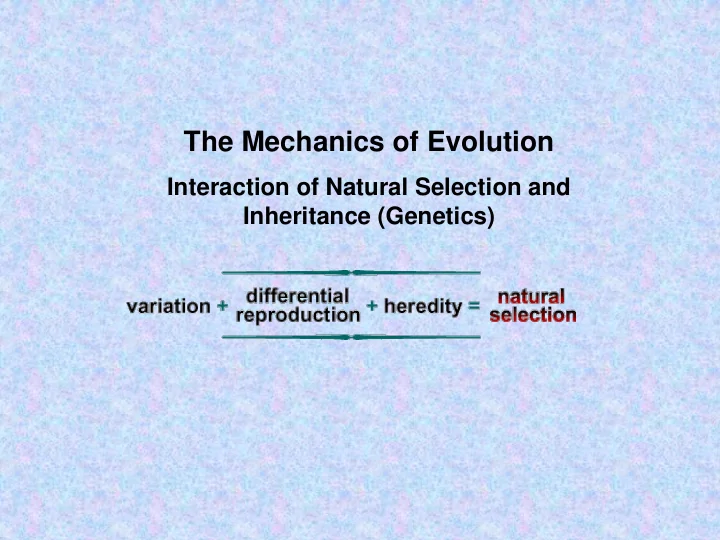
SLIDE 1
The Mechanics of Evolution
Interaction of Natural Selection and Inheritance (Genetics)
SLIDE 2
Lifeforms are not immutable; they change.
SLIDE 3
Natural Selection and how it works
SLIDE 4
In each species, there is variation in traits.
For example, some beetles are green and some are brown.
The basics are pretty simple:
SLIDE 5 Mutation
Some "green genes" randomly mutated to "brown genes" (although since any particular mutation is rare, this process alone cannot account for a big change in allele frequency over
How Does Genetic Variation Arise?
SLIDE 6
There is differential reproduction.
Since the environment can't support unlimited population growth, not all individuals get to reproduce to their full potential. In this example, green beetles tend to get eaten by birds and survive to reproduce less often than brown beetles do.
SLIDE 7
There is heredity.
The surviving brown beetles have brown baby beetles because this trait has a genetic basis.
SLIDE 8
End result:
The more advantageous trait, brown coloration, which allows the beetle to have more offspring, becomes more common in the population. If this process continues, eventually, all individuals in the population will be brown. If you have variation, differential reproduction, and heredity, you will have evolution by natural selection as an outcome. It’s as simple as that.
SLIDE 9
We can make it more complicated.
That is, it is comprised of both a phenotype and a genotype. ... the outward physical manifestation of internally coded, inheritable, information.
SLIDE 10
The relationship between the two is simple!
The codes for the
SLIDE 11
Fitness describes how good a particular genotype is at leaving offspring in the next generation relative to how good other genotypes are at it.
Fitness is a relative term. A genotype's fitness depends on the environment in which the organism lives.
We can make it more complicated.
SLIDE 12
Fitness is a handy concept because it lumps everything that matters to natural selection (survival, mate- finding, reproduction) into one idea. The fittest individual is not necessarily the strongest, fastest, or biggest. The Fitness Concept
SLIDE 13 Adaptation
An adaptation is a feature that is common in a population because it provides some improved function. Adaptations are well fitted to their function and are produced by natural selection. Adaptations can take many forms:
- a behavior that allows better evasion of predators
- a protein that functions better at body temperature
- an feature that allows the organism to access a valuable new resource
SLIDE 14
Microevolution is evolution on a small scale — within a single population. Microevolution and its processes
SLIDE 15
SLIDE 16
Macroevolution
Macroevolution is evolution on a grand scale — what we see when we look at the over-arching history of life: stability, change, lineages arising, and extinction.
SLIDE 17 1. All species produce offspring at a faster rate than food supplies can increase. 2. Except for identical twins, no two individuals are exactly alike. 3. In each generation, more individuals are produced than can survive. 4. Individuals that possess certain traits have an advantage
5. The environment determines whether a trait is beneficial. 6. Traits are inherited and passed on to the next generation. 7. Over time, successful variations accumulate in a population, and a new species may appear.
Natural Selection: A Summary