The meanings of indexical words What does a listener understand - - PowerPoint PPT Presentation

the meanings of indexical words
SMART_READER_LITE
LIVE PREVIEW

The meanings of indexical words What does a listener understand - - PowerPoint PPT Presentation

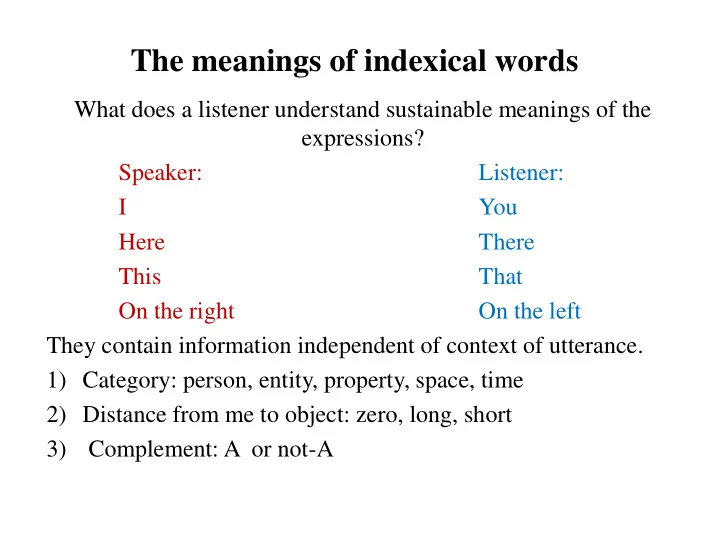
The meanings of indexical words What does a listener understand sustainable meanings of the expressions? Speaker: Listener: I You Here There This That On the right On the left They contain information independent of context of


slide-1
SLIDE 1

The meanings of indexical words

What does a listener understand sustainable meanings of the expressions? Speaker: Listener: I You Here There This That On the right On the left They contain information independent of context of utterance. 1) Category: person, entity, property, space, time 2) Distance from me to object: zero, long, short 3) Complement: A or not-A

slide-2
SLIDE 2

From expression to denotation

  • The indexical word has an objective meaning separated from its

index function. The speech acts like “This color is red”, “It is Monday now”, “ You are here”, “That is Me” correspond to mental acts of substitution experimental data into the concept or under the condition of space and time.

  • There are some forms of presentations of data in addition to

space and time in our mind. Every entity, property, point, instant can be designated by names and numbers. Therefore they are elements of reality. If they are marked by indexical pronouns or adverbs then they denote transcendental conditions of perception

  • f different aspects of phenomena.
  • These words indicate the different ways to connect the elements
  • f the language with elements of reality.
slide-3
SLIDE 3

Coordinate systems

  • Each system contains the original word and the derived words

denoting dimensions:

  • Here: left – right, top – bottom, front - back. 3 dimensions
  • Now: before - later.

1 dimension

  • This: that.

0 dimensions

  • Likewise - otherwise.

0 dimensions

  • There are the centers of reference frames.
  • Each system is established independently of the other .
  • Relations of the words correspond to relations of their meanings

Move right, forward and up = Move in the direction No.12 of here To occur earlier = To occur at a distance of 2 from now.

slide-4
SLIDE 4

Space category:

(Left, here, right) Χ(top, here, below) Χ(front, here, behind)

  • Combined directions:
  • (far, top, left, behind) …
  • 26 areas near to the center
  • 26 areas far from
  • the center
  • 1 center
  • 53 areas

here near far

slide-5
SLIDE 5

Spatial parameters

  • 1. Directions (x, y, z)
  • 2. Distances ( zero – here, short - near, long – far)
  • 3. Complement (here – there)
  • The category of time has a similar structure:
  • 1. Directions (past, future)
  • 2. Distances (now, recently, long ago, soon, in the distant future)
  • 3. Complement (not now – not now)
  • ________(_________(___T(0)___)_________)__________→
  • forgotten memorized perceptible anticipated unforeseeable
  • The intervals of space and time are allocated by the mental action.
slide-6
SLIDE 6

Spaces of selves and things

  • The meaning of pronouns are considered as the centers of

zero-dimensioned systems.

  • The paths from “I” to “He” and from “This” to “That” have no

main direction. Any point other than the Central, can be indicated by such word.

  • Not-I

Not-This

  • A thing may be like this to a greater or lesser extent.
  • A person is either me or not me without gradations

That I He This

slide-7
SLIDE 7

The appeal to the second person

  • The linguistic rules which govern the use of the indexicals are not

sufficient to determine their referent in all contexts.

  • If one sets the coordinate system , he represents an action of

establishing the centre. The speaker takes into account the difference

  • f their coordinate system from the listener’s one.
  • the comparison of the two coordinate systems:
  • 1) the recitation of an actor's speech on stage

2) the indication of the city on the map

  • 3) the memory of a past event
slide-8
SLIDE 8

We match the point of visual space to points of physical space; the visible image of the object to the external object; the a priori mental scheme to the matter.

slide-9
SLIDE 9

If I and you both say “I” we refer to different persons. The indexicals “He” and “That” can refer to same subject or different subject correctly. Writer

  • He
  • I

He Now I Reader

  • Now

I

  • He
  • I

Now

slide-10
SLIDE 10

What rules govern the modification of references?

  • Space: No limitation.
  • I can choose the point "Here", stop and shift your attention to

another point. I said "Here“ about my room yesterday, now I say "Here“ about Moscow, I am going to say "Here“ about Moon.

  • Time: conditions of modification of consciousness-time.
  • Recalling the events 30 years ago, I remember how I broke my
  • arm. I refer “Now” from “Now I feel the pain” to the April 29
  • 1986. I represent the structure of the last period at present

time.

  • When I dream about the future: “I'm rich now”, I anticipate
  • not only the moment but the whole time series, starting from

the present.

slide-11
SLIDE 11

Change an intentional act expressed by pronouns

  • Property:

2)This

  • association

This 1)This logical consequence “This” denotes intentional property of individual, general or empty objects. There are two ways of the shift of attention: 1) Property - property (by logic rules) 2) Property - thing - property (by association) The owner of the property must exist in the second case only.

rectangular red colored

slide-12
SLIDE 12

Entity 3 ways causality

logical subordination

association It It It

slide-13
SLIDE 13

Summary

  • Indexical words are the intermediaries between

perceptions and theoretical regularities. They introduce us into the world of objective knowledge.

  • Intentionality is the logical content indexical

expressions independently of the context of their use.

  • The denotation of this expression always exists, even if

the proposition is false.

  • All indexical applied to objects of any type, not just the

empirical objects, for example, functional position in the system of relations.

  • The coordinate system of speaker and listener are

connected by strict rules of transcendental Subjectivity.

slide-14
SLIDE 14
  • Thank you for attention!