Commitments as Elements of a Contract A kind of normative - - PowerPoint PPT Presentation

commitments as elements of a contract
SMART_READER_LITE
LIVE PREVIEW

Commitments as Elements of a Contract A kind of normative - - PowerPoint PPT Presentation

Commitments Commitments as Elements of a Contract A kind of normative relationship: Express meanings of interactions Are atoms of contractual relationships Enable correctness checking of contracts Yield precise meanings and


slide-1
SLIDE 1

Commitments

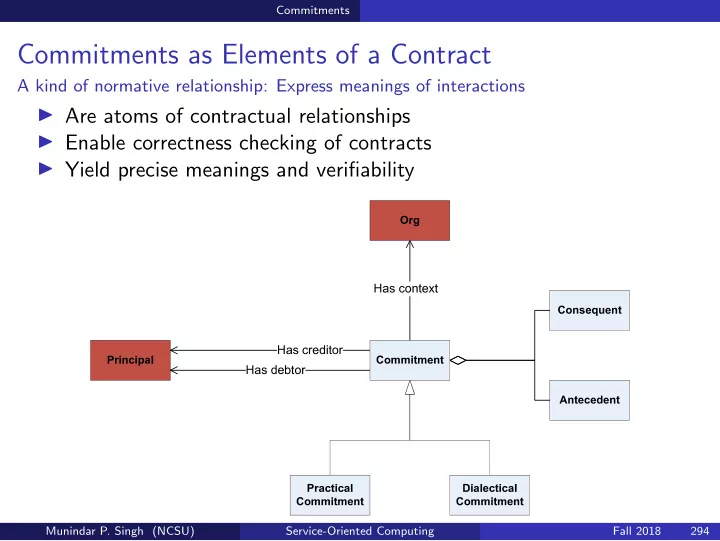
Commitments as Elements of a Contract

A kind of normative relationship: Express meanings of interactions

◮ Are atoms of contractual relationships ◮ Enable correctness checking of contracts ◮ Yield precise meanings and verifiability

Munindar P. Singh (NCSU) Service-Oriented Computing Fall 2018 294

slide-2
SLIDE 2

Commitments

Example: Commitment Progression

Via explicit operations or because of logical properties

C(Buyer, Seller, goods, pay): Active and conditional

◮ If goods ∧ C(Buyer, Seller, goods, pay) Then

◮ Active and detached (or unconditional or base) ◮ C(Buyer, Seller, T, pay)

◮ If C(Buyer, Seller, T, pay) Then

◮ If pay Then Satisfied ◮ If never pay Then Violated

◮ If C(Buyer, Seller, goods, pay) Then

◮ If pay Then Satisfied ◮ If never pay and never goods Then Expired

Can be nested:

C(Seller, Buyer, pay, C(Shipper, Buyer, T, deliverGoods))

Munindar P. Singh (NCSU) Service-Oriented Computing Fall 2018 295

slide-3
SLIDE 3

Commitments

Operationalizing Commitments: Detach then Discharge

C(debtor, creditor, antecedent, consequent) create(d, c, p, q) p q d:Debtor c:Creditor

Munindar P. Singh (NCSU) Service-Oriented Computing Fall 2018 296

slide-4
SLIDE 4

Commitments

Operationalizing Commitments: Discharge First; Optional Detach

How about this?

create(d, c, p, q) q p d:Debtor c:Creditor

  • pt

[true]

Munindar P. Singh (NCSU) Service-Oriented Computing Fall 2018 297

slide-5
SLIDE 5

Commitments

Operationalizing Commitments: Detach First; Optional Discharge

How about this?

create(d, c, p, q) p q d:Debtor c:Creditor

  • pt

[true]

Munindar P. Singh (NCSU) Service-Oriented Computing Fall 2018 298

slide-6
SLIDE 6

Commitments

Operationalizing Commitments: Creation by Creditor

C(debtor, creditor, antecedent, consequent) create(d, c, p, q) p q d:Debtor c:Creditor

Munindar P. Singh (NCSU) Service-Oriented Computing Fall 2018 299

slide-7
SLIDE 7

Commitments

Operationalizing Commitments: Strengthening by Creditor

C(debtor, creditor, antecedent, consequent) create(d, c, p, q) p q d:Debtor c:Creditor C(d, c, p, q) C(d, c, ⊤, q) no active commitment

Munindar P. Singh (NCSU) Service-Oriented Computing Fall 2018 300

slide-8
SLIDE 8

Commitments

Commitment Life Cycle (and Patterns)

C(debtor, creditor, antecedent, consequent)

Munindar P. Singh (NCSU) Service-Oriented Computing Fall 2018 301

slide-9
SLIDE 9

Commitments

Commitment Operations

◮ create(C(d, c, p, q)) establishes the commitment ◮ detach(C(d, c, p, q)) turns it into a base commitment ◮ discharge(C(d, c, p, q)) satisfies the commitment ◮ cancel(C(d, c, p, q)) cancels the commitment ◮ release(C(d, c, p, q)) releases the debtor from the commitment ◮ delegate(z, C(d, c, p, q)) replaces d by z as the debtor

◮ d remains ultimately responsible (in our work)

◮ assign(w, C(d, c, p, q)) replaces c by w as the creditor

Munindar P. Singh (NCSU) Service-Oriented Computing Fall 2018 302

slide-10
SLIDE 10

Commitments

Cupid: Unifying Accountability and Traceability

Computing states of norms over event stores

◮ Benefits: Basis for

◮ Intelligent decision making ◮ Key Performance Indicators

◮ Begin from event schema

◮ Keys ◮ Distinguished timestamp attribute

◮ Specify accountability requirements as norms ◮ Automatically generate SQL schema from event schema ◮ Automatically generate SQL queries to determine accountability status at specified moment

◮ Now ◮ A hypothetical moment to help ascribe responsibility

Munindar P. Singh (NCSU) Service-Oriented Computing Fall 2018 303

slide-11
SLIDE 11

Commitments

An Information Model and Commitment Specification

Quote (mID , cID , qID , itemID , uPrice , t ) with key qID Order ( cID , mID ,

  • ID ,

qID , qty , addr , t ) with key oID Payment ( cID , mID , pID ,

  • ID ,

pPrice , t ) with key pID Shipment (mID , cID , sID ,

  • ID ,

addr , t ) with key sID Refund (mID , cID , rID , pID , rAmount , t ) with key rID Coupon ( cID , mID , uID ,

  • ID ,

rebate , t ) with key uID commitment DiscountQuote mID to cID create Quote detach Order and Payment [ , Quote + 10] where pPrice >= 0.9 ∗ uPrice ∗ qty discharge Shipment [ , Payment + 5]

A DiscountQuote commitment from a merchant to a customer is ◮ created upon Quote; ◮ detached if Order happens and Payment happens within ten days of Quote and is for at least 90% of quoted amount (else expires) ◮ discharged if Shipment happens within five days of Payment (else violated)

Munindar P. Singh (NCSU) Service-Oriented Computing Fall 2018 304

slide-12
SLIDE 12

Commitments

Example: Compensation

Illustrates nesting: A commitment depends upon another commitment’s state

commitment Compensation mID to cID create Quote detach v i o l a t e d ( DiscountQuote ) discharge Refund [ , v i o l a t e d ( DiscountQuote ) + 9] where rAmount = pPrice

A Compensation commitment is created upon Quote and says that if DiscountQuote is violated, the merchant will refund the payment within nine days

  • f the violation.

Munindar P. Singh (NCSU) Service-Oriented Computing Fall 2018 305

slide-13
SLIDE 13

Commitments

Properties

◮ All Cupid queries are safe

◮ Given any possible model M with finite extensions for base events, the extension of Q relative to M, [ [Q] ], is finite

◮ Well-identified specifications capture a notion of adequate correlation among the events that in the specification. ◮ Instances of a finitely expirable specification are guaranteed to expire if not detached within a finite amount of time. ◮ Instances of a finitely violable specification are guaranteed to expire if not discharged within a finite amount of time.

Munindar P. Singh (NCSU) Service-Oriented Computing Fall 2018 306

slide-14
SLIDE 14

Commitments

Commitment-Based Multiagent Approaches

Give primacy to business meanings of service engagements

◮ Identify messages ◮ Identify their meanings in terms of their effect on the social state

◮ Creation of the commitments among the participants ◮ Manipulation of commitments ◮ Changes to parts of the state relevant to commitments

◮ Instead of explicit state transitions, consider inference on the social state based on the messages

Munindar P. Singh (NCSU) Service-Oriented Computing Fall 2018 307

slide-15
SLIDE 15

Commitments

Example Commitment Protocol

Purely declarative specification

Offer(mer, cus, price, item) means create(mer, cus, price, item) Accept(cus, mer, price, item) means create(cus, mer, item, price) Reject(cus, mer, price, item) means release(mer, cus, price, item) Deliver(mer, cus, item) means declare(mer, cus, item) Pay(cus, mer, price) means declare(cus, mer, price) ◮ Specifies how each message affects the social state

◮ By acting on a commitment explicitly ◮ By bringing about a social fact via Declare that may cause commitments to detach or discharge

◮ The social state is conceptual ◮ In general, no centralized store of social state

◮ Raises the challenge of commitment alignment in distributed systems

Munindar P. Singh (NCSU) Service-Oriented Computing Fall 2018 308

slide-16
SLIDE 16

Commitments

Distinguishing Message Syntax and Meaning

Two views of the same enactment

Munindar P. Singh (NCSU) Service-Oriented Computing Fall 2018 309

slide-17
SLIDE 17

Commitments

Evaluation with respect to MAS

◮ Compliance: At the business level. A protocol enactment is correct as long as the parties involved do not violate their commitments ◮ Flexibility: Enhanced by expanding the operational choices for each party, e.g., discharge a commitment when convenient (even sooner); delegate or assign ◮ Software engineering: Commitments are a high-level abstraction for capturing business interactions

◮ Support loose coupling among agents ◮ Accommodate the autonomy of each participant

Munindar P. Singh (NCSU) Service-Oriented Computing Fall 2018 310

slide-18
SLIDE 18

Commitments

Illustrating Flexible Enactment

These are compliant executions in terms of commitments, and thus realize the above protocol

Munindar P. Singh (NCSU) Service-Oriented Computing Fall 2018 311

slide-19
SLIDE 19

Commitments

Comparing Agent Communication Approaches

Traditional Traditional Commitment SE AI Protocols Abstraction control flow mentalist business relationship Compliance lexical basis unverifiable semantic basis Flexibility low low high Interoperability message- level integration business-level

Munindar P. Singh (NCSU) Service-Oriented Computing Fall 2018 312