The Manhattan Project - Personalities and Problems Fromm Institute - - PDF document

the manhattan project personalities and problems
SMART_READER_LITE
LIVE PREVIEW

The Manhattan Project - Personalities and Problems Fromm Institute - - PDF document

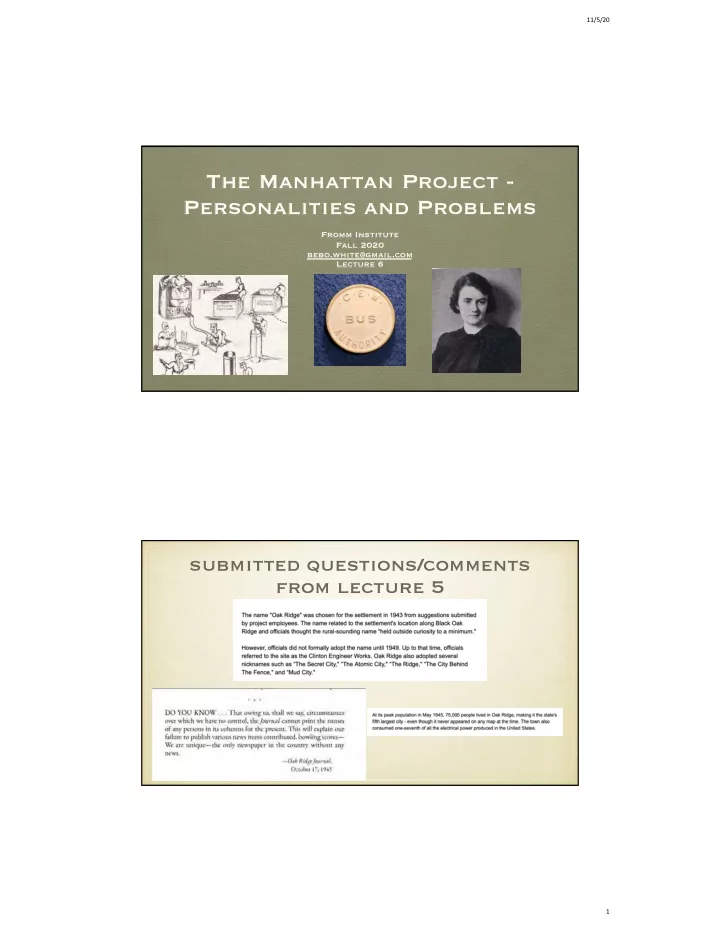
11/5/20 The Manhattan Project - Personalities and Problems Fromm Institute Fall 2020 bebo.white@gmail.com Lecture 6 submitted questions/comments from lecture 5 1 11/5/20 revisiting the labs mission (and our course vision) Given

slide-1
SLIDE 1

11/5/20 1

The Manhattan Project - Personalities and Problems

Fromm Institute Fall 2020 bebo.white@gmail.com Lecture 6

submitted questions/comments from lecture 5

slide-2
SLIDE 2

11/5/20 2

revisiting the labs’ mission (and

  • ur course vision)
  • Given that the original mission of the Manhattan Project was to build an atomic bomb, that short-term mission would end

successfully or not

  • If the project was successful, it might not only end World War II, but also
  • It would change global politics
  • It would change the future of weaponry
  • U.S. adversaries (especially the USSR) would want their own bomb
  • Change the relationships between scientists, politicians/bureaucrats and the general public
  • Change the path of government-funded “big science” research (not just for military/defense)
  • As the bomb project came closer to completion, many of the decisions made included a consideration of the post-war lab

roles

  • The labs would not (and could not) remain secret and would be forced to change some of their wartime modus operandi and

public perception - that is why (IMHO) looking at their history is so important

historically cew and hew had a lot in common - relationships inside and outside their communities

  • Total disruption of a rural agricultural community (more than 60,000 acres)
  • The creation of a secret government town
  • Massive influx of workers (population grew from 3,000 in 1942 to 75,000 in

1945)

  • Emphasis on security 24 hours per day onsite and offsite
  • Issues with discrimination
  • HEW had the dust; CEW had the mud
slide-3
SLIDE 3

11/5/20 3

lots of rumors about what cew was doing

  • Synthetic rubber
  • “I thought they were making sour mash [whiskey] to drop on the
  • Germans. Get them all drunk” (resident to New Y
  • rk Times)
  • An experiment in socialism: “a model community designed to

prepare the American people for Communist rule”

  • The FDR fifth term button-making factory - how did that one get

from HEW to CEW or was it the other way around?

slide-4
SLIDE 4

11/5/20 4

.,.,.

.-

.

.

·

.

..

/

..

MANHATTANJ

CONTRACTORS'

August 1942 -

PRQ,JECT

EMPLOYMENT

December 1946

...

,

140 140 10 60 50 40 10

  • .

\

' / ' I
  • '
  • I. 'I
/

..- .

I 'r'>
  • .
CEW OPERATIONS

I''

I

go,

I I

8 :

  • I

r

I C:

.,.

1

I

.

Q

,.

.

1942 1943 1944 1945 1946 100 60 50

  • - ' - - 40

3 0

20

10

the war manpower commission (wmc) searches for workers

  • No shortage of scientists (actually a surplus); great shortage of electricians and

plumbers

  • Knoxville did not provide the expected boom of candidates
  • Secrecy hampered recruitment efforts
  • Recruitment happened throughout the South
  • Poaching complaints
  • Covert recruitment complaints
  • Each year recruited 15,000-20,000 female workers with only ~1,700 yield
slide-5
SLIDE 5

11/5/20 5

who was recruited?

  • Key groups: coal miners, farmers (seasonal), rural industry
  • Opportunities for all family members older than 18 years
  • Average age: women - 28; men - 35
  • Fewer than 50% of Y-12 workers were high school graduates; 67% had

graduated from at least the 8th grade

  • Women whose husbands were unemployed or not in the area
  • Those wishing to take advantage of CEW schools for their children
slide-6
SLIDE 6

11/5/20 6

is this a security leak?

“It just didn’t make any sense at all…The uniforms were first washed, then ironed, all new buttons sewed on and passed to me. I’d hold the uniform up to a special instrument and if I heard a clicking noise - I’d throw it back to be done all over again. That’s all I did - all day long” (1943 Business Week interview)

despite the security, there were spies at cew

  • Both George Koval and Alfred Slack worked at Y-12 and

provided the Soviets with valuable information about U(235) separation

  • Koval was born in US, advanced degrees in Moscow,

married a Russian woman, received Soviet citizenship (how did he get a security clearance?)

  • Both Koval and Slack had the same Soviet contact

(Harry Gold) as the spies at Los Alamos

  • Koval was given an award posthumously by Vladimir

Putin in 2007 George Koval Alfred Slack

slide-7
SLIDE 7

11/5/20 7

  • . !

·. :

t-.

  • ' ;.'

H ·

ri·_:

I \,

';.,.

,,..,, I, ' ._ ir Irt- 1 . ' \' ,.-;
  • .. ..,

, '.,

I I. j

JULrY ,, tt

w 1 r

II 12 IJ 1 4 15• , II ':" ..I"' ... I?'liir'liiir! IS 1 9 .;.; : .fl i .

G R A n

  • P

R 1 z e ' A 2 '

N O L O A F I N

8-, , . . ; 1; ,:; .:. ./. ('1 ,,Q (;.... A LLl"V 'i f to• • 1 " •" ,. ...,........ •" , _.. ,. I, • •" ' ' f l-'fllL O V E£:5 -.ltooll • 1 , .. 1 , "'
  • A
I•
  • ! f U
l \fl -• 1.iA ,I ........,.. . . ,j
  • 1
. . , . . . . . ,
  • I"""hlil1• •
u n i
  • , e
1 M T u !li"!J iiii1 1 1 W ' "-i.ltllNu• (/,,,;.,,-, DISMISSAL
  • . r.;:1 1e=
H I G H C U R R E N T &V O L lhAblmcll z ( ( l l l l l t 'I

· 1

.ENNESSEE EAST A _ CORP.

  • 0-

OAK RIDGE. DATE

6, 1

u

023

MIii

  • W K D .

PREM .. HA

  • REG.

PREM.

T O T.

()

e id e

M OYEE SHOULD DE1tA RETAI THIS A E EN

D - F O A B T A X

E-RENT

F - U . ' S . T A X G- H OS P . H - W A R B O N0 9 .. L : H U T MEALS

a

LODGING

slide-8
SLIDE 8

11/5/20 8

hutments fill the formerly empty valleys

Happy V alley - 1944

16 ft. x 16 ft.

“government had to attract people to the project with houses near to what they were used to. Black housing was better than what a black worker in Mississippi would have had, while a white scientist wouldn’t feel the same way”

slide-9
SLIDE 9

11/5/20 9

your seniority (or race) might get you a trailer or an “alphabet house”

“every house that Skidmore Owings designed [for Oak Ridge] (and they were built to last a mere 4 years, but still exist today) includes a fireplace, no matter how tiny, because the architects at the firm believed that scientists wanted to sit by a fire and read after dinner”

slide-10
SLIDE 10

11/5/20 10

racial bias in the cew labor force

  • African-Americans were only allowed laborer jobs at CEW
  • Many qualified African-American scientists were only able to work at

The Met Lab or other university projects .. .

  • !Cl.
D . 1 1 ■ -
  • P
. 0 i ! l : 1 1 : I C I6 1 1 1 5 1a 1 ' ! 1 1 · C Cl
  • l.9

J'

l' f

&

j

/A.

I" p"'

.

.

!

C • d

Ii "' I •
slide-11
SLIDE 11

11/5/20 11

cew workers were immediately recognizable in knoxville

  • They might be “furriners”
  • They seemed to have an abundance of ration

stamps

  • They had “fistfuls of cash”
  • They had muddy boots

like hew, keep the workers happy and distracted

  • The Army created a shopping center of nearly 200 businesses
  • 16 baseball parks (10 baseball teams, 10 softball teams), bowling

alleys, skating rinks, swimming pools

  • A symphony orchestra (organized by a CEW biochemist); “residents

could boast that they had an orchestra before they had sidewalks”

  • Organized dance parties and movie nights
  • Excellent bus system since most workers did not have cars
slide-12
SLIDE 12

11/5/20 12

from the mountains of Tennessee to the mesas of new mexico

different worlds and relationships but with a common purpose

slide-13
SLIDE 13

11/5/20 13

  • Approximately 100 scientists, engineers, and support staff lived and worked in

Los Alamos when it opened in 1943

  • By 1945, 6,000 men, women, and children lived there - more than 4,000
  • f them worked in the labs
  • The Army assigned housing based upon an individual’s position of employment
  • Members of the local surrounding community (the Pueblos, Hispanics) worked

there but did not live there; in the 1940 census, less than 1% of the population in New Mexico was African-American

  • It is unknown how many African-Americans were considered or recruited on

“Oppie’s tour,” but there is no evidence that any of the residents were African- American

slide-14
SLIDE 14

11/5/20 14

look how young these guys are

T ed Hall Oppie, Bethe F eynman Kisty F ermi T eller Johnny James Chadwick

(1943)

Bohr Robert Wilson: 29 Klaus Fuchs: 32 Serber: 34 Weisskopf: 35 McMillan: 36

slide-15
SLIDE 15

11/5/20 15

in los alamos they worked hard and played hard

  • “The battleship” (Bethe) and “the mosquito boat” (Feynman) rattled the halls of the Theory Section
  • “Kisty’s” explosions rattled the canyon walls
  • The Serbers “played secret agents” to distract the Santa Fe locals with rumors about “electric rockets”
  • Parties continued on “Bathtub Row” and in the dormitories
  • Strict segregation between the men’s and women’s dormitories
  • “My brother tried to handle all of Gen. Grove’s concerns except for the number of babies being born

at Los Alamos” (Frank Oppenheimer) - extra space was added to the site hospital

  • Rumors about a Los Alamos underground (gambling, visits by Santa Fe “girls,” etc.)
  • And meanwhile, Klaus Fuchs, David Greenglass, and Ted Hall played with the Russians

“the battleship” and “the mosquito boat”

Feynman and Bethe greatly respected one another, but Feynman refused to be awed by Bethe’s established credentials; “No, no, you’re crazy . It’ll go like this!” It was a contest between “The Battleship” (Bethe) and “The Mosquito Boat” (Feynman) that often resulted in loud conversations heard throughout the group “Dick was as likely to begin in the middle or at the end, and jump back and forth until he had convinced himself he was right (or wrong)” Bethe later made Feynman the leader of a sub-group

slide-16
SLIDE 16

11/5/20 16

party time - los alamos style

Oppie was known for his martinis and cooking 200 proof lab alcohol was more widely available than liquor

· I
  • ..__

)

./

,.

.

_ ..--·

... '

: ; . g .

u · .

'i, .

61:.:. ...7596

slide-17
SLIDE 17

11/5/20 17

Teller brought his 100-year old Steinway Feynman brought his bongos and congas (though this looks like a Native American drum)

  • There were two movie theaters - one with showings every night and the
  • ther (which doubled as a chapel) three nights a week
  • The town council (of which Feynman was once a member) handled such

issues as:

  • fraternization between men’s and women’s dormitories
  • restaurant complaints
  • requests for services (e.g., shoe-repair)
  • changes in movie schedules
  • overcrowding in public laundries
slide-18
SLIDE 18

11/5/20 18

  • ppie remained under

surveillance

On June 14, 1943 Oppie went to Berkeley to recruit an administrative assistant - he didn’t know that he was being followed- “Oppenheimer traveled via Key Railway from Berkeley to San Francisco…where he was met by Jean Tatlock who kissed him. They dined at the Xochimilcho Cafe, 787 Broadway, San Francisco, then proceeded at 10:50 PM to 1405 Montgomery Street and entered a top floor

  • apartment. Subsequently, the lights were extinguished and Oppenheimer was not observed until

8:30 AM the next day when he and Jean Tatlock left the building together” (Army agent report) Oppie never saw her again and in January 1944 Jean committed suicide - “I wanted to live and to give and got paralyzed somehow” Peer De Silva, the head of lab security, later wrote that when he notified Oppie of Jean’s death that he wept

'C L ll U I D N T [

.fbp,«L

Q t rJi. l f &
  • f '
U i N l f l - - - - itlII UC-TIIIII U M U ,_ ' (1 1 -1 EU H u "t}
  • PIEDIIQlll
slide-19
SLIDE 19

11/5/20 19

July 29, 1943.

  • Dr. J. R. Oppenheimer
  • P. 0. Box 1663

Santa Fe. New Mexico Dear Dr. Oppenheimer: . . . It is requested that: (a)You refrain from flying in airplanes of any description; the time saved is not worth the r i s k . (b)You refrain from driving an automobile for any appreciable distance (above a few miles) and from being without suitable protection on any lonely road, such as the road from Los Alamos to Santa Fe. . . . (c). . In driving about town a guard of some kind should be used, particularly during hours

  • f darkness. The cost of such guard is a proper charge against the United States.

I realized that these precautions may be personally burdensome... Sincerely,

  • L. R. Groves

Brigadier General, C. E.

groves insisted that everyone leave the lab on sundays

slide-20
SLIDE 20

11/5/20 20

lots of places to hike and explore

Kisty’s Playground

los alamos and po’ woh’ geh’

  • wingeh
  • Construction and operation of the lab severely disrupted the lives of the

native Pueblo community

  • Edith Warner worked at the Otowi train depot and had a tea room that

served dinners (reservations needed to be made months in advance); she also had a guest house used by lab visitors

  • Los Alamos families were routinely invited to feasts, dances and weddings

at Pueblo de San Ildefonso; the village plaza was great place to relax

  • Some Pueblo members were given jobs at the lab
slide-21
SLIDE 21

11/5/20 21

.from our ranch

in the P e c o s .

In th e summer of 1937 I . f i r s t stopped at Edith W a r n e r ' s t e a

room .

I was on a pack t r i p w ith

r c r r

b r o t h e r a n d s i s t e r - i n - l a w , b u t came on ahead 0£ them because

  • n e . or the

h o r s e s we had w i t h u s g o t away and I had to go a£ter h i m . We· had tea and c h o c o l a t e eak e and t a l k ; i t was my f i r s t u n f o r g e t a b l e m e e t i n g . . I remember t h a t i n t h e summer 0£ 191.,l I b r o u g h t my w if'e o v e r t o i n t r o d u c e h e r to E d i t h . By earl.y

: 1 9 4 3 we.

came to Los Alamos., and v e r y e a r l y we sto p p ed to t a l k w i t h h e r , a n d t r y t o r e a s s u r e h e r . We saw. her regularl.Jr a f t e r t h a t , a n d £ o r the l a s t tim e in the summer be.fore her d e a t h ,

. .,

a.t.ter ·she. ba.4uioved to the new house.

With all goodwishes,

Robert Oppenheimer

slide-22
SLIDE 22

11/5/20 22

edith warner’s chocolate loaf cake

spies in their midst (1/2)

Klaus Fuchs (Rest/Charles) - part of the British Tube Alloys group, assistant to Rudolf Peierls dating back to Frisch-Peierls Memo; had a thorough knowledge of program history dating back to the MAUD Report; worked on implosion design and early “Super/H-Bomb” work; good friend of Richard Feynman; babysat for the Tellers; “really changed history” (Hans Bethe); his arrest started a sequence leading to the execution of the Rosenbergs Ted Hall (M’Lad) - part of the Harvard group; at one point was the youngest scientist at Los Alamos (19 years old); worked on U(235) critical mass and implosion design; “concerned about the consequences of an American monopoly

  • n nuclear weapons after the war;”
slide-23
SLIDE 23

11/5/20 23

spies in their midst (2/2)

David Greenglass (Caliber) - machinist; worked at CEW but was transferred to Los Alamos; Communist leanings while young, but (conveniently) omitted them on his security clearance application; brother of Ethel Rosenberg; recruited by his sister-in-law in 1944 Oscar Seborer (Godsend) - worked on “Gadget’s” explosive trigger; started at CEW but transferred to Los Alamos in 1944; Oscar’s contacts are unknown; activities were only uncovered in 2019; still being investigated even though Oscar is dead

  • The KGB’s codename for The Manhattan Project was “Enormous”
  • October, 1944 - Hall, while on vacation visiting his parents in New York City, goes to the

CPUSA office and begins an ongoing sequence of contacts

  • June 2, 1945 (Saturday) - Fuchs drives to Santa Fe and meets with Soviet courier Harry

Gold…two weeks later Feynman drove Fuchs’ car to Santa Fe when Arline died

  • June 3, 1945 - On his Sunday day off, machinist David Greenglass in Albuquerque gives

Gold a crude drawing of approved bomb plans (before Trinity)

  • Fuchs, Hall, and Greenglass did not know of each other’s activities
  • Even though the USSR was an ally they were never a part of a shared program -

estimates are Fuchs, Greenglass, and Hall cut years off their bomb development program

  • First Soviet bomb was thought to be almost an exact copy of Trinity
slide-24
SLIDE 24

11/5/20 24

“Once, in a fanciful conversation about likely candidates to be a Nazi spy…Klaus Fuchs… suggested that it could only be Dick Feynman - who else had insinuated himself into so many different parts of the laboratory’s work? Who else had a regular rendezvous in Albuquerque?” (Genius, James Gleich) “It turned out he [Fuchs] was quite a good dancer, and he became a pet of many of the Hill

  • wives. ‘In Los Alamos, we all trusted him and saw him frequently. We had frequent parties,

and Fuchs came often. He seemed to enjoy himself, played ‘murder’ or charades with the

  • thers, and said only a few words. We all thought him pleasant and knew nothing about

him.’(Laura Fermi)” (109 East Palace, Jennet Conant) There are even some conspiracy-theorists who say that 1) given Feynman’s ability at lock- picking and safe-cracking 2) his knowledge of how to thwart site security 3) his involvement in so many aspects of the lab 4) his friendship with Fuchs, that maybe he was a spy…BS (Bebo)

feynman - the prankster

  • His breaches of site security are legendary
  • Coming and going through holes in perimeter fences
  • Opening combination locks on cabinets/desks with secure papers and would leave a chastising

note in them

  • Default settings, written notes
  • In one case he found the combination by guessing a number he thought a physicist might

use: 27-18-28 (e=2.71828…)

  • Reaching under locked drawers or filing cabinets
  • Today he would be great for site security testing!
slide-25
SLIDE 25

11/5/20 25

1945’s “spring-summer of discontent”

1.The equipment designs were frozen and manufacturing had begun 2.A test site had been selected and was being prepared 3.Lawrence was informed by Groves that gaseous diffusion and plutonium production was so

successful that the calutrons would not be funded after the war

4.The death of FDR and succession by Truman who was unaware of the project

5.The surrender of Germany

6.T

est rehearsal at the selected site

7.President’s Interim Committee decides on usage

8.Bomb manufacturing begins

april 12 - fdr’s death

  • Noticing distractions amongst staff, Oppie convened an outside, optional memorial service
  • His stated themes were Ashima (“love”), Raj (“passion”) and Attwa (“spirit”)
  • “We have been living through years of great evil and great terror. [FDR] in an old and

unperverted sense [had been] our leader. [The sacrifices of this war will result] in a world more fit for human habitation. We should dedicate ourselves to the hope, that his good works will not have ended with his death”

  • “Man is a creature whose substance is faith. What his faith is, he is.” (Bhagavad-Gita)
  • “Roosevelt was a great architect, perhaps Truman will be a good carpenter” (Oppie to

physicist David Hawkins)

slide-26
SLIDE 26

11/5/20 26

hst and the project

  • Secretary of War Henry Stimson gave Truman a “heads up” at a

meeting immediately after his swearing in

  • April 25 meeting at White House
  • “within four months we shall in all probability have completed the

most terrible weapon ever know in human history, one bomb of which could destroy a whole city”

  • Groves came via a back entrance for the Q&A

may 7 - germany surrenders

  • Little impact at the lab
  • Robert Wilson attempted to raise the question if work should continue
  • “We have been too late. Now that the bomb could not be used against the

Nazis, doubts arose. Those doubts, even if they do not appear in official reports, were discussed in many private discussions” (Emilio Segrè)

  • One member of the British delegation (Sir Joseph Rotblat) elected to quit

before the defeat of Japan

  • Oppie was attending rehearsal at test site
slide-27
SLIDE 27

11/5/20 27

los alamos ramps up (1/2)

  • Weapon design for the uranium gun bomb was frozen in February 1945 - confidence

was high enough that a test was deemed unnecessary (“Little Boy” design)

  • (A plutonium gun bomb “Thin Man” had been abandoned earlier)
  • Design for plutonium implosion bomb was approved in March 1945 but a test was

deemed necessary (“Trinity” and “Fat Man” design)

  • March - “Deak” Parsons made in charge of Project Alberta/Project A (readying

bombs for delivery and use) - some activities had begun in June 1943

  • Kenneth Bainbridge made in charge of Project Trinity - work had begun Spring,

1944

Batter my heart, three-personed God; for you As yet but knock, breathe, shine, and seek to mend; That I may rise and stand, o’erthrow me, and bend Your force to break, blow, burn, and make me new. I, like an usurped town, to another due, Labor to admit you, but O, to no end; Reason, your viceroy in me, me should defend, but is captived, and proves weak or untrue. yet dearly I love you, and would be loved fain, But am betrothed unto your enemy. Divorce me, untie or break that knot again; Take me to you, imprison me, for I, Except you enthrall me, never shall be free, Nor even chaste, except you ravish me.

(John Donne, Sonnet XIV , Oppie and Jean shared an admiration of Donne)

slide-28
SLIDE 28

11/5/20 28

los alamos ramps up (2/2)

  • Chemists and machinists went into high gear working with plutonium as quickly as “product” came in from HEW
  • “Product” from HEW arrived as a syrup-like nitrate that had to be purified and turned into metal
  • Pu(239) is very toxic and corrosive; it has multiple metallic phases based on temperature and pressure
  • W
  • uld it truly fission spontaneously?
  • Kisty’s group worked on the “explosive lenses”
  • Bethe’s group calculated (the Bethe-Feynman formula) a yield of ~5 KT because calculations indicated
  • 30 ± 15 generations of fission (length of chain reaction) would occur in 1 microsecond
  • Only 20% of the Pu(239) would fission in that time before the device would blow itself apart
  • Date was set for July 4…
  • A test site had already been selected and was being prepared
slide-29
SLIDE 29

11/5/20 29

building “n” - segrè’s remote lab

Spontaneous fission studies - protected by barbed wire and rattlesnakes

August 14,1944

  • G. B. Kistiakowsky
  • J. R. Oppenheimer

Organization of Explosives Division ... I would like to formulate as follows the functions of the Explosives Division of which you are assuming thedirection.

  • 1. To investigate promising explosives, methods of initiation, boosting, detonation, etc. for

implosion.

  • 2. To develop methods for improving the quality of castings.
  • 3. To develop lens systems and methods for fabricating and testing them.
  • 4. To develop a suitable engineering design for the assembly...
  • 5. To cooperate closely with the Gadget Division in providing the necessary charges for their

investigations. . . . keep Captain Parsons promptly and fully informed . . . . Feel free to present me with any problems in whose solution I could proveuseful.

  • J. R. Oppenheimer
slide-30
SLIDE 30

11/5/20 30

trinity - “now this is not the end. it is not even the beginning of the end. but it is, perhaps, the end of the beginning”(w.c.)

1

a

lo

I.,.._...

I