The LSST Data management and French computing activities Dominique - - PowerPoint PPT Presentation

the lsst data management and french computing activities
SMART_READER_LITE
LIVE PREVIEW

The LSST Data management and French computing activities Dominique - - PowerPoint PPT Presentation

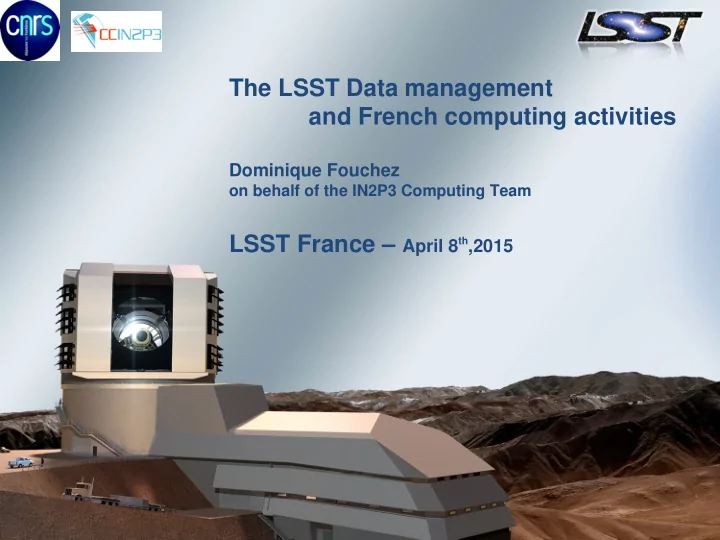
The LSST Data management and French computing activities Dominique Fouchez on behalf of the IN2P3 Computing Team LSST France April 8 th ,2015 OSG All Hands SLAC April 7-9, 2014 1 The LSST Data management and French computing


slide-1
SLIDE 1

1

OSG All Hands • SLAC • April 7-9, 2014

The LSST Data management and French computing activities

Dominique Fouchez

  • n behalf of the IN2P3 Computing Team

LSST France – April 8th,2015

slide-2
SLIDE 2

2

The LSST Data management and French computing activities

  • Introduction to the LSST Data Management
  • The french contributions to LSST computing

– Data Challenge 2013 – CFHTLS reprocessing – Qserv – CC IN2P3

  • Toward a deeper France – USA collaboration
  • Conclusion
slide-3
SLIDE 3

3

The big data issues

  • LSST Data Management System must deal with an

unprecedented data volume.

– one 6.4-gigabyte image every 17 seconds – 15 terabytes of raw scientif i

c image data / night

– 60-petabyte f i

nal image data archive

– 20-petabyte f i

nal database catalog

– 2 million real time events per night every night for 10 years

  • Provide a highly reliable open source system to provide:

– Real time alerts, – catalog data products, – image data.

  • Provides the infrastructure to transport, process, and

serve the data.

slide-4
SLIDE 4

4

The lsst data management

slide-5
SLIDE 5

5

Data Access Services Processing Middleware System Administration, Operations, Security Long-Haul Communications Physical Plant (included in above) Base Site

Application Layer (LDM-151)

  • Scientif i

c Layer

  • Pipelines constructed from reusable,

standard “parts”, i.e. Application Framework

  • Data Products representations standardized
  • Metadata extendable without schema change
  • Object-oriented, python, C++ Custom Software

Middleware Layer (LDM-152)

  • Portability to clusters, grid, other
  • Provide standard services so applications

behave consistently (e.g. provenance)

  • Preserve performance (<1% overhead)
  • Custom Software on top of Open Source,
  • Off-the-shelf Software

Infrastructure Layer (LDM-129)

  • Distributed Platform
  • Different sites specialized for real-time

alerting vs peta-scale data access

  • Off-the-shelf, Commercial Hardware &

Software, Custom Integration

Science Data Archive (Images, Alerts, Catalogs) Alert, Calibration, Data Release Productions/Pipelines Application Framework Science User Interface and Analysis Tools Archive Site

Data Management System Layered Architecture

Data Management System Design LDM-14

slide-6
SLIDE 6

6

The LSST Data management and French computing activities

  • Introduction to the LSST Data Management
  • The french contributions to LSST computing

– Data Challenge 2013 – CFHTLS reprocessing – Qserv – CC IN2P3

  • Toward a deeper France – USA collaboration
  • Conclusion
slide-7
SLIDE 7

7

LSST Computing organization in France

Computing LSST-France

Réza Ansari

(LAL Orsay)

Christian Arnault (LAL

Orsay)

Dominique Boutigny

(CC-IN2P3 - SLAC)

Emmanuel Gangler

(LPC Clermont Ferrand)

Dominique Fouchez

(CPPM Marseille)

  • Software
  • Tools
  • Training
  • Quality
  • Coordination with science

activities

  • Level 3 pipelines
  • Simulation
  • Precursor dataset

(SDSS - CFHT – DES – HSC…)

  • Data Challenges
  • Qserv
  • Data access
  • Camera Software
  • Integration and test

data

  • French Computing

Coordinator

  • Coord. CC-IN2P3
  • Coord. US

Fabio Hernandez

Johann Cohen- Tanugi

(LUPM Montpellier)

slide-8
SLIDE 8

8

The LSST Data management and French computing activities

  • Introduction to the LSST Data Management
  • The french contributions to LSST computing

– Data Challenge 2013 – CFHTLS reprocessing – Qserv – CC IN2P3

  • Toward a deeper France – USA collaboration
  • Conclusion
slide-9
SLIDE 9

9

Data Challenge 2013

First large scale Data Challenge in summer 2013 Goals :

  • SDSS Stripe 82 reprocessing with LSST Stack
  • Test the Satellite (a.k.a. Split) Data Release Processing

together with NCSA

Processing :

  • Calibrated images from SDSS in 5 bands (u, g, r, i, z)
  • Individual image processing and photometric calibration
  • Co-addition
  • Forced photometry

Coordination with NCSA and DM team

  • File transfer between the 2 sites using the CC-IN2P3 iRODS system
  • Output cross validation on a predefined overlapping region

Coordination of 5 french lab around CC-IN2P3

slide-10
SLIDE 10

10

Data Challenge 2013

At IN2P3 only :

  • 105 CPU hours – 700 CPU cores in // during 2.5 months
  • Input data : 4.8 TB in 4.4 million files
  • Output data : ~100 TB in 21 million files stored in GPFS
  • Data exchanged between NCSA and CC-IN2P3 through the network
  • Output products stored in a large MySQL database
  • Test of the Dirac middleware system at CC-IN2P3

Some issues :

➢ Database issue completely underestimated

  • Lack of production control tools (book-keeping, etc...)

But very successful :

  • Validated the Satellite DRP concept

➢ Demonstrating that a coordinated production between both sites was

achievable with reasonable efforts

slide-11
SLIDE 11

11

The LSST Data management and French computing activities

  • Introduction to the LSST Data Management
  • The french contributions to LSST computing

– Data Challenge 2013 – CFHTLS reprocessing – Qserv – CC IN2P3

  • Toward a deeper France – USA collaboration
  • Conclusion
slide-12
SLIDE 12

12

CFHTLS reprocessing

Ideal use case to learn and understand the LSST stack in details

  • Start from an initial work from Simon Krughoff (UW)
  • Excellent collaboration with the DM team

Contributions from :

  • DB : Development and test of the obs_cfht package
  • LPNHE : Image reduction – Algorithms – Camera
  • CPPM : Transient detection (comp. science PhD student from Bogota)
  • LAL : Data analysis / validation
  • LPC : Data analysis / validation – code development – data production
  • LUPM : Joining the effort
slide-13
SLIDE 13

13

CFHTLS reprocessing

Avoid doing “DC for the sake of DC” but would rather try to make them scientifically useful

  • A lot of expertise at IN2P3 on CFHT / Megacam with the SNLS

group (LPNHE + CPPM)

  • CFHT / Megacam much closer to LSST than SDSS (drift scan)
  • All the data are already at CC-IN2P3
  • Number of scientific results and technical procedures has been

published

➢ First and only Weak Lensing dataset publicly available

slide-14
SLIDE 14

14

CFHTLS reprocessing

Stars Galaxies

A full program of work to :

  • Assess pipelines' quality
  • Tune parameters
  • Implement new algorithms

Benefit from HSC expertise on LSST DM stack

slide-15
SLIDE 15

15

Comparison to HST / Aegis

slide-16
SLIDE 16

16

Some issues with coadd

A lot of cross checks still to be performed Partial images seem to trigger problems in processCoadd (Philippe) Cannot compute CoaddPsf at point (39677, 5312) ! Bad registration

slide-17
SLIDE 17

17

Summary on f i rst contributions to CFHT reprocessing Many improvement on CFHT software implementation, (Dominique Boutigny), where key for success are :

  • Queries to experts : hipchat, mailling list, next office (!)
  • Use of github, tickets and branch
  • Trello and ipython notebook for documentation and sharing of

information

slide-18
SLIDE 18

18

The LSST Data management and French computing activities

  • Introduction to the LSST Data Management
  • The french contributions to LSST computing

– Data Challenge 2013 – CFHTLS reprocessing – Qserv (Emmanuel's talk) – CC IN2P3

  • Toward a deeper France – USA collaboration
  • Conclusion
slide-19
SLIDE 19

19

The LSST Data management and French computing activities

  • Introduction to the LSST Data Management
  • The french contributions to LSST computing

– Data Challenge 2013 – CFHTLS reprocessing – Qserv – CC IN2P3

  • Toward a deeper France – USA collaboration
  • Conclusion
slide-20
SLIDE 20

20

CC IN2P3

Technical work on LSST software (Fabio Hernandez) (Christian's talk)

  • Binary distribution of official LSST software releases through

CernVM FS, available worldwide

  • Analysis of I/O activity during data processing

➢ Could serve as input data for another comp. science PhD : simulation of

large scale computing infrastructure (SimGrid)

Satellite Data Release Processing

  • Requires a plan to ramp up the CC-IN2P3 infrastructure
  • Periodic Data Challenges

➢ To stress and validate the infrastructure ➢ To test middleware and tools ➢ To explore possible alternative strategies, hardware and software

slide-21
SLIDE 21

21

The french contributions to LSST computing

CFHT reprocessing is a central point for a lots of our activities : Work on the stack software : gain in expertise, contribution to the algorithms Use the produced real data as a benchmark for the Qserv deployment and performances. Use of real request, develop end user tools etc .. Real data prototype for testing and sizing the infrastructure at CC-IN2P3 : CPU, IO : tracking of activity with synthetic files ( fabio), production framework ... Science : A lot of improvement are needed : (Pierre's talk) But many potential outcomes

  • work on transients (preparation for SN science) (Juan Pablo's talk)
  • weak lensing systematics (Dominique Boutigny and David Kirkby )
  • strong interest from DESC members in general
  • work on calibration (Fabrice's talk)
  • photo z (discussion in computing parallel session)

Last but not Least : A genuine processing lead by France/CC-IN2P3

slide-22
SLIDE 22

22

The LSST Data management and French computing activities

  • Introduction to the LSST Data Management
  • The french contributions to LSST computing

– Data Challenge 2013 – CFHTLS reprocessing – Qserv – CC IN2P3

  • Toward a deeper France – USA collaboration
  • Conclusion
slide-23
SLIDE 23

23

Toward a deeper France – USA collaboration

The Computing MOA :

  • March 5th, the LSST heads went to sign the MOA
slide-24
SLIDE 24

24

The Computing MOA

Parties :

  • IN2P3 – LSSTC – LSSTPO – NCSA

Purpose :

  • Establish a partnership to enable participation by French scientists

in the scientific exploitation of the LSST database

  • Specify the terms of an IN2P3 contribution to the LSST Data

Release Processing during the survey operations Agreement :

  • NCSA is the lead production data processing center, i.e. the

Archive Center for LSST and the Data Access Center for the US

  • CC-IN2P3 is a satellite data processing Center
  • NCSA and CC-IN2P3 will process 50% of the data (level 2)
  • A full dataset will be available in both sites
slide-25
SLIDE 25

25

The Computing MOA

Agreement (cont.):

  • IN2P3 will coordinate with RENATER to establish the necessary

bandwidth between CC-IN2P3 and Chicago StarLight POP

  • CC-IN2P3 and NCSA : reciprocal disaster recovery centers for LSST
  • Joint Coordination Council (JCC) to collaborate in the planning,

technical and operational constraints ==> Implementation plan

  • NCSA has the lead responsibility for defining the constraints
  • Guarantee that IN2P3 contributions are consistent with the LSST

Data Management

  • Joint tests of Satellite DRP no later than the start of Commissioning

(October 2019)

  • CC-IN2P3 contribution valuated to 900 k$/year in operation cost
  • Data rights for 45 new PI on top of the data right granted from the

Camera MOA

slide-26
SLIDE 26

26

Toward a deeper France – USA collaboration

The Computing MOA :

  • March 5th, the LSST heads went to sign the MOA

The CC-IN2P3 and NCSA:

  • March 6th : visit of the CC infrastructure
  • Agreements for a collaboration on LSST and beyond
  • CC-IN2P3 is setting up a specific internal organization to prepare its
  • fficial involvement in LSST computing operation

A CFHTLS data challenge at CC-IN2P3 ?

  • Test of the stack and of the CC infrastructure
  • Share results with the LSST full collaboration
slide-27
SLIDE 27

27

Conclusions

French contribution to LSST data management software :

  • A first successful data challenge
  • Adaptation of the software to process CFHTLS images
  • Work on Qserv
  • Technical development at CCIN2P3, distribution, IO ..
  • First comparison of LSST processing with SNLS processing
  • New contribution to image subtraction starting
  • Link with camera software starting

The MoA signature will allow us to pursue thoses effort and go beyond : Many new opportunities may and should arise from this strong effort : New collaborations, fund raising, international visibility ...