The logarithm as an inverse function In this section we concentrate - - PowerPoint PPT Presentation

the logarithm as an inverse function
SMART_READER_LITE
LIVE PREVIEW

The logarithm as an inverse function In this section we concentrate - - PowerPoint PPT Presentation

The logarithm as an inverse function In this section we concentrate on understanding the logarithm function. If the logarithm is understood as the inverse of the exponential function, then the properties of logarithms will naturally follow from


slide-1
SLIDE 1

Elementary Functions

Part 3, Exponential Functions & Logarithms Lecture 3.3a, Logarithms: Basic Properties

  • Dr. Ken W. Smith

Sam Houston State University

2013

Smith (SHSU) Elementary Functions 2013 1 / 29

The logarithm as an inverse function

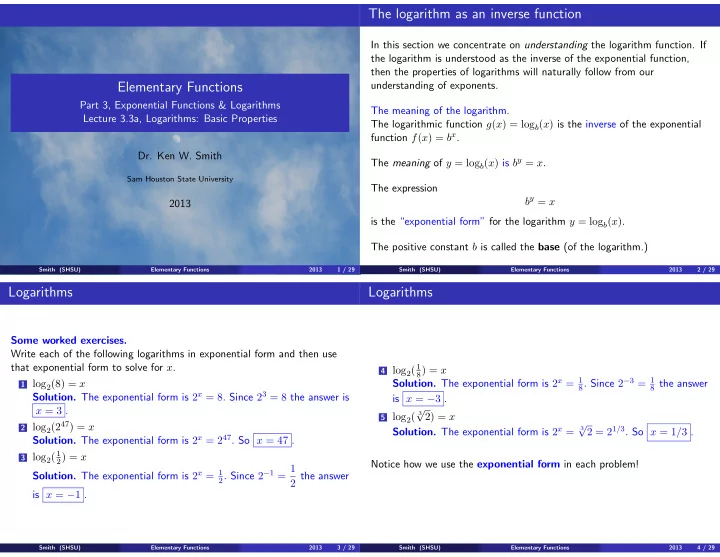
In this section we concentrate on understanding the logarithm function. If the logarithm is understood as the inverse of the exponential function, then the properties of logarithms will naturally follow from our understanding of exponents. The meaning of the logarithm. The logarithmic function g(x) = logb(x) is the inverse of the exponential function f(x) = bx. The meaning of y = logb(x) is by = x. The expression by = x is the “exponential form” for the logarithm y = logb(x). The positive constant b is called the base (of the logarithm.)

Smith (SHSU) Elementary Functions 2013 2 / 29

Logarithms

Some worked exercises. Write each of the following logarithms in exponential form and then use that exponential form to solve for x.

1 log2(8) = x

  • Solution. The exponential form is 2x = 8. Since 23 = 8 the answer is

x = 3 .

2 log2(247) = x

  • Solution. The exponential form is 2x = 247. So x = 47 .

3 log2( 1 2) = x

  • Solution. The exponential form is 2x = 1
  • 2. Since 2−1 = 1

2 the answer is x = −1 .

Smith (SHSU) Elementary Functions 2013 3 / 29

Logarithms

4 log2( 1 8) = x

  • Solution. The exponential form is 2x = 1
  • 8. Since 2−3 = 1

8 the answer

is x = −3 .

5 log2(

3

√ 2) = x

  • Solution. The exponential form is 2x =

3

√ 2 = 21/3. So x = 1/3 . Notice how we use the exponential form in each problem!

Smith (SHSU) Elementary Functions 2013 4 / 29

slide-2
SLIDE 2

The graph of a logarithm function

The graph of y = 2x was drawn in an earlier lecture (see below.) The graph of the inverse function y = log2 x is obtained by reflecting the graph of y = 2x across the line y = x.

Smith (SHSU) Elementary Functions 2013 5 / 29

The graph of a logarithm function

The graph of y = log2 x :

Smith (SHSU) Elementary Functions 2013 6 / 29

The graph of a logarithm function

If we draw them together, we have the picture below.

Smith (SHSU) Elementary Functions 2013 7 / 29

The graph of a logarithm function

The graph of the exponential function y = 2x: The graph of the logarithmic function y = log2 x:

Smith (SHSU) Elementary Functions 2013 8 / 29

slide-3
SLIDE 3

Logarithms

We agreed earlier that the exponential function f(x) = bx has domain (−∞, ∞) and range (0, ∞). Since g(x) = logb x is the inverse function of f(x) the domain of the log function will be the range of the exponential function, and vice versa. So the domain of logb x is (0, ∞) and the range is (−∞, ∞). The most useful base for logarithms is e. We will abbreviate loge(x) by ln(x) and speak of the “natural logarithm”. Sometimes, for historical reasons, we may use base 10. It is customary to speak then of the “common logarithm” and abbreviate log10(x) by log(x), dropping the subscript. However (warning!), in higher mathematics and engineering applications, log(x) usually means base e and is equivalent to ln(x). In these notes we will use log(x) to mean log10(x). One more abbreviation – in computer science, because computers store data in binary (in bits of zeroes and ones), one uses base 2. Some abbreviate log2(x) as lb(x) and speak of the “binary” logarithm.

Smith (SHSU) Elementary Functions 2013 9 / 29

Logarithms

In summary, here are our abbreviations:

1 ln x means the logarithm base e, 2 log x means the logarithm base 10 and 3 lb x means the logarithm base 2.

Smith (SHSU) Elementary Functions 2013 10 / 29

Logarithms

A few more worked exercises. Write each of the following logarithms in exponential form and then use that exponential form to solve for x.

1 log(1000) = x

  • Solution. The exponential form is 10x = 1000. Since 103 = 1000 the

answer is x = 3 .

2 ln( 1

e3 ) = x

  • Solution. The exponential form is ex = e−3 so the answer is −3 .

3 lb( 1

√ 2) = x

  • Solution. The exponential form is 2x =

1 √

  • 2. Since 21/2 =

√ 2 then 2−1/2 = 1 √ 2 and so the answer is x = −1/2 .

Smith (SHSU) Elementary Functions 2013 11 / 29

Properties of exponential functions in terms of logarithms

The logarithm function plucks the exponent from an expression. For this reason, the properties of exponents translate into properties of logarithms. For example, we know that when we multiply two terms with a common base, we add the exponents: (bx)(by) = bx+y (1) Suppose we call the first term M := bx and the second term N := by. Then one may ask the question, “What is the exponent on b in the product MN? The answer is “We add the exponents appearing in M and N.” In other words (if we learn to translate “logb” as “the exponent on b that...”), we can restate this exponent property as “when we multiply numbers we add their exponents”. This is the product property for logarithms: logb(MN) = logb M + logb N (2)

Smith (SHSU) Elementary Functions 2013 12 / 29

slide-4
SLIDE 4

Logarithms

What happens when we divide two terms with a common base? bx by = bx−y (3) When we do division, we subtract exponents. So, in the language of logarithms, we have the quotient property, “the exponent in a quotient is the difference of the two exponents”: logb(M N ) = logb M − logb N (4)

Smith (SHSU) Elementary Functions 2013 13 / 29

Logarithms

A third important property of exponents: when we raise a term like bx to a power, we multiply exponents. (bx)c = bxc (5) In our “logarithm language” (thinking of M as bx) we have the exponent property logb(Mc) = c logb M (6) Each of these three properties is merely a restatement, in the language of logarithms, of a property of exponents.

Smith (SHSU) Elementary Functions 2013 14 / 29

Logarithms

We review the three basic logarithm rules we have developed so far. Product Property of Logarithms: logb(MN) = logb M + logb N Quotient Property of Logarithms: logb(M N ) = logb M − logb N Exponent Property of Logarithms: logb(Mc) = c logb M Each of these properties is a restatement, in the language of logarithms, of a property of exponents.

Smith (SHSU) Elementary Functions 2013 15 / 29

Exponential Functions

In the next presentation, we develop several more properties of logarithms. (END)

Smith (SHSU) Elementary Functions 2013 16 / 29

slide-5
SLIDE 5

Elementary Functions

Part 3, Exponential Functions & Logarithms Lecture 3.3b, Logarithms: Basic Properties, Continued

  • Dr. Ken W. Smith

Sam Houston State University

2013

Smith (SHSU) Elementary Functions 2013 17 / 29

Logarithms

We review the three basic logarithm rules we have developed so far. Product Property of Logarithms: logb(MN) = logb M + logb N Quotient Property of Logarithms: logb(M N ) = logb M − logb N Exponent Property of Logarithms: logb(Mc) = c logb M Each of these three properties is merely a restatement of a property of exponents.

Smith (SHSU) Elementary Functions 2013 18 / 29

Changing the base

Suppose we want to change the base of our logarithm. This often occurs when we want to use a “good” base like e on a problem which began with a different base. Suppose we want to work with base c but our problem began with base b: y = logb x. Rewrite this in exponential form: by = x. Now take the log of both sides of the equation. If we want to work in base c then let us apply logc() to both sides of our equation. logc(by) = logc(x). Now we use the exponent property pulling the exponent y outside the logarithm: y logc(b) = logc(x). Solve for y: y = logc x log b .

Smith (SHSU) Elementary Functions 2013 19 / 29

Changing the base

We began with y = logb x. We rewrote this as y = logc x logc b . So y, which was originally equal to logb x is now logb x = logc x logc b Let’s call this the “change of base” equation or “change of base” property. One way to remember this is to note that on the left side of the equal sign (logb x), b is lower than x. Then on the right side of the equal sign ( log x

log b ), b is still lower than x!

Smith (SHSU) Elementary Functions 2013 20 / 29

slide-6
SLIDE 6

Logarithms

  • Example. Suppose we want to compute log2(17) but our calculator only

allows us to use the natural logarithm ln. Then, by the change of base equation we can write log2(17) = ln 17 ln 2 ≈ 4.087463.

Smith (SHSU) Elementary Functions 2013 21 / 29

More on the logarithm as an inverse function

We began this lecture by defining g(x) = logb(x) as the inverse function of f(x) = bx. Since these functions are inverses, we know then that (f ◦ g)(x) = (g ◦ f)(x) = x. (7) Let us examine this in more detail. Note that (g ◦ f)(x) = g(f(x)) = g(bx) = logb(bx). Since the log function and the exponential function are inverse functions, this must be equal to just x and we have logb(bx) = x. This equation is really fairly easy to understand. If we translate “logb(x)” as “the exponent on b that give x” then we should translate logb(bx) as “the exponent on b which gives bx.” Obviously this should be x since x is the exponent one places on b to get

  • bx. (If that doesn’t make sense, read through it one more time slowly....)

Smith (SHSU) Elementary Functions 2013 22 / 29

More on the logarithm as an inverse function

Since (f ◦ g)(x) = x we also have x = (f ◦ g)(x) = f(g(x)) = f(logb x) = blogb x. So blogb x = x. This is almost as easy to understand as the previous equation. It says that if we place on b “the exponent you put on b to get x” (logb x) then we should just get x!

Smith (SHSU) Elementary Functions 2013 23 / 29

Six properties of logarithms

In summary, we have developed the following six properties of logarithms.

1 The Product Property of Logarithms:

logb(MN) = logb M + logb N

2 The Quotient Property of Logarithms:

logb(M N ) = logb M − logb N

3 The Exponent Property of Logarithms:

logb(Mc) = c logb M

Smith (SHSU) Elementary Functions 2013 24 / 29

slide-7
SLIDE 7

Six properties of logarithms

4 The Change of Base Property

logb x = logc x logc b

5 Inverse Property #1

logb bx = x

6 Inverse Property #2

blogb x = x

Smith (SHSU) Elementary Functions 2013 25 / 29

More on the logarithm as an inverse function

If we understand the logarithm as the inverse of the exponential function then we are prepared to find the inverse of a variety of functions. Here are some examples. Find the inverse function of:

1 f(x) = ex2. 2 f(x) = ex2−5. 3 f(x) = 5 + ex. 4 f(x) = log2(x + 2) + 2.

Solutions

1 To find the inverse of f(x) = ex2 set y = ex2 and swap inputs and

  • utputs

x = ey2. Take the natural logarithm of both sides ln x = y2 and solve for y by taking square roots of both sides √ ln x = y. So one inverse function is f−1(x) = √ ln x .

Smith (SHSU) Elementary Functions 2013 26 / 29

More on the logarithm as an inverse function

2 To find the inverse of y = ex2−5 we swap letters so that x = ey2−5,

take natural logs of both sides ln x = y2 − 5, add 5 and take square roots so that f−1(x) = √ ln x + 5 .

3 To find the inverse of y = 5 + ex we swap variables, subtract 5 from

both sides and then take the natural log to get ln(x − 5) = y. So f−1(x) = ln(x − 5) .

Smith (SHSU) Elementary Functions 2013 27 / 29

More on the logarithm as an inverse function

4 To find the inverse of f(x) = log2(x + 2) + 2 we write

y = log2(x + 2) + 2, change variables (to indicate that we are swapping inputs and

  • utputs)

x = log2(y + 2) + 2, and subtract 2 from both sides x − 2 = log2(y + 2). At this point it is best to write this logarithmic equation in exponential form. 2x−2 = y + 2. Subtract 2 from both sides 2x−2 − 2 = y and then write out our answer using inverse function notation. f−1(x) = 2x−2 − 2

Smith (SHSU) Elementary Functions 2013 28 / 29

slide-8
SLIDE 8

Exponential Functions

In the next series of lectures, we apply properties of logarithms. (END)

Smith (SHSU) Elementary Functions 2013 29 / 29