
SLIDE 1
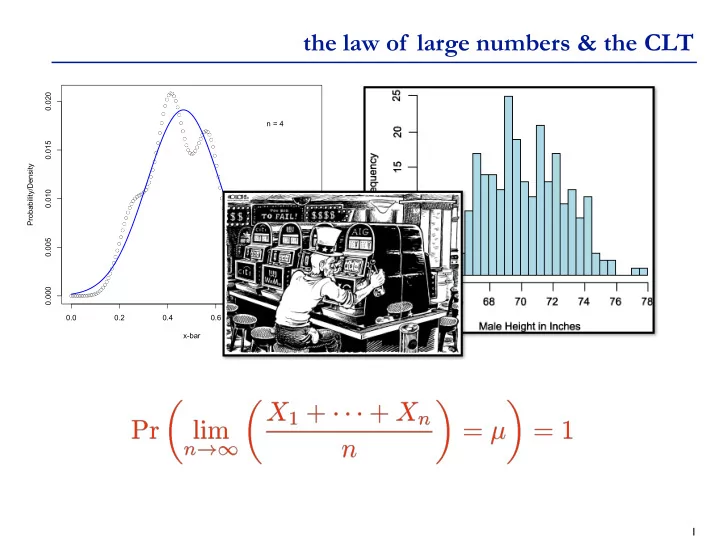
0.0 0.2 0.4 0.6 0.8 1.0 0.000 0.005 0.010 0.015 0.020 x-bar Probability/Density n = 4
the law of large numbers & the CLT
1
the law of large numbers & the CLT 0.020 n = 4 0.015 - - PowerPoint PPT Presentation
the law of large numbers & the CLT 0.020 n = 4 0.015 Probability/Density 0.010 0.005 0.000 0.0 0.2 0.4 0.6 0.8 1.0 x-bar 1 sums of random variables If X,Y are independent, what is the distribution of Z = X + Y ? Discrete
0.0 0.2 0.4 0.6 0.8 1.0 0.000 0.005 0.010 0.015 0.020 x-bar Probability/Density n = 4
the law of large numbers & the CLT
1
sums of random variables
If X,Y are independent, what is the distribution of Z = X + Y ? Discrete case: pZ(z) = Σx pX(x) • pY(z-x) Continuous case: fZ(z) = ∫ fX(x) • fY(z-x) dx E.g. what is the p.d.f. of the sum of 2 normal RV’s? W = X + Y + Z ? Similar, but double sums/integrals V = W + X + Y + Z ? Similar, but triple sums/integrals
2
+∞
y = z - x
example
If X and Y are uniform, then Z = X + Y is not; it’s triangular (like dice):
Intuition: X + Y ≈ 0 or ≈ 1 is rare, but many ways to get X + Y ≈ 0.5
3
0.0 0.2 0.4 0.6 0.8 1.0 0.020 0.025 0.030 0.035 0.040 0.045 x-bar Probability/Density n = 1 0.0 0.2 0.4 0.6 0.8 1.0 0.000 0.005 0.010 0.015 0.020 0.025 0.030 x-bar Probability/Density n = 2
moment generating functions
Powerful math tricks for dealing with distributions We won’t do much with it, but mentioned/used in book, so a very brief introduction: The kth moment of r.v. X is E[Xk] ; M.G.F. is M(t) = E[etX]
4
aka transforms; b&t 229
Closely related to Laplace transforms, which you may have seen.
mgf examples
5
An example: MGF of normal(μ,σ2) is exp(μt+σ2t2/2) Two key properties:
MX+Y(t) = E[et(X+Y)] = E[etX etY] = E[etX] E[etY] = MX(t) MY(t)
e.g.: MX(t) = exp(at+bt2),with b>0, then X ~ Normal(a,2b) Important example: sum of independent normals is normal:
X~Normal(μ1,σ12) Y~Normal(μ2,σ22)
MX+Y(t) = exp(μ1t + σ12t2/2) • exp(μ2t + σ22t2/2)
= exp[(μ1+μ2)t + (σ12+σ22)t2/2]
So X+Y has mean (μ1+μ2), variance (σ12+σ22) (duh) and is normal!
(way easier than slide 2 way!)
“laws of large numbers” Consider i.i.d. (independent, identically distributed) R.V.s X1, X2, X3, … Suppose Xi has μ = E[Xi] < ∞ and σ2 = Var[Xi] < ∞. What are the mean & variance of their sum? So limit as n→∞ does not exist (except in the degenerate case where μ = 0; note that if μ = 0, the center of the data stays fixed, but if σ2 > 0, then the variance is unbounded, i.e., its spread grows with n).
6
weak law of large numbers Consider i.i.d. (independent, identically distributed) R.V.s X1, X2, X3, … Suppose Xi has μ = E[Xi] < ∞ and σ2 = Var[Xi] < ∞ What about the sample mean , as n→∞? So, limits do exist; mean is independent of n, variance shrinks.
7
Mn = 1 n
n
X
i=1
Xi
E [ Mn] = E X1 + · · · + Xn n
Var [ Mn] = Var X1 + · · · + Xn n
n
Continuing: iid RVs X1, X2, X3, …; μ = E[Xi]; σ2 =
Var[Xi];
Expectation is an important guarantee. BUT: observed values may be far from expected values. E.g., if Xi ~ Bernoulli(½), the E[Xi]= ½, but Xi is NEVER ½. Is it also possible that sample mean of Xi’s will be far from ½? Always? Usually? Sometimes? Never? weak law of large numbers
8
Var [ Mn] = Var X1 + · · · + Xn n
n
Mn = 1 n
n
X
i=1
Xi
n→∞
Proof: (assume σ2 < ∞; theorem true without that, but harder proof) By Chebyshev inequality, weak law of large numbers For any ε > 0, as n → ∞
9
b&t 5.2
E [ Mn] = E X1 + · · · + Xn n
Var [ Mn] = Var X1 + · · · + Xn n
n
strong law of large numbers i.i.d. (independent, identically distributed) random vars X1, X2, X3, … Xi has μ = E[Xi] < ∞ Strong Law ⇒ Weak Law (but not vice versa) Strong law implies that for any ε > 0, there are only a finite number of n satisfying the weak law condition (almost surely, i.e., with probability 1) Supports the intuition of probability as long term frequency
10
b&t 5.5
Mn = 1 n
n
X
i=1
Xi |Mn − µ| ≥ ✏
weak vs strong laws
Weak Law: Strong Law:
How do they differ? Imagine an infinite 2-D table, whose rows are indp infinite sample sequences Xi. Pick ε. Imagine cell m,n lights up if average of 1st n samples in row m is > ε away from μ. WLLN says fraction of lights in nth column goes to zero as n →∞. It does not prohibit every row from having ∞ lights, so long as frequency declines. SLLN also says only a vanishingly small fraction of rows can have ∞ lights.
11
weak vs strong laws – supplement
The differences between the WLLN & SLLN are subtle, and not critically important for this course, but for students wanting to know more (e.g., not on exams), here is my summary. Both “laws” rigorously connect long-term averages of repeated, independent observations to mathematical expectation, justifying the intuitive motivation for E[.]. Specifically, both say that the sequence of (non-i.i.d.) rvs derived from any sequence of i.i.d. rvs Xi converge to E[Xi]=μ. The strong law totally subsumes the weak law, but the later remains interesting because (a) of its simple proof (Khintchine, early 20th century; using Cheybeshev’s inequality (1867)) and (b) historically (WLLN was proved by Bernoulli ~1705, for Bernoulli rvs, >150 years before Chebyshev [Ross, p391]). The technical difference between WLLN and SLLN is in the definition of convergence. Definition: Let Yi be any sequence of rvs (i.i.d. not assumed) and c a constant. Yi converges to c in probability if Yi converges to c with probability 1 if The weak law is the statement that Mn converges in probability to μ; the strong law states it converges with probability 1 to μ. The strong law subsumes the weak law since convergence with probability 1 implies convergence in probability for any sequence Yi of rvs (B&T problem 5.5-15). B&T ex 5.15 illustrates the failure of the converse. A second counterexample is given on the following slide.
12
Mn = Pn
i=1 Xi/n
∀✏ > 0, limn→∞ Pr (|Yn − c| > ✏) = 0 Pr (limn→∞ Yn = c) = 1
weak vs strong laws – supplement
Example: Consider the sequence of rvs Yn ~ Ber(1/n) Recall the definition of convergence in probability: Then Yn converges to c = 0 in probability since Pr(Yn > ε) = 1/n for any 0 < ε <1, hence the limit as n→∞ is 0, satisfying the definition. Recall that Yn converges to c with probability 1 if However, I claim that does not exist, hence doesn’t equal zero with probability 1. Why no limit? A 0/1 sequence will have a limit if and only if it is all 0 after some finite point (i.e., contains only a finite number of 1’s) or vice versa. But the expected number of 0’s & 1’s in the sequence are both infinite; e.g.: Thus, Yn converges in probability to zero, but does not converge with probability 1. Revisiting the “lightbulb model” 2 slides up, w/ “lights on” ⇔ 1, column n has a decreasing fraction (1/n) of lit bulbs, while all but a vanishingly small fraction of rows have infinitely many lit bulbs. (For an interesting contrast, consider the sequence of rvs Zn ~ Ber(1/n2).)
13
∀✏ > 0, limn→∞ Pr (|Yn − c| > ✏) = 0 Pr (limn→∞ Yn = c) = 1
Pr (limn→∞ Yn =
E ⇥P
i>0 Yi
⇤ = P
i>0 E[Yi] = P i>0 1 i = ∞
sample mean → population mean
14
Xi ~ Unif(0,1) limn→∞ Σi=1 Xi/n→ μ=0.5
n
50 100 150 200 0.0 0.2 0.4 0.6 0.8 1.0 Trial number i Sample i; Mean(1..i)
sample mean → population mean
15
50 100 150 200 0.0 0.2 0.4 0.6 0.8 1.0 Trial number i Sample i; Mean(1..i)
μ±2σ
Xi ~ Unif(0,1) limn→∞ Σi=1 Xi/n→ μ=0.5
std dev(Σi=1 Xi/n) = 1/√12n
n n
another example
17
50 100 150 200 0.0 0.2 0.4 0.6 0.8 1.0 Trial number i Sample i; Mean(1..i)
another example
18
50 100 150 200 0.0 0.2 0.4 0.6 0.8 1.0 Trial number i Sample i; Mean(1..i)
another example
19
200 400 600 800 1000 0.0 0.2 0.4 0.6 0.8 1.0 Trial number i Sample i; Mean(1..i)
weak vs strong laws
Weak Law: Strong Law:
How do they differ? Imagine an infinite 2-D table, whose rows are indp infinite sample sequences Xi. Pick ε. Imagine cell m,n lights up if average of 1st n samples in row m is > ε away from μ. WLLN says fraction of lights in nth column goes to zero as n →∞. It does not prohibit every row from having ∞ lights, so long as frequency declines. SLLN also says only a vanishingly small fraction of rows can have ∞ lights.
20
the law of large numbers Note: Dn = E[ | Σ1≤i≤n(Xi-μ) | ] grows with n, but Dn/n → 0 Justifies the “frequency” interpretation of probability “Regression toward the mean” Gambler’s fallacy: “I’m due for a win!” “Swamps, but does not compensate” “Result will usually be close to the mean” Many web demos, e.g. http://stat-www.berkeley.edu/~stark/Java/Html/lln.htm
21
200 400 600 0.0 0.2 0.4 0.6 0.8 1.0 Trial number n Draw n; Mean(1..n)
normal random variable X is a normal random variable X ~ N(μ,σ2)
22
1 2 3 0.0 0.1 0.2 0.3 0.4 0.5
x f(x)
µ = 0 σ = 1
Mn = 1 n
n
X
i=1
Xi → N ✓ µ, σ2 n ◆ the central limit theorem (CLT) i.i.d. (independent, identically distributed) random vars X1, X2, X3, … Xi has μ = E[Xi] < ∞ and σ2 = Var[Xi] < ∞ As n → ∞, Restated: As n → ∞,
23
Note: on slide 5, showed sum of normals is exactly normal. Maybe not a surprise, given that sums of almost anything become approximately normal...
25
0.0 0.2 0.4 0.6 0.8 1.0 0.000 0.005 0.010 0.015 0.020 0.025 Probability/Density n = 3 0.0 0.2 0.4 0.6 0.8 1.0 0.000 0.005 0.010 0.015 0.020 Probability/Density n = 4 0.0 0.2 0.4 0.6 0.8 1.0 0.000 0.005 0.010 0.015 0.020 0.025 0.030 x-bar Probability/Density n = 2 0.0 0.2 0.4 0.6 0.8 1.0 0.020 0.025 0.030 0.035 0.040 0.045 x-bar Probability/Density n = 1
CLT applies even to whacky distributions
26
0.0 0.2 0.4 0.6 0.8 1.0 0.00 0.01 0.02 0.03 0.04 0.05 0.06 x-bar Probability/Density n = 1 0.0 0.2 0.4 0.6 0.8 1.0 0.000 0.005 0.010 0.015 0.020 Probability/Density n = 4 0.0 0.2 0.4 0.6 0.8 1.0 0.000 0.005 0.010 0.015 0.020 0.025 Probability/Density n = 3 0.0 0.2 0.4 0.6 0.8 1.0 0.000 0.005 0.010 0.015 0.020 0.025 0.030 x-bar Probability/Density n = 2
27
0.0 0.2 0.4 0.6 0.8 1.0 0.000 0.002 0.004 0.006 0.008 0.010 0.012 Probability/Density n = 10
a good fit (but relatively less good in extreme tails, perhaps)
CLT in the real world CLT also holds under weaker assumptions than stated above, and is the reason many things appear normally distributed Many quantities = sums of (roughly) independent random vars Exam scores: sums of individual problems People’s heights: sum of many genetic & environmental factors Measurements: sums of various small instrument errors “Noise” in sci/engr applications: sums of random perturbations ...
28
Human height is approximately normal. Why might that be true? R.A. Fisher (1918) noted it would follow from CLT if height were the sum of many independent random effects, e.g. many genetic factors (plus
some environmental ones like diet). I.e., suggested part of mechanism
by looking at shape of the curve.
in the real world…
29
Male Height in Inches
Frequency
DeMoivre-Laplace Theorem: As n→∞: Equivalently:
normal approximation to binomial
Let Sn = number of successes in n trials (with prob. p). Sn ~ Bin(n,p) E[Sn] = np Var[Sn] = np(1-p) Poisson approx: good for n large, p small (np constant) Normal approx: For large n, (p stays fixed): Sn ≈ Y ~ N(E[Sn], Var[Sn]) = N(np,np(1-p)) Rule of thumb: Normal approx “good” if np(1-p) ≥ 10
Pr(a ≤ Sn ≤ b) − → Φ ✓
b−np
√
np(1−p)
◆ − Φ ✓
a−np
√
np(1−p)
◆
normal approximation to binomial
31
30 40 50 60 70 0.00 0.02 0.04 0.06 0.08 k P(X=k)
Normal(np, np(1-p)) Binomial(n,p) Poisson(np)
n = 100 p = 0.5
normal approximation to binomial
Ex: Fair coin flipped 40 times. Probability of 15 to 25 heads?
32
Normal approximation: Exact (binomial) answer:
> pbinom(25,40,.5) - pbinom(14,40,.5) [1] 0.9193095 > pnorm(5/sqrt(10))- pnorm(-5/sqrt(10)) [1] 0.8861537 > 5/sqrt(10) [1] 1.581139 > pnorm(1.58)- pnorm(-1.58) [1] 0.8858931
SIDEBARS I’ve included a few sidebar slides like this
calculations in R, (b) to check my own math, and (c) occasionally to show the (usually small) effect of some
unless you want to pick up some R tips.
normal approximation to binomial
Ex: Fair coin flipped 40 times. Probability of 20 or 21 heads?
34
Normal approximation: Exact (binomial) answer:
Pbin(X = 20 ∨ X = 21) = ✓40 20 ◆ + ✓40 21 ◆ ✓1 2 ◆40 ≈ 0.2448 Pnorm(20 ≤ X ≤ 21) = P ✓20 − 20 √ 10 ≤ X − 20 √ 10 ≤ 21 − 20 √ 10 ◆ ≈ P ✓ 0 ≤ X − 20 √ 10 ≤ 0.32 ◆ ≈ Φ(0.32) − Φ(0.00) ≈ 0.1241
Hmmm… A bit disappointing.
> sum(dbinom(20:21,40,.5)) [1] 0.2447713 > pnorm(0)- pnorm(-1/sqrt(10)) [1] 0.1240852 > 1/sqrt(10) [1] 0.3162278 > pnorm(.32)- pnorm(0) [1] 0.1255158
normal approximation to binomial
Ex: Fair coin flipped 40 times. Probability of 20 heads?
36
Normal approximation: Exact (binomial) answer:
Pbin(X = 20) = ✓40 20 ◆ ✓1 2 ◆40 ≈ 0.1254 Pnorm(20 ≤ X ≤ 20) = P ✓20 − 20 √ 10 ≤ X − 20 √ 10 ≤ 20 − 20 √ 10 ◆ ≈ P ✓ 0 ≤ X − 20 √ 10 ≤ 0 ◆ = Φ(0.00) − Φ(0.00) = 0.0000
Whoa! … Even more disappointing.
DeMoivre-Laplace and the “continuity correction” The “continuity correction”: Imagine discretizing the normal density by shifting probability mass at non-integer x to the nearest integer (i.e., “rounding” x). Then, probability of binom r.v. falling in the (integer) interval [a, ..., b], inclusive, is ≈ the probability of a normal r.v. with the same μ,σ2 falling in the (real) interval [a-½ , b+½], even when a = b.
37
More: Feller, 1945 http://www.jstor.org/stable/10.2307/2236142
1 2 3 4 5 6 7 8 9 10 0.00 0.10 0.20 PMF/Density
Bin(n=10, p=.5) vs Norm(μ=np, σ2 = np(1-p)) PMF vs Density
(close but not exact)
CDF minus CDF
0.00 0.10 0.20 PMF/Density 0.0 0.2 0.4 0.6 0.8 1.0 CDF 1 2 3 4 5 6 7 8 9 10
0.00 0.10 Binom CDF Minus Normal CDF
normal approx to binomial, revisited
Ex: Fair coin flipped 40 times. Probability of 20 heads?
39
Normal approximation: Exact (binomial) answer:
Pbin(X = 20) = ✓40 20 ◆ ✓1 2 ◆40 ≈ 0.1254 Pbin(X = 20) ≈ Pnorm(19.5 ≤ X ≤ 20.5) = Pnorm ✓19.5 − 20 √ 10 ≤ X − 20 √ 10 < 20.5 − 20 √ 10 ◆ ≈ Pnorm ✓ −0.16 ≤ X − 20 √ 10 < 0.16 ◆ = Φ(0.16) − Φ(−0.16) ≈ 0.1272
{19.5 ≤ X ≤ 20.5} is the set of reals that round to the set of integers in {X = 20}
normal approx to binomial, revisited
Ex: Fair coin flipped 40 times. Probability of 20 or 21 heads?
40
Normal approximation: Exact (binomial) answer:
{19.5 ≤ X < 21.5} is the set of reals that round to the set of integers in {20 ≤ X < 22}
One more note on continuity correction: Never wrong to use it, but it has the largest effect when the set of integers is small. Conversely, it’s often omitted when the set is large.
Pbin(X = 20 ∨ X = 21) = ✓40 20 ◆ + ✓40 21 ◆ ✓1 2 ◆40 ≈ 0.2448 Pbin(20 ≤ X < 22) = Pnorm(19.5 ≤ X ≤ 21.5) = Pnorm ✓19.5 − 20 √ 10 ≤ X − 20 √ 10 ≤ 21.5 − 20 √ 10 ◆ ≈ Pnorm ✓ −0.16 ≤ X − 20 √ 10 ≤ 0.47 ◆ ≈ Φ(0.47) − Φ(−0.16) ≈ 0.2452
> pnorm(1.5/sqrt(10))- pnorm(-.5/sqrt(10)) [1] 0.2451883 > c(0.5,1.5)/sqrt(10) [1] 0.1581139 0.4743416 > pnorm(0.47) - pnorm(-0.16) [1] 0.244382
continuity correction is applicable beyond binomials Roll 10 6-sided dice X = total value of all 10 dice Win if: X ≤ 25 or X ≥ 45
42
E[X] = E[P10
i=1 Xi] = 10E[X1] = 10(7/2) = 35
Var[X] = Var[P10
i=1 Xi] = 10Var[X1] = 10(35/12) = 350/12
P(win) = 1 − P (25.5 ≤ X ≤ 44.5) = 1 − P ✓
25.5−35
√
350/12 ≤ X−35
√
350/12 ≤ 44.5−35
√
350/12
◆ ≈ 2(1 − Φ(1.76)) ≈ 0.079
example: polling
Poll of 100 randomly chosen voters finds that K of them favor proposition 666. So: the estimated proportion in favor is K/100 = q Suppose: the true proportion in favor is p.
percentage points, i.e., the probability of |q - p| > 0.1
K ≈ normal with mean 100p and variance 100p(1-p); or: q ≈ normal with mean p and variance σ2 = p(1-p)/100 Letting Z = (q-p)/σ (a standardized r.v.), then |q - p| > 0.1 ⇔ |Z| > 0.1/σ By symmetry of the normal PBer( |q - p| > 0.1 ) ≈ 2 Pnorm( Z > 0.1/σ ) = 2 (1 - Φ(0.1/σ)) Unfortunately, p & σ are unknown, but σ2 = p(1-p)/100 is maximized when p = 1/2, so σ2 ≤ 1/400, i.e. σ ≤ 1/20, hence 2 (1 - Φ(0.1/σ)) ≤ 2(1-Φ(2)) ≈ 0.046 I.e., less than a 5% chance of an error as large as 10 percentage points.
43
Exercise: How much smaller can σ be if p ≠ 1/2?
summary
Distribution of X + Y: summations, integrals (or MGF) Distribution of X + Y ≠ distribution X or Y in general Distribution of X + Y is normal if X and Y are normal (*) (ditto for a few other special distributions) Sums generally don’t “converge,” but averages do: Weak Law of Large Numbers Strong Law of Large Numbers Most surprisingly, averages often converge to the same distribution: the Central Limit Theorem says sample mean → normal
[Note that (*) essentially a prerequisite, and that (*) is exact, whereas CLT is approximate]
44