The Journal fetal light response regulates mouse eye development - - PDF document

the journal
SMART_READER_LITE
LIVE PREVIEW

The Journal fetal light response regulates mouse eye development - - PDF document

3/12/2013 A direct and melanopsin-dependent The Journal fetal light response regulates mouse eye development Sujata Rao, Christina Chun, Jieqing Fan, J Matthew Kofron, Michael B Yang, Rashmi S Hegde,Napoleone Ferrara, David R Copenhagen,


slide-1
SLIDE 1

3/12/2013 1

S

A direct and melanopsin-dependent fetal light response regulates mouse eye development

NEUROSCIENCE JOURNAL CLUB BIONB 4110 CORNELL UNIVERSITY Glen Malaret Nishad Prinja

Sujata Rao, Christina Chun, Jieqing Fan, J Matthew Kofron, Michael B Yang, Rashmi S Hegde,Napoleone Ferrara, David R Copenhagen, Richard A Lang Nature (2013), PMID 23334418

The Journal

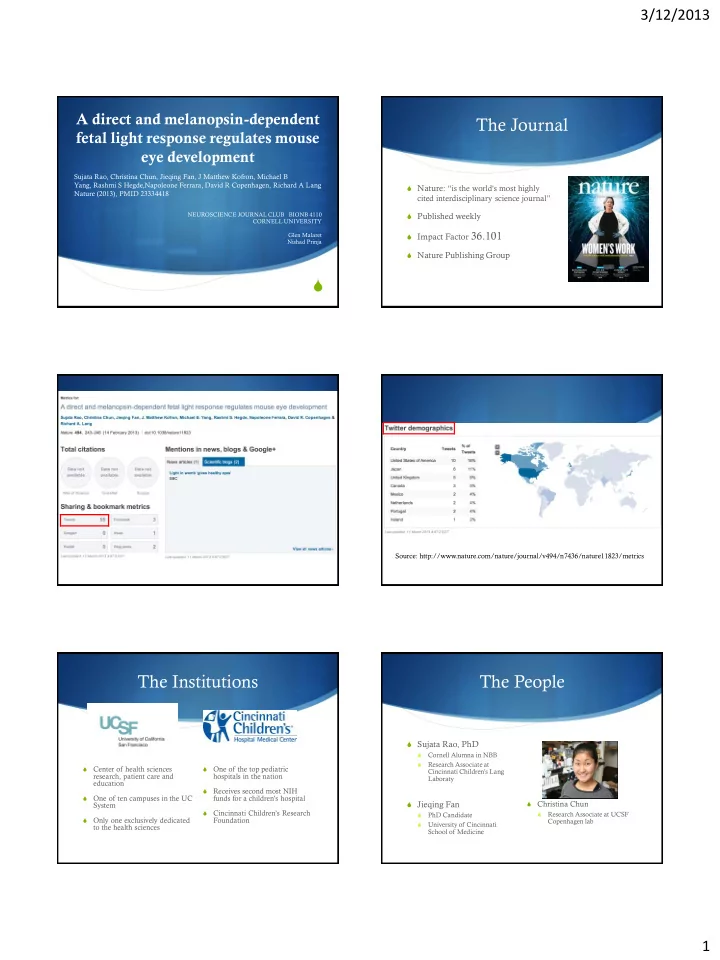
S Nature: “is the world's most highly cited interdisciplinary science journal” S Published weekly S Impact Factor 36.101 S Nature Publishing Group Source: http://www.nature.com/nature/journal/v494/n7436/nature11823/metrics

The Institutions

S Center of health sciences research, patient care and education S One of ten campuses in the UC System S Only one exclusively dedicated to the health sciences S One of the top pediatric hospitals in the nation S Receives second most NIH funds for a children’s hospital S Cincinnati Children’s Research Foundation

The People

S Sujata Rao, PhD

S

Cornell Alumna in NBB

S

Research Associate at Cincinnati Children’s Lang Laboraty

S Jieqing Fan

S

PhD Candidate

S

University of Cincinnati School of Medicine S Christina Chun

S

Research Associate at UCSF Copenhagen lab

slide-2
SLIDE 2

3/12/2013 2

S J. Matthew Kofrom, PhD

S PhD University of Minnesota S Assistant Professor, UC Department of Pediatrics

S Michael B. Yang, MD

S MD Harvard Medical

School

S Associate Professor, UC Department of Ophthalmology

S Rashmi S. Hegde, PhD

S PhD University of

Pittsburgh

S Professor, UC Department

  • f Pediatrics

S Napoleone Ferrara,

MD

S Genetech Fellow S Professor at UC San

Diego School of Medicine

S Credited with identifying

the human VEGF gene S David R. Copenhagen

PhD

S PhD UC Berkley S Professor of Ophthalmology and Physiology at UCSF S Research Supervisor

S Richard A. Lang, PhD

S

PhD University of Melbourne S Director of the Visual Systems Group in Cincinnati Children’s S Professor, UC Department

  • f Pediatrics

S Research Supervisor Special thanks to

  • Dr. Howland for

info & images

slide-3
SLIDE 3

3/12/2013 3

Vitreoretinal findings similar to retinopathy of prematurity in infants with compound heterozygous protein S deficiency ☆Mintz-Hittner, et al. (1999) Ophthalmology Volume 106, Issue 8, 1 August 1999, Pages 1525–1530

Human hyaloid vasculature usually regresses at about 7th month of pregnancy. Here, in a premature human infant the tunical vasculosa lentis surrounds the lens (arrows 1) and is contiguous with the hyaloid vascular system (arrow 2). Notice the glial sheath of the hyaloid artery (arrow 3). From: www.missionforvisionusa.org

Hypothesis|Scope

S Hypothesis A pathway exists – light responsiveness in early retina triggers the clearance of optic axis. S Scope S Investigating – light/dark response, gene expression of Opn4, mRNA coding of VEGFA, mother-pup development template.

Figure S7

Methods: Hyaloid/Retinal Labelling

S Hyaloid Vessels collected and Hoechst stained (Blue Dye) S Flat-mounts were prepared and labeled with antibodies S Vessels were counted in many x200 microscope fields

Methods: Cell Sorting

S Flow Sorting w/ retinal neuron markers S Cells labeled with Goat PDGFR S Cells sorted with FACSAriaII

slide-4
SLIDE 4

3/12/2013 4

Figure 1: Hyaloid regression is regulated by light. Figure 2: Hyaloid regression and retinal angiogenesis are regulated by melanopsin.

Figure S5 Method: Isolation & Analysis of Vitreous

S Eyes washed - Phosphate Buffered Saline (PBS) rinse S Neutral, sterile buffer free of ionic contents S Small slit thru retina – vitreous collected S ELISA performed –Vegfa Quantikine kits S Immunoblots probed – unique VEGFA carboxy-terminal

antibody

Method: RNA isolation & qPCR

S RNA isolated – RNeasy S qPCR performed w. QuantiTect SYBR green S Both agents supplied by Qiagen Labs Inc. S Actin amplified for normalization S qPCR performed w. Vegfa primers –> S 5’ –GACAGAACAAAGCCAGA– 3’ S 5’ –CACCGCCTTGGCTTGTCAC– 3’

Figure 3; a-e

slide-5
SLIDE 5

3/12/2013 5

Method: Assessment of Hypoxia

S Pups inj. w. 180µg pimonidazole HCl (hypoxyprobe) ea. S Hypoxyprobe + rabbit 1º antibody + anti-rabbit 2º Alexa594 S (fluorescent labeling agents) S Pixel intensity S Averaged along line – from retinal center to periphery S 20-25 line intervals per retina, 5-6 retinas per genotype

Figure 3; f-i Methods: Light Measurments

S Controlled for light intensity S Converting wavelengths into units of photons cm-2s-1 S λ=479nm (Blue light) calculated to be 5 𝑦 1013 photons cm-2s-1 S Suns radiant flux density: 2.6 𝑦 1016 photons cm-2s-1 S LED lights were inserted into the mice’s abdominal cavity

Figure S6 Figure 4 Questions?

slide-6
SLIDE 6

3/12/2013 6

Fin Thank you to Dr. Hopkins, Dr. Howland & the members of NSJ Cornell