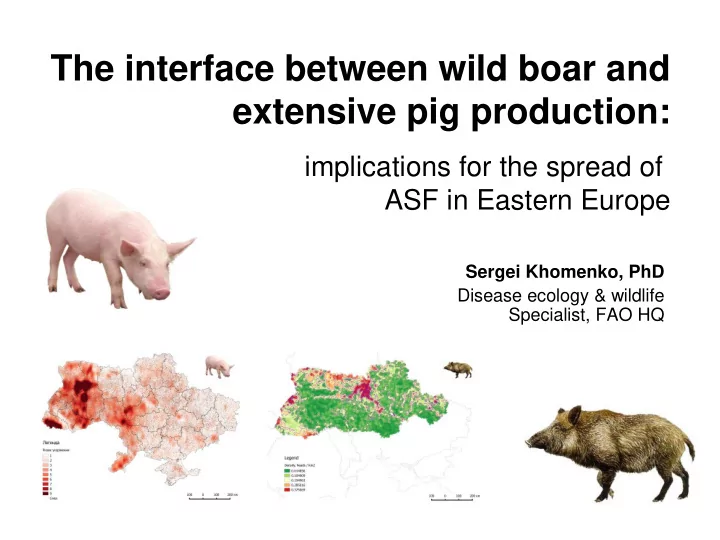
SLIDE 1 The interface between wild boar and extensive pig production:
Sergei Khomenko, PhD Disease ecology & wildlife Specialist, FAO HQ
implications for the spread of ASF in Eastern Europe
SLIDE 2
Epidemiological cycle of ASF in Eastern Europe
SLIDE 3 ASF transmission at the interface
- Disposal of contaminated carcasses
and products scavenged upon by wild boar (very common);
- Direct contacts between domestic
and wild pigs where free range pig breeding exists (rare and localized);
- Environmental contamination and
mechanical transmission with feed &
- ther livestock species sharing habitats
with wildlife or humans attending wild boar habitats (moderately common);
- Hunting wild boar (always highly
selective towards sick animals !) and delivery of contaminated carcasses to the households (occurs increasingly more often)
SLIDE 4 A shift in the seasonality of ASF in wild boar after 2010 towards summer
Bimodal in 2007-2010 Single peak after 2010
Dudnikov et al, 2014
SLIDE 5
In 2012-2014 ASF has shifted to a much higher density area in the RF
SLIDE 6 ASF monthly dynamics All outbreak density, 2007-2014
Spread of ASF in EE SUMMARY
SLIDE 7 Average density in the affected countries
2012
Country heads/km2
Russia
0.08
Ukraine
0.11
Belarus
0.28
Estonia
0.51
Poland
0.73
Lithuania
0.84
Latvia
1.04
SLIDE 8
What is population density ?
1. At country level – just a convenient standardized way to compare relative abundance; 2. At province / district level – compare relative abundance at sub-national level; 3. Real population density (epidemiologically relevant) is the number of animals per unit area of suitable habitats.
3 – is very variable in time and space and difficult to measure in a consistent and comparable way between locations
SLIDE 9 + Clipped =
Population and/or harvest data (2005- 2010) on 504 spatial objects in 48 countries 3,600,000 – post harvest 2-2,500,000 - harvested
Resultant polygons were used to re-calculate average density of wild boar (particularly at the edges of its distribution range) Zero population and 3 outliers with extremely high population density were removed from the dataset
Wild boar population modeling in the N Eurasia
SLIDE 10
- 1. A niche-based deterministic modeling to identify
predictors explaining pattern(s) of wild boar distribution and population density;
- 2. Developing a geostatistical approach to disaggregate
wild boar population data from admin units to 1 or 5 km resolution rasters based on the predictors;
- 3. Produce a set of fine scale geospatial products
describing patterns of suitability / distribution / population density of wild boar on the scale of North Palearctic.
Tasks, approaches and expected geospatial products
SLIDE 11
Results of wild boar range classification into 4 niches 2 1 3 4
SLIDE 12 East European (2) & Southern (3) models :
- nly trends without ATP kriging adjustment
Correct model 2 Correct model 3 “Sympatric” zone
SLIDE 13 Modeled wild boar spring population density in E Europe
> 1.5
R2 for observed versus modeled numbers is 0.95
SLIDE 14 Modeled wild boar spring population density in E Europe and ASF outbreaks in 2013-14
> 1.5
SLIDE 15 Population density and size maps
BELARUS LATVIA
Note that scales are different:
Latvia 0.3 – 2.2 heads / km2 Belarus 0 – 0.9 heads / km2
SLIDE 16 Population density at 5 km resolution and estimates by districts
UKRAINE BELARUS POLAND RUSSIA BELARUS POLAND RUSSIA
SLIDE 17 Population density and estimates at district level
RUSSIA UKRAINE BELARUS POLAND
SLIDE 18 ASF in wild boar and domestic pigs in Ukraine and wild boar density map
BELARUS RUSSIA UKRAINE
KYIV
Railway stations Hunting implicated
SLIDE 19 Quantifying the interface
< BACKYARD PIG DENSITY (0 - 85) < WILD BOAR DENSITY (0 - 0.4)
SLIDE 20 Fine scale backyard pig population mapping
< INTERPOLATED BACKYARD PIG DENSITY < INTERPOLATED EPIUNIT (VILLAGE) DENSITY
SLIDE 21 Applications of the suitability / population density maps
- Population (or sample sizes) estimates for
prevalence surveys or management interventions;
- Risks of wild/domestic interactions, spillover
events;
- Population connectivity / fragmentation –
simulated disease spread;
- Disease modeling in combination with other
spatial variables;
- Retrospective epidemiological studies (e.g. in
Russia and other ASF affected countries);
SLIDE 22 1 2 3 4 5 6 7 8 9 Wild Dom estic
Mortality Fattening Hunting Slaughter Mating pigs Rut
Phases
life cycle
Minimum density Farrowing feeding
Relative popula- tion density
Maximum density
January June December Spring census + (40-100 %)
SLIDE 23 Seasonality patterns may strongly differ from area to area
W Ukraine AR Crimea (no seasonality)
NUMBER OF PIGS IN VILLAGES (n=29000)
40%
SLIDE 24
Environmental factors
Carcasses of domestic pigs and wild boar can survive for months frozen and snow covered and can re-initiate transmission cycle in spring
SLIDE 25 Understanding and managing ASF at the wild/domestic interface
- Currently wild boar / extensive pig production
(backyard) are a UNIQUE epidemiological system with regards to maintaining and propagating ASF infection;
- Disease prevention / control should address
BOTH sectors and anticipate a rather complex interplay of various risk factors that are changing in time and space;
- All the information / strategies / efforts have to
be shared and harmonized across the affected (or at risk countries) and sectors (pig production & wildlife management or forestry) involved.
SLIDE 26 https://sites.google.com/site/stopasfgis/home
Google translate from Ukrainian !
“STOP ASF” - Ukrainian
- nline decision support GIS
SLIDE 27
Simple Google services based decision support systems could be a good common information platform for all countries
SLIDE 28 Advantages of dynamic online GIS:
- 1. Cost effective - does not require commercial software
and expensive training of personnel.
- 2. Expandable, updatable and easily customisable to
accommodate new information (including other species / diseases) in future.
- 3. Adapted to collaborative data submission and
revision from multiple remote computers;
- 4. User friendly and accessible from various internet
connected devices;
- 5. Allows for various levels of access to the data and
information products (e.g. ensure that control of user credentials is possible).
SLIDE 29
Operational ASF control map – Chernigov Oblast, Ukraine
SLIDE 30
A zoom into the dynamic map
SLIDE 31 Way forward with ASF problem, wild boar and wildlife disease issues
- Systematic epidemiological studies on ASF in the affected
countries are badly needed;
- A manual on disease management in wild boar (other
wildlife?) based on the best available knowledge and expertise (EC’s experience with CSF is really valuable);
- Wildlife disease training centre/s (laboratory) needed;
- Country/region specific projects piloting management
approach to disease prevention and control at the livestock / wildlife interface (CSF, ASF, FMD, AI, rabies +)
SLIDE 32 Territoriality and movements
small home ranges (4 km2);
schedules
food availability
Daytime Nighttime Future farrowing area Escaping hunting 1 hour resolution movements of a tracked wild boar saw in Bulgaria
SLIDE 33 January June
Young male dispersal Farrowing Re-unification
groups Movements
and rut Movements to crops & food-rich areas Pre- hunting stock
SLIDE 34 Movement types
- Daily movements of families and boars (<2 km);
- Seasonal feeding raids and congregations (up
to 5-10 km rarely longer);
- Boar movements at rut (25-30 km) and juvenile
male dispersal (sometimes up to 150-200 km);
- Seasonal shift of habitats (in the mountains and
deserts, at the edge of the distribution range);
- Emergency (flood, fire, hunting pressure)
induced movements.
SLIDE 35
THANKS FOR ATTENTION
SLIDE 36 Wild Boar makes only 1.9 % of the susceptible population in the ASF affected and at risk countries
Domestic pigs Wild boar
SLIDE 37 Low biosequrity pigs Wild boar
ASF is likely to endemically persist in domestic pigs in Eastern Europe for a long time (YEARS !) and will expand to the West As ASF progressively expands westwards there is a high risk that it arrives to the areas where wild boar population is extremely high (e.g. up to 10 heads / km2)
SLIDE 38
ASF v CSF in wild boar and LB pigs in 2010-2012
LB PIG DENSITY WILD BOAR DENSITY
SLIDE 39
Duration of freezing conditions