The Impact of Alcohol on Road Crashes Monitoring and Evaluation - - PowerPoint PPT Presentation

the impact of alcohol on road crashes
SMART_READER_LITE
LIVE PREVIEW

The Impact of Alcohol on Road Crashes Monitoring and Evaluation - - PowerPoint PPT Presentation

The Impact of Alcohol on Road Crashes Monitoring and Evaluation Kathleen Elsig 13 November, 2014 1 Why Evaluate? Justify use of resources (human, financial) What is the story you want to tell Identify areas of success people about


slide-1
SLIDE 1

The Impact of Alcohol on Road Crashes

Monitoring and Evaluation

1
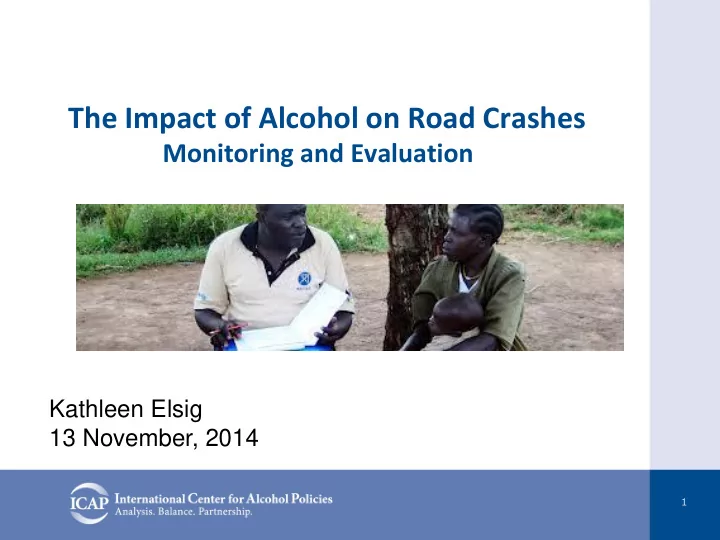
Kathleen Elsig 13 November, 2014

slide-2
SLIDE 2

Why Evaluate?

  • Justify use of resources (human,

financial)

  • Identify areas of success
  • Identify reasons for lack of success
  • Identify progress within the behavior

change process

  • Build better programs in the future
  • Communicate actual outcomes and

progress

2

What is the story you want to tell people about your project?

slide-3
SLIDE 3

M&E and road safety data?

3

M&E activities can provide an excellent «micro» view of the road safety situation

slide-4
SLIDE 4

When to begin thinking about M&E?

  • In the planning stage
  • Link M&E with the objectives of

your activity

  • Be clear on what you want to

achieve, the steps you will take to achieve your objectives, who is the target audience

4

slide-5
SLIDE 5

What do you want to evaluate?

Process

  • Was the activity

was carried out as planned ?

Impact

  • What are the

long-term, deeper changes resulting from the activity?

Outcome

  • What kind of

change has

  • ccurred as a

result of the activity? Process evaluation Impact assessment Outcome evaluation

slide-6
SLIDE 6

Information types and sources

Quantitative information

Responses from surveys Observation studies Enforcement data (pre-program)

Qualitative information

Individual interviews Focus groups

6

50% of respondents know the legal BAC limit befoe and 75% after 75% of drivers were buckled- up before, 85% after 8% of drivers tested were above the legal BAC level before an 2% after Individuals responded enforcement should be strengthened Focus group discussions show young men feel the level of risk for being breath tested is low Collect before, during and after the activity

slide-7
SLIDE 7

Process evaluation

  • Answers the questions
  • Were all planned activities actually implemented?
  • Were activities implemented on time?
  • Were activities implemented within budget?
  • Indicators you can measure
  • Activity milestones (e.g. events, police check-points)
  • Timeline
  • Budget
  • Relatively simple to undertake
slide-8
SLIDE 8

Impact assessment

  • Answers the questions
  • Did the activity achieve the desired impact?
  • What were the impacts of the activity?
  • Indicators you can measure
  • Quantitative and qualitative
  • e.g. nr of drink drive incidents and fatalities
  • e.g. nr. of drivers over the limit
  • More complex to undertake. Requires long-term

commitment for evaluation.

slide-9
SLIDE 9

Outcome evaluation

  • Answers the questions
  • What has changed or is different as a result of the

activity?

  • Indicators you can measure
  • Quantitative and qualitative
  • e.g. improved knowledge, attitudes and perception,
  • e.g. legislative change
  • Relatively simple. Requires short-term

commitment for evaluation.

slide-10
SLIDE 10
  • Randomized controlled trials
  • Before–after study
  • Interrupted time series
  • Qualitative + Quantatative research - focus

groups, interviews, surveys Project plan with timeline, milestones, budget etc

Evaluation – study types for drink drive activities

Process evaluations Impact and

  • utcome

evaluations

slide-11
SLIDE 11
  • Undertaken throughout implementation
  • To understand progress and manage risks
  • Information collected can be qualitative and quantitative
  • Enforcement – hours of activity, number of drink drivers, level over the

legal BAC

  • Communication – audience response, message understanding,

misconceptions, media effectiveness, knowledge of law, etc.

  • Crash and health data – fatality and injury trend, health data
  • Word of Mouth – industry response, patron response, community views,

media commentary, talk back radio

11

A few words about monitoring…

slide-12
SLIDE 12

Septemb er 2008

Possible Objectives Possible Performance Indicators Possible Measurement tools

Reduce the number of deaths, injuries drink- drive crashes Fewer deaths, injuries from crashes involving driver with illegal BAC

  • Police crash data
  • Health sector data

Increase number of drivers prosecuted for drink-driving

  • Number of court cases for

drink-drive

  • Fewer drunk drivers
  • Pre – post campaign

data from justice

  • Increase in (RBT)

Increase action in community to prevent drinking and driving More community drink- drive prevention activities

  • Pre/post campaign survey
  • Increase in number of

community activities

Reduce the number of drivers who are drinking and driving Fewer drivers over the legal BAC limit

  • Police breath test data
  • Health sector data

… by gender, age

Putting it together

slide-13
SLIDE 13

Situation assessmet Planning Implementation + monitoring Evaluation Lessons learned

13

The M&E

slide-14
SLIDE 14

A ‘Practical’ Evaluation

  • Accept that not all things can be controlled
  • Try to control for obvious influences (i.e. don’t measure drink

driving outside licensed premises or major events)

  • Measure before and after program and before and after major

program components (i.e. enforcement periods, publicity phases)

  • Measure after the end of the

activity (e.g. 12 months) to determine longer term impact, performance and to build trend data.

14

slide-15
SLIDE 15

Summary…

  • Plan your evaluation in at the start
  • Program monitoring is vital for success
  • Be practical about what is possible
  • If funds are desperately short spend the money on qualitative

research, especially understanding the target group.

  • Lessons learned can be used to strengthen future activities
  • Anything can be evaluated – workshops, training, conferences,

projects, campaigns etc

  • We can learn important lessons from success and failure

15

slide-16
SLIDE 16

Thank you for your attention www.icap.org

16