
SLIDE 1
you set the focus
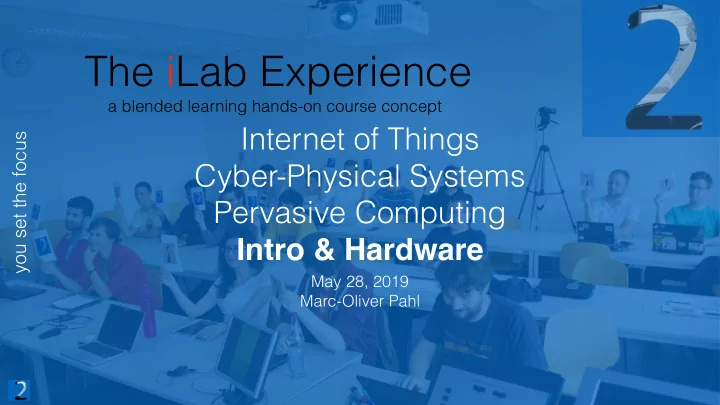
The iLab Experience
a blended learning hands-on course concept
Internet of Things Cyber-Physical Systems Pervasive Computing Intro & Hardware
May 28, 2019 Marc-Oliver Pahl
The iLab Experience a blended learning hands-on course concept - - PowerPoint PPT Presentation
The iLab Experience a blended learning hands-on course concept Internet of Things you set the focus Cyber-Physical Systems Pervasive Computing Intro & Hardware May 28, 2019 Marc-Oliver Pahl Kick Off 04/23 1 IPv6 IPv6 04/30 BGP 2
you set the focus
The iLab Experience
a blended learning hands-on course concept
Internet of Things Cyber-Physical Systems Pervasive Computing Intro & Hardware
May 28, 2019 Marc-Oliver Pahl
1 2 3 4 5 6 7 8 9 11 12 13 WWW IPv6 IoT1 14 Your Exercise BGP
YE 1st Lecture BGP Kick Off IPv6 IoT DIY HW Guest Composition IoT Smart Space SW & Measure VSL Hands-On YE Didactics, Tools Prepare Your Exercise YE Review Presentation YE Final Presentation, Wrap-Up
04/23 04/30 05/07 05/14 05/21 05/28 06/04 (06/11) 06/18 06/25 07/02 (07/09) 07/16
Minilab 1+2+3 Your Exercise Topic Storm (IoT) WWW Security summer term 2019 Giving good Feedback
10
You review Prepare Your Exercise Your Exercise Topic Voting Event
07723
Minis IoT2 Your Exercise YE1
Oral Attestations
Stefan sends mail when it opens. Then: FCFS
We ask what is worth being remembered. We want to make sure you reached our learning goals.
What defines…?
Orchestration Distributed Smart 2pace System
TWO DIY Maker Cultures
DIY Hardware
DIY Software
Arduino DS2OS Smart Device Smart Space App time ?
A computing system that is typically embedded, interfaces its environment via sensors and actuators, and can be remotely managed.
2005
Portable easy-to-program applications that manage smart environments.
8Creating your own IoT Software Apps is difficult. Creating your own IoT Software Apps is easy.
Device Hardware Application Software Internet of Things Cyber-Physical-Systems Ambient Intelligence Smart Space Orchestration Pervasive Computing
http://www.wallsave.com/wallpapers/1024x768/enterprise/86570/enterprise-startrek-voyager-eu-borg-86570.jpg http://sticktwiddlers.com/wp-content/uploads/2011/11/dave-2001-space-odyssey-hal-9000-sad-hill-news.jpg ds2os.org/
Orchestration Distributed Smart 2pace System
A little history of Computing
1960s: IBM 704 1981: IBM 5150
www.digitaltrends.com2010: Apple iPad 2013: Google Nexus 10
www.hyundai-displays.comPublic Touch-Displays
* : 1 1:1 1 : * * : *
Mainframe Personal Computer Mobile Computing Pervasive Computing Ubiquitous Computing
1 2 3
[1]computing center home everywhere at me everywhere at the environment
1
1967
1
1967 1972
1
1967 1972 1988 2012 2003 2008 2010
1 2
1967 1972 1988 2012 2003 2008 2010
[1]1 2 3
ds2os.org/
Orchestration Distributed Smart 2pace System
What makes the implementation of Pervasive Computing difficult?
Vendor S p a t i a l Middleware Functional Technical
Flickr | Rubén Bodewig | https://www.flickr.com/photos/rubodewig/5161937181/ Orchestration Distributed Smart 2pace System
Heterogeneity
Image Source: Prashant Sharma, Microsoft Ventures | https://www.microsoftventures.com/blog/entry/InternetofThings101UnderstandingtheBuildingBlocksoftheConnectedWorld%7C1064 Orchestration Distributed Smart 2pace System
26
Orchestration Distributed Smart 2pace System
27
ds2os.org/
Orchestration Distributed Smart 2pace System
Ubiquitous Computing, Distributed Computing, Mobile Computing, and Pervasive Computing
What is Ubiquitous Computing?
[1]everywhere in everything Level of Embeddedness Level of Mobility
low high high low
Distributed Computing Mobile Computing Pervasive Computing Ubiquitous Computing
ds2os.org/
Orchestration Distributed Smart 2pace System
Virtual Reality, Augmented Reality, and Pervasive Computing
Computing VR AR PerCom
http://www.forbes.com/sites/danielnyegriffiths/2014/05/01/virtual-legality-legal-letters-claim-oculus-vr-made-the-oculus-rift-using-zenimax-ip/ http://glass-apps.org/google-glass http://masspictures.net/google-glass/ http://guardianlv.com/2014/01/google-glass-the-definition-of-live/ http://www.digitaltrends.com/cool-tech/oculus-rift-myo-gesture-control-armband-pure-awesomeness/#!O5sPv Flickr | Plage Vinilos y Adhesivos | https://www.flickr.com/photos/plagevinilosyadhesivosdecorativos/5429084250/ Flickr | O Palsson | https://www.flickr.com/photos/opalsson/4387563218/ Technology Immersiveness Technology Awareness
http://www.forbes.com/sites/danielnyegriffiths/2014/05/01/virtual-legality-legal-letters-claim-oculus-vr-made-the-oculus-rift-using-zenimax-ip/ http://guardianlv.com/2014/01/google-glass-the-definition-of-live/ Flickr | Plage Vinilos y Adhesivos | https://www.flickr.com/photos/plagevinilosyadhesivosdecorativos/5429084250/ Graubünden Tourism 28.6.2015: The Great Escape | Bündner entführen Städter in die Berge
ds2os.org/
Orchestration Distributed Smart 2pace System
DIY - Hardware Creation
Orchestration Distributed Smart 2pace System
Smart Space Orchestration
Physical World Physical World Computer Virtual World Computer
Three parts
autonomous management, …
system.
ds2os.org/
Orchestration Distributed Smart 2pace System
ID card-based Reconfiguration of a Smart Room
40 Profile mop Profile b Profile Standby
The ID cards can be used to configure Smart Environments
Profile Store
41 Profile mop Profile b Profile Standby
ID card Profile Store Profile mop Profile b Profile Standby
The ID cards can be used to configure Smart Environments
alarm ceiling light PC shutters …
42 DIY Hardware
13€ 60€ 10€ 40€
Dave Mellis Tom Igoe Gianluca Martino David Cuartielles Massimo Banzi time 2005 Creating your own hardware is difficult. Creating your own hardware is easy. *HW Maker Culture
46 Orchestration Distributed Smart 2pace System
TWO DIY Maker Cultures
DIY Hardware
DIY Software
Arduino DS2OS Smart Device Smart Space App time ?
A computing system that is typically embedded, interfaces its environment via sensors and actuators, and can be remotely managed.
2005
Portable easy-to-program applications that manage smart environments.
47Creating your own IoT Software Apps is difficult. Creating your own IoT Software Apps is easy.
Orchestration Distributed Smart 2pace System
DIY Hardware
DIY Hardware
DIY Software Arduino DS2OS Smart Device Smart Space App time 2016
ds2os.org/
Orchestration Distributed Smart 2pace System
s2o - hardware
Marc-Oliver Pahl
Orchestration Distributed Smart 2pace System
What is this about?
Smart Devices
A hardware device that can sense and interact with its environment via sensors and actuators, and that can be managed remotely using software is called Smart Device.
Smart Spaces
A physical space that contains smart devices is called Smart Space.
Smart Space Orchestration
Monitoring and controlling (managing) Smart Devices within a Smart Space with software is called Smart Space Orchestration.
Orchestration Distributed Smart 2pace System
Creating Hardware
time 2005 Creating your own hardware is difficult. Creating your own hardware is easy.
Orchestration Distributed Smart 2pace System
Massimo Banzi - one of the creators of Arduino 2012 TED talk
Orchestration Distributed Smart 2pace System
Arduino Video
every field you could imagine”
Orchestration Distributed Smart 2pace System
Do It Yourself (DIY) Hardware
You will experience it in this lab…
Orchestration Distributed Smart 2pace System
Introduction to Electronics
The electrical engineering details will not be part of the exam. Slides by Alexander Güssow
Orchestration Distributed Smart 2pace System
How is a Breadboard cabled?
Agenda
– Voltage and current – Units and parameters – Resistance: Ohms Law and Kirchhoff's Laws – (Light Emitting) Diodes
2
Voltage in practice
DC Voltage
AC Voltage
7
Voltmeters measure static and fluctuating voltages
Source: Fluke 80 Series V User Manual, May 2004 Rev.2, 11/08, page 14 8
Oscilloscopes display time-variant voltage curves
Source: https://www.adafruit.com/products/2145, 18.11.2015
Current
– Charge Flow?
Current is the charge flow rate in a circuit in Coulomb/s.
10
Current in practice
11
Ammeters measure static and fluctuating currents
Source: Fluke 80 Series V User Manual, May 2004 Rev.2, 11/08, page 25 12
Voltage and Current
Measurements
14 Source: https://commons.wikimedia.org/wiki/File:Masc henregel.svg, 19.11.15 Source: Adapted from http://www.elektronik-kompendium.de/sites/grd/0201113.htm, 19.11.15
Common units and parameters
15
Name Symbol SI-Unit Formula Voltage U or u(t) or V V Current I or i(t) A Electric Power P W 𝑄 = 𝑉 ⋅ 𝐽 Electric Energy W Ws, J 𝑋 = 𝑄 ⋅ 𝑢 Electrical resistance R Ohm (Ω) 𝑆 = 𝑉/𝐽
Ohms Law
their value
Resistance
𝑆 = 𝑉 𝐽 Resistor (circuit symbol) Resistor (picture)
Source: Adapted from https://upload.wikimedia.org/wikipedia/commons/d/d7/FourIVcurves.svg, 19.11.15
𝐽(𝑉) = 𝑉 ⋅ 1 𝑆
Resistor Current-Voltage characteristic
Resistor color codes
Source: http://www.digikey.com/- /media/Images/Marketing/Resources/Calcul ators/resistor-color-chart.jpg, 19.11.15 18
Kirchhoffs 1st Law
„The sum of currents into and out of any single node of a network is always zero.“ Pay attention to the direction of the current-arrows:
Kirchhoffs 1st law holds for all nodes in a circuit.
𝑗𝑙
𝑜 𝑙=1
= 0
Source: http://www.elektronik-kompendium.de/sites/grd/0608011.htm, 19.11.2015
𝐽 − 𝐽1 − 𝐽2 − 𝐽3 = 0
Source: https://commons.wikimedia.org/wiki/File:Kirchhoff%27s_Current_Law.svg, 19.11.2015
Kirchhoffs 2nd Law
„The sum of Voltages in any closed loop through a cirquit is always zero.“ Source: http://www.elektronik-kompendium.de/sites/grd/0608011.htm, as of 19.11.2015
𝑉2 + 𝑉1 − 𝑉𝑟1 − 𝑉𝑟2 = 0
Source: https://en.wikipedia.org/wiki/File:Kirshhoff-example.svg, as of 19.11.2015
𝜁1 − 𝑆1 ⋅ 𝑗1
𝑃ℎ𝑛𝑡 𝑀𝑏𝑥
− 𝑆2 ⋅ 𝑗2 = 0 𝜁2 − 𝜁1 − 𝑆2 ⋅ 𝑗2 − 𝑆3 ⋅ 𝑗3 = 0
Resistor superposition
Series circuit 𝑆𝑢𝑝𝑢𝑏𝑚 = 𝑆𝑙
𝑜 𝑙=1
Parallel circuit 𝑆𝑢𝑝𝑢𝑏𝑚 = 1 1 𝑆𝑙
𝑜 𝑙=1
Source: http://www.iris.uni-stuttgart.de/lehre/eggenberger/eti/, Chapter 8, as of 19.11.2015
Voltage divider circuit
Known: U Wanted: R1 and R2 such that U1 and U2 are what we want
𝑉1 = 𝑉 𝑆1 𝑆𝑘
𝑜 𝑘=0
changes U1 and U2
Source: https://commons.wikimedia.org/wiki/File:Einfacher- unbelasteter-Spannungsteiler.svg, as of 19.11.2015
Current divider circuit
Given I, R1 and R2, what are I1 and I2? 𝐽1 = 𝐽 1/ 1/𝑆𝑘
𝑜 𝑘=0
𝑆1
Source: https://commons.wikimedia.org/wiki/File:Stromteiler.svg, as of 19.11.2015
(Light Emitting) Diodes – I-V Diagram
Source: http://electronics.stackexchange.com/questions/76367/accounting-for- led-resistance, as of 19.11.15
LEDs I-V Diagram, Case specs
Source: http://www.electronics.dit.ie/staff/tscarff/DT089_Physical_Computing_1 /LEDS/Leds.htm, as of 19.11.15
How to actually use LEDs
𝐸 = 𝐽𝑇 𝑓
𝑊𝐸 𝑜⋅𝑊𝑈 − 1
𝑛𝑏𝑦
80% 𝐽𝐺
𝑛𝑏𝑦 when the circuit is operating
Resistor-Diode and Diode I-V Diagram
Source: Own work using LTSpice simulation program, IN4148 Diode
Common Sensors
Resistive type
with measure
linear Digital type
conversion on-chip
– PWM (Automotive) – Manufacturer specific protocol – Bus (I2C, CAN, ...)
Microcontroller interfaces
I2C / TWI GND, TCL, SDA Master-Slave-Bus GPIOs PxN, i.e. PB1
29
UART / Serial TIA-232-F GND, Rx, Tx Point-to-Point SPI SCLK, MOSI, MISO, nSS / nCS Master-Slave-Bus Selected Star or Daisy-Chaining
Using Manufacturer Specific Interfaces
– Voltage levels – Timing requirements – Sample comm diagrams
protocol analyzer)
(Embedded) Computer Architecture
Bare metal
– Preemption – Priorities – Cyclic approach – Event driven approach
Operating system
deterministic
– Priority Scheduling – Preemptive Scheduling
known / bounded
Arduino Mega 2560
34
Arduino Hardware Architecture
36
ATmegaX: 8-Bit Harvard RISC
Source(s): https://nishantnath.com/2012/03/23/introduction-to-atmega-microcontrollers/, as of 23.05.16USB/Programmer (ATmega16U2)
ds2os.org/
Orchestration Distributed Smart 2pace System
The DS2OS Solution
Abstraction
Knowledge Agent
Knowledge RepositoryKnowledge Manager
Gateway
Actuator SensorGateway Gateway
subscribe notify get setService UI Service Service Service
subscribe notify get set virtual nodesHeterogeneous Smart Devices Bidirectional Adaptation Context Management Orchestration Workflows, etc. People
Interface DevicesInterface Devices Physical World
Level of Abstraction
Physical World Devices Services Context A VSL-driven Smart Space
Services VSL Overlay Hardware Underlay
Other Services Gateway Services Logical Connectivity Physical Connectivity
Knowledge Agent
Gateway
Advanced ReasoningOrchestration User Interface ...
Actuator SensorDS2OS Site Local Global
CentralModel Repository App StoreP2P search
Summary Today Part I
Computing, and Pervasive Computing
HIWIS