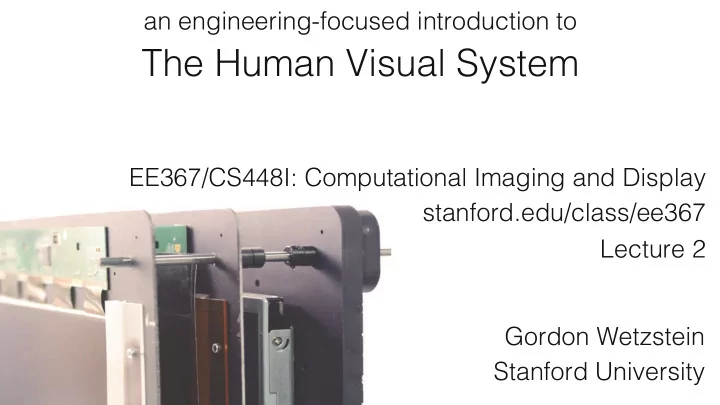
SLIDE 1
The Human Visual System!
Gordon Wetzstein! Stanford University! an engineering-focused introduction to! EE367/CS448I: Computational Imaging and Display! stanford.edu/class/ee367! Lecture 2!
SLIDE 2 nautilus eye, wikipedia!
SLIDE 3 Dawkins, “Climbing Mount Improbable”,! Norton & Company, 1997!
SLIDE 4 reptile eye, http://pichost.me/1608580/!
SLIDE 5 Evolution of the Eye!
wikipedia!
- wl, https://www.pinterest.com/pin/452400725039917330/!
SLIDE 6 pigeon, http://globe-views.com/dreams/pigeon.html!
SLIDE 7 jumping spider, wikipedia!
SLIDE 8 national geographics!
SLIDE 9 Summary of Human Visual System (HVS)
visual acuity: 20/20 is ~1 arc min
field of view: ~190° monocular, ~120° binocular, ~135° vertical
temporal resolution: ~60 Hz (depends on contrast, luminance)
dynamic range: instantaneous 6.5 f-stops, adapt to 46.5 f-stops
color: everything in the CIE xy diagram; distances are linear in CIE Lab
- depth cues in 3D displays
depth cues in 3D displays: vergence, focus, conflicts, (dis)comfort
accommodation range: ~8cm to ∞, degrades with age
SLIDE 10 Overview!
sensors! network! high-level processing! low-level processing! compute!
wikipedia!
SLIDE 11 Overview!
primary visual cortex! ventral stream:! recognition, object identification! dorsal stream: spatial awareness!
wikipedia!
SLIDE 12
The Retina!
SLIDE 13 The Retina!
Roorda & Williams, 1999, Nature!
5 arcmin visual angle!
SLIDE 14
Anatomy of the Human Eye
SLIDE 15 Oculumotor Processes!
near focus! far focus!
adithyakiran.wordpress.com!
16 years: ~8cm to "! 50 years: ~50cm to " (mostly irrelevant)!
SLIDE 16
Oculumotor Processes + Visual Cues
SLIDE 17 Visual Field / Field of View!
monocular visual field!
Ruch & Fulton, 1960!
binocular visual field!
SLIDE 18
Immersive VR – How Important is the FOV?!
SLIDE 19 Visual Acuity!
characters are 5 arc min, need to resolve 1 arc min to read!
Snellen chart!
SLIDE 20 Retina Displays!
Apple Inc.! d! p=??! eye! #! p=2d tan(#/2)!
Steve Jobs: 300 dpi is retina resolution!
p=2*12”*tan(1 arc min /2)=0.0035”!
tablet, 12” away,! resolvable pixel:!
- ur math: ~573 dpi (Shannon!)
!
SLIDE 21
Dynamic Range!
SLIDE 22
High Dynamic Range Displays!
SLIDE 23
Refractive Errors!
SLIDE 24
300 dpi or higher!
Vision-Correcting Displays!
SLIDE 25 Eye vs Camera!
wikipedia! [Williams 91]!
SLIDE 26 Contrast!
Which image has a higher contrast? What is contrast?! global vs. local, Weber contrast: Michelson contrast:!
I ! I
SLIDE 27 Contrast Sensitivity Function!
peak at ~4-6 cpd! spatial frequency! contrast!
Campbell & Robson, 1968; Daly, 1993!
shifts depending on viewing distance! packing density of cones ~60 cpd!
SLIDE 28 Hybrid Images!
Oliva, Torralba, & Schyns, 2006, ACM SIGGRAPH!
SLIDE 29 Hybrid Images
Oliva, Torralba, & Schyns, 2006, ACM SIGGRAPH
SLIDE 30
Color Perception!
SLIDE 31 Sensitivity of Cones!
reddit.com!
SLIDE 32 CIE XYZ Color Space!
wikipedia!
CIE xy chromaticity diagram!
SLIDE 33 Display Gamut!
SmallHD!
my gamut – how did I do that?
SLIDE 34 CIE XYZ – Distances are Nonlinear!
MacAdam ellipses!
wikipedia!
SLIDE 35
CIE LAB Color Space!
lightness! color-opponent pairs!
SLIDE 36 CIE LAB Color Space!
https://www.colorcodehex.com/color-model.html!
SLIDE 37 Depth Perception!
wikipedia!
SLIDE 38 Depth Perception!
mo ues!
perspective!
relative object size!
absolute size!
accommodation!
retinal blur!
motion parallax!
texture gradients!
shading!
…!
wikipedia!
binocular cues!
(con)vergence!
disparity / parallax!
…! !
SLIDE 39 binocular disparity! motion parallax! accommodation/blur! convergence! current glasses-based (stereoscopic) displays! near-term: light field displays! longer-term: holographic displays!
Depth Perception!
SLIDE 40 Depth Perception!
Cutting & Vishton, 1995!
SLIDE 41 Visual Illusions – Perspective, Occlusion, Size!
M.C. Escher!
SLIDE 42
SLIDE 43 Visual Illusions – Which Cues are These?
Held et al., 2006, ACM SIGGRAPH
SLIDE 44 Walker, Lewis E., 1865. Hon. Abraham Lincoln, President of the United States. Library of Congress! Charles Wheatstone., 1841. Stereoscope.!
Stereoscopic Displays!
SLIDE 45
Stereoscopic Displays
SLIDE 46
Stereoscopic Displays!
Charles Wheatstone 1838! stereoscopic displays! 176 years later!
SLIDE 47 A Brief History of Virtual Reality!
1838! 1968! 2012-2015!
Stereoscopes!
Wheatstone, Brewster, …!
VR, AR, !
Ivan Sutherland!
VR explosion!
Oculus, Sony, Valve, MS, …!
Next-generation VR Displays!
SLIDE 48 Vergence-Accommodation Conflict!
Marty Banks, UC Berkeley!
effects!
visual discomfort!
visual fatigue!
nausea!
diplopic vision!
eyestrain!
compromised image quality!
pathologies in developing visual system!
…!
SLIDE 49
Top View! Real World:! ! Vergence & Accommodation Match!
SLIDE 50
Top View! Stereo Displays Today:! ! Vergence-Accommodation Mismatch!! Screen!
SLIDE 51 Zone of Comfort!
Shibata et al, 2011, Journal of Vision!
SLIDE 52 The Light Field Stereoscope!
www.computationalimaging.org!
Technical Paper! & E-Tech Demo!
with NVIDIA Research! ! ACM SIGGRAPH 2015!
SLIDE 53 Summary
visual acuity: 20/20 is ~1 arc min
field of view: ~190° monocular, ~120° binocular, ~135° vertical
temporal resolution: ~60 Hz (depends on contrast, luminance)
dynamic range: instantaneous 6.5 f-stops, adapt to 46.5 f-stops
color: everything in the CIE xy diagram; distances are linear in CIE Lab
- depth cues in 3D displays
depth cues in 3D displays: vergence, focus, conflicts, (dis)comfort
accommodation range: ~8cm to ∞, degrades with age
SLIDE 54 Homework I!
wikipedia!
take a step back in evolution!
build a pinhole camera!
capture photos with it!
read instructions carefully!!
SLIDE 55
light! leakage!
Homework I – Build a Pinhole Camera!
digital camera! blocked optical path!
SLIDE 56 Next: Digital Photography I!
aperture!
depth of field!
field of view!
noise!
sensors!
color filter arrays!
SLIDE 57 References and Further Reading
interesting textbooks on perception:
- Wandell, “Foundations of Vision”, Sinauer Associates,1995
- Howard, “Perceiving in Depth”, Oxford University Press, 2012
depth cues and more:
- Cutting & Vishton,” Perceiving layout and knowing distances: The interaction, relative potency, and contextual use of different information about depth”, Epstein and Rogers
(Eds.), Perception of space and motion, 1995
- Held, Cooper, O’Brien, Banks, “Using Blur to Affect Perceived Distance and Size”, ACM Transactions on Graphics, 2010
- Hoffman and Banks, “Focus information is used to interpret binocular images”. Journal of Vision 10, 2010
- Hoffman, Girshick, Akeley, and Banks, “Vergence-accommodation conflicts hinder visual performance and cause visual fatigue”. Journal of Vision 8, 2008
- Huang, Chen, Wetzstein, “The Light Field Stereoscope”, ACM SIGGRAPH 2015
the retina and visual acuity:
- Roorda, Williams, “The arrangement of the three cone classes in the living human eye”, Nature, Vol 397, 1999
- Snellen chart: https://en.wikipedia.org/wiki/Snellen_chart
the visual field:
- Ruch and Fulton, Medical physiology and biophysics, 1960
- contrast sensitivity function & hybrid images:
- Oliva, Torralba, Schyns, “Hybrid Images”, ACM Transactions on Graphics (SIGGRAPH), 2006
Oliva, Torralba, Schyns, “Hybrid Images”, ACM Transactions on Graphics (SIGGRAPH), 2006
- Spatio-temporal CSF: Kelly, Motion and Vision. II. Stabilized spatio-temporal threshold surface, Journal of the Optical Society of America,1979
- Mantiuk, Kim, Rempel, Heidrich, “HDR-VDP-2: A calibrated visual metric for visibility and quality predictions in all luminance conditions”, SIGGRAPH 2011