The grass isnt always greener on the other side: Indigenous - - PowerPoint PPT Presentation

the grass isn t always greener on the
SMART_READER_LITE
LIVE PREVIEW

The grass isnt always greener on the other side: Indigenous - - PowerPoint PPT Presentation

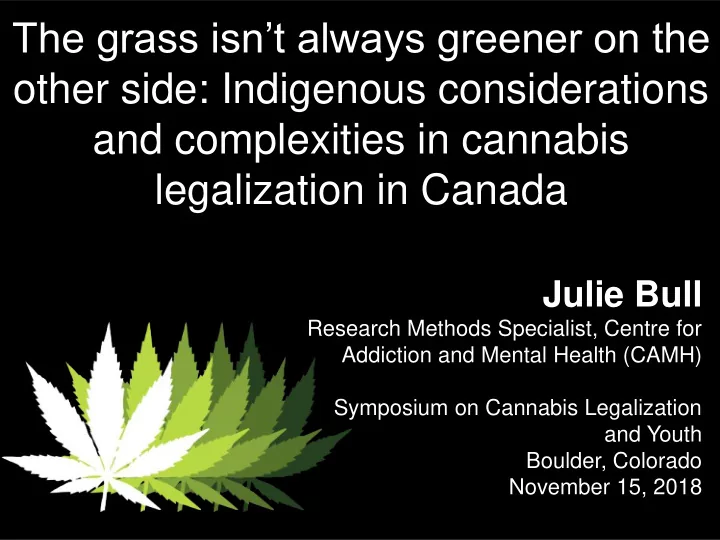
The grass isnt always greener on the other side: Indigenous considerations and complexities in cannabis legalization in Canada Julie Bull Research Methods Specialist, Centre for Addiction and Mental Health (CAMH) Symposium on Cannabis


slide-1
SLIDE 1

The grass isn’t always greener on the

  • ther side: Indigenous considerations

and complexities in cannabis legalization in Canada

Julie Bull

Research Methods Specialist, Centre for Addiction and Mental Health (CAMH) Symposium on Cannabis Legalization and Youth Boulder, Colorado November 15, 2018

slide-2
SLIDE 2

I acknowledge that the land on which we gather was first the home of Native Americans, primarily the Southern Arapaho tribe, who maintained a village near Haystack Mountain. Utes, Cheyennes, Comanches, and Sioux were occasional visitors to the area.

slide-3
SLIDE 3
slide-4
SLIDE 4
slide-5
SLIDE 5

First Nations, Inuit, and Métis are RIGHTS holders, not stake holders

slide-6
SLIDE 6
slide-7
SLIDE 7

Indigenous Peoples have the right to self-determination. By virtue of that right they freely determine their political status and freely pursue their economic, social and cultural development.

Article 3

slide-8
SLIDE 8

2015

slide-9
SLIDE 9

MULTI-JURISDICTIONAL RESPONSES TO FEDERAL CANNABIS LEGALIZATION

Main Objectives and Scope: Build research infrastructure that will facilitate a comparative case study analysis of provincial and community planned responses to cannabis legalization

  • Policy stakeholders in BC, AB, ON, QC and within each region

leaders and members of First Nations, Inuit, and Métis communities and African Canadian, South Asian, East Asian, and Latino communities Translate and disseminate findings that are usable and accessible for all research team collaborators, the wider public, and communities Establish a cross-jurisdictional collaborative team

  • Develop expanded partnerships and funding proposals
slide-10
SLIDE 10

MULTI-JURISDICTIONAL RESPONSES TO FEDERAL CANNABIS LEGALIZATION

Methods: Policy document collection and review

  • Emphasizing relevant policy documents from each jurisdiction to support

understanding of important and dynamic contextual factors surrounding the implementation of distinct sub-federal cannabis regulatory systems Focus groups

  • Members of participating Indigenous and racialized communities

Semi-structured one-to-one interviews

  • May include members of Indigenous and racialized communities who

prefer to be interviewed, Medical Officers of Health, health authority

  • fficials, NGO executive directors, community organization managers,

municipal officials, local police chiefs, and other policy and public health service authorities

slide-11
SLIDE 11

MULTI-JURISDICTIONAL RESPONSES TO FEDERAL CANNABIS LEGALIZATION

Team (alphabetical order after the Co-PIs):

Sergio Rueda, CAMH (Co-PI) Elaine Hyshka, U of Alberta (Co-PI) Thomas G. Brown, McGill Neil Boyd, Simon Fraser U Julie Bull, CAMH Tara Elton-Marshall, CAMH Benedikt Fischer, CAMH Julie George, CAMH Akwatu Khenti, CAMH Rick Linden, U of Manitoba Renee Linklater, CAMH Robert E. Mann, CAMH M-J Milloy, UBC Marie Claude Ouimet, U Sherbrooke Akwasi Osuwu-Bempah, U of T Margaret Robinson, Dalhousie Tara Marie Watson, CAMH Samantha Wells, CAMH

slide-12
SLIDE 12
slide-13
SLIDE 13
slide-14
SLIDE 14
slide-15
SLIDE 15
slide-16
SLIDE 16
slide-17
SLIDE 17
slide-18
SLIDE 18
slide-19
SLIDE 19
slide-20
SLIDE 20
slide-21
SLIDE 21
slide-22
SLIDE 22
slide-23
SLIDE 23
slide-24
SLIDE 24
slide-25
SLIDE 25
slide-26
SLIDE 26

“Nothing about us without us”

slide-27
SLIDE 27

Nakummek – Miigwech – Thank you – Merci

Julie.Bull@camh.ca