The GOLEM Project Automatic Fabrication Results Marcin Pilat - - PDF document

the golem project
SMART_READER_LITE
LIVE PREVIEW

The GOLEM Project Automatic Fabrication Results Marcin Pilat - - PDF document

Contents Evolutionary Robotics Project Introduction Evolutionary Design Simulator The GOLEM Project Automatic Fabrication Results Marcin Pilat Further Research Conclusions Evolutionary Robotics GOLEM Project


slide-1
SLIDE 1

The GOLEM Project

Marcin Pilat

Contents

  • Evolutionary Robotics
  • Project Introduction
  • Evolutionary Design
  • Simulator
  • Automatic Fabrication
  • Results
  • Further Research
  • Conclusions

Evolutionary Robotics

  • Robotics:
  • Design/manufacture/programming of machines
  • Standard Robotics:
  • Human design
  • Human programming
  • Evolutionary Robotics:
  • Full autonomy in design
  • Self-programming
  • Self-manufactured

GOLEM Project

  • Name: Genetically Organized Lifelike Electro

Mechanics (GOLEM)

  • Creators: Hod Lipson (Cornell), Jordan B.

Pollack (Brandeis)

  • Goal: automatic design and manufacture of

robotic lifeforms

  • Results: First instance of automatic design and

manufacture of robots

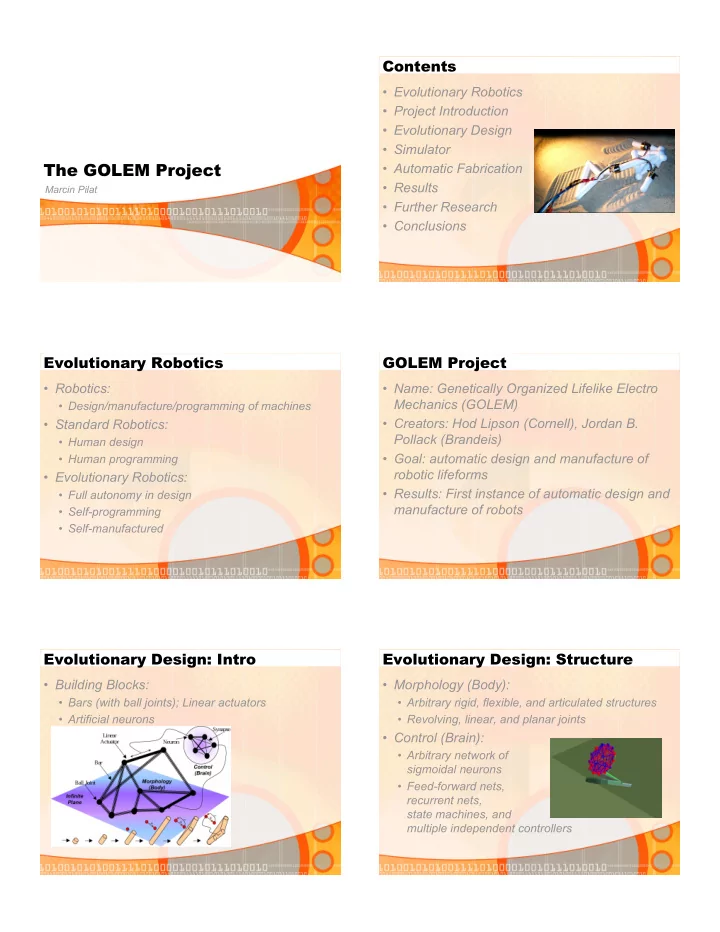
Evolutionary Design: Intro

  • Building Blocks:
  • Bars (with ball joints); Linear actuators
  • Artificial neurons

Evolutionary Design: Structure

  • Morphology (Body):
  • Arbitrary rigid, flexible, and articulated structures
  • Revolving, linear, and planar joints
  • Control (Brain):
  • Arbitrary network of

sigmoidal neurons

  • Feed-forward nets,

recurrent nets, state machines, and multiple independent controllers

slide-2
SLIDE 2

Evolutionary Design: Evolution

  • Based on ES and EP
  • Generations: 300-600
  • Population: 200 individuals (steady-state)
  • Initially null individuals (no bars/actuators/neurons)
  • Selection: Fitness-proportionate
  • Replacement: random
  • Genetic Operators: mutations
  • Fitness: net Euclidean distance moved over

12 cycles of neural control

Evolutionary Design: Mutations

  • Mutation types (probabilities):
  • removal/addition of bar (0.01)
  • removal/addition of unconnected neuron (0.01)
  • change in length of bar (0.1)
  • change in neuron synaptic weight (0.1)
  • split vertex with separating bar (0.03)
  • split bar by a vertex (0.03)
  • attach/detach neuron to bar (0.03)
  • At least one mutation applied

Simulator

  • Mechanics and neural control simulated

concurrently

  • Mechanics:
  • quasi-static motion (each frame statically stable)
  • relaxation (minimize energy term)
  • static friction and noise
  • Neural Net:
  • Discrete cycles
  • Actuator length in increments 1cm

Automatic Fabrication: Printing

  • Rapid-prototyping technology (“3D Printing”)
  • Point model converted to solid model
  • Built with layered thermoplastic material:
  • Complex joints:
  • Can be melted and recycled

Automatic Fabrication: Assembly

  • Evolved neural controller

downloaded into PIC microcontroller:

  • Linear actuators connected

in proper places

  • Robot is ready to be used:

Results: Overview

  • Different and elaborate solutions evolved
  • Typically around 20 building blocks
  • Some developed symmetry
  • Typically 10s of generations passed before

initial movement

  • Typical evolution:
slide-3
SLIDE 3

Results: Evolutionary Patterns

extreme divergence intermediate divergence extreme convergence massive extinction

Results: Population

  • Snake

family:

Results: Fitness

  • Plots of individual fitness over generations:
  • 1) progress in noticeable jumps
  • 2) progress rate slows down as fitness

improves

Results: Robot Examples 1

  • Arrow:

Results: Robot Examples 2

  • Tetra:

Results: Robot Examples 3

  • Ratchet:
slide-4
SLIDE 4

Results: Robot Examples 4

  • Snake:
  • Biped:

Results: Robot Examples 5

  • Crab:
  • Balance:

Results: Robot Examples 6

  • Complex1:
  • Complex2:

Further Research

  • Study very large populations with more CPU

power [Golem@home]

  • Inclusion of more sophisticated training

environment, sensors, robot interactions

  • Discover and reuse modules
  • How can more complex modular structures

self-organize?

Conclusions

  • Demonstrated:
  • automatic manufacturing of automatically designed

electromechanical systems

  • with minimum human interaction

GOLEM

  • Thank You
  • All images and videos from GOLEM website at:

http://demo.cs.brandeis.edu/golem/