SLIDE 1 4/23/2014 1
The Role of the CEO and the Role of the Administrator are Naturally in Conflict
……………………………………………………………………………………………………………………………………………………………………………
Close the Leadership Gap and Create Alignment Among Management
Robin Brogdon, MA • President, BluePrints April 30, 2014
Asheville, NC
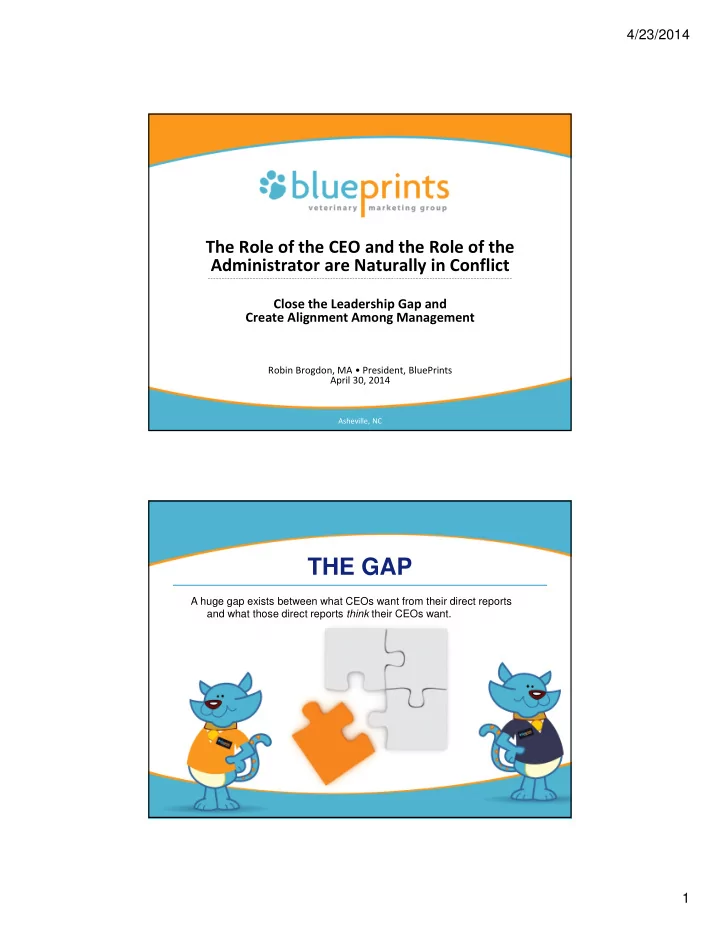
THE GAP
A huge gap exists between what CEOs want from their direct reports and what those direct reports think their CEOs want.
SLIDE 2 4/23/2014 2
IT’S A WIRING PROBLEM
Entrepreneur vs. Administrator FUTURE PRESENT
There are Six Essential Roles
What is most important?
- Vision?
- Strategic thinking?
- The ability to build client relationships and
close the deal? It must be part of your job.
SLIDE 3 4/23/2014 3
There are Six Essential Roles
What if your CEO is not an entrepreneur? The Administrator’s job just got a lot harder because you must teach them to think like one.
1 - Strategist
This function sets the future direction of your practice.
SLIDE 4
4/23/2014 4
2 - Ambassador
Meet with your important clients. Get to know each other.
3 - Inventor
Find your clients’ pain and develop new services to relieve it.
SLIDE 5
4/23/2014 5
4 - Coach
Become a teacher, coach and mentor.
5 - Investor
Treat your practice as an investment.
SLIDE 6 4/23/2014 6
6 - Student
Stay active in professional development, not just in your area of expertise.
Staying Focused
How much time should it take?
- Whose job is it?
- Priority list
- Personal mission statement
- CEO success profile
- Have a written job
description!
SLIDE 7 4/23/2014 7
The CEO challenge:
Alignment with your direct reports.
Of all the resources available, leading and leveraging people to work together is the most difficult.
There are Six Essential Roles
What is most important? Understand your role in the company beyond your functional skills and abilities.
SLIDE 8 4/23/2014 8
1 – Co-Strategist
Help the CEO chart the practice’s future course.
2 – Team Leader
Exert leadership throughout the
SLIDE 9
4/23/2014 9
3 – Local Expert
Become world-class in your area of expertise.
4 – Champion of Change
Help implement change throughout the practice.
SLIDE 10
4/23/2014 10
5 – Role Model
Live the vision, mission and values.
6 - Student
Commit to ongoing personal and professional development.
SLIDE 11 4/23/2014 11
A Wiring Problem
Most entrepreneurs are hard-wired very differently than their direct reports.
- Unrealistic expectations
- Friction in the relationship
- They just don’t get it
The Solution
Two-fold
- Future vs. present
- An alliance must be met
SLIDE 12 4/23/2014 12
Closing the Gap
The company needs both points of view.
- Recognize everyone’s role
Once a Month
- The CEO’s short and long-term expectations for the person
and for the position
- Developmental goals and objectives for the manager
- Any coaching, help, resources, etc. the manager needs to get
the job done
Don’t sit back – ASK!
SLIDE 13 4/23/2014 13
Five Ways to Add Value to the Practice as an Administrator
- 1. Manage your time effectively.
- 2. Self-review.
- 3. Advocate for your area of expertise.
- 4. Be a strong team player.
- 5. Manage the relationship with your CEO.
Succeed as Second in Command
- 1. Know the CEO’s vision for the practice.
- 2. Help your CEO find his role within the vision.
- 3. Help your CEO do the right thing.
- 4. Define your role as the CEO sees it with clarity.
- 5. Know your own management styles.
- 6. Establish a formal method of communication.
- 7. Get feedback on your performance.
- 8. Redefine the organization structure as needed.
SLIDE 14 4/23/2014 14
Enhance Your Ability to Survive and Thrive as #2
- 1. Define the practice objectives and manage accordingly.
- 2. Identify the CEO’s role and assist him/her.
- 3. Keep the CEO informed. Bad news is ok as long as it is
not a surprise.
- 4. Hold to your meeting schedules.
- 5. Stretch your authority.
- 6. Put yourself in your CEO’s shoes occasionally.
- 7. Accomplish the business objectives you have set.
Above all, manage the relationship with the CEO.
Five Fatal Flaws of Management
FLAW #1
Unclear and Inconsistent Communication
Five ways to DELIVER A BETTER MESSAGE:
- 1. Know your objective
- 2. Be clear, specific and concise
- 3. State your point in 25 words or less
- 4. Check for understanding
- 5. Watch your body language
SLIDE 15 4/23/2014 15 Five ways to be a better LISTENER:
- 1. Eliminate distractions
- 2. Get rid of excess paper to reduce distractions at your desk
- 3. Know your blind spots (assumptions and prejudices)
- 4. Be an active listener. Paraphrase, ask questions
- 5. Be an empathic listener. Listen for "context clues" within
the message
Five Fatal Flaws of Management
FLAW #1
Unclear and Inconsistent Communication
- 1. Emotion (fear of the unknown, anger, uncertainty, mistrust)
- 2. Perception (don't see the need for change)
- 3. Attitude (belief that most changes aren't for the better)
- 4. Reluctance (adopting a wait-and-see attitude)
Five Fatal Flaws of Management
FLAW #2
Failure to acknowledge change
SLIDE 16 4/23/2014 16 The Change Message Model
- 1. State the change -- Be clear, concise, truthful
- 2. Payoff -- why the change?
- 3. Support -- how are we going to get there?
- 4. Optimism -- be positive about the future
Five Fatal Flaws of Management
FLAW #2
Failure to acknowledge change
Five Fatal Flaws of Management
FLAW #3
Managing everyone alike
SLIDE 17 4/23/2014 17 Development Coaching
- Strengths
- Next Goals
- Assistance
- Professional Development
Five Fatal Flaws of Management
FLAW #3
Managing everyone alike
- Make sure all tasks are clear and understood
- At the beginning of the year, establish each individual's
performance appraisal criteria
- Establish a contract with difficult employees to ensure success
- Create smaller and achievable incremental goals that are measured
- n a monthly and quarterly basis
- Provide variety in the scope of work
- Form a sponsor or mentor program
- Create individual development plans
- Establish a quarterly review process for your team
Five Fatal Flaws of Management
FLAW #4
Failure to establish clear expectations
SLIDE 18 4/23/2014 18
- Know what you want from your time
- Set SMART (Specific, Measurable, Attainable, Rewarding
and Timely) goals
- Learn the difference between "urgent" and "important"
- Know and respect your priorities
- Plan your actions for achieving your goals
- Schedule time for your tasks
- Know how you spend your time
- Analyze time-wasters
Five Fatal Flaws of Management
FLAW #5
Poor time management
CEO Best Practices Executive Communications
Communicating Change
- What are the reasons behind our proposed change?
- What are our goals?
- Who does the change affect?
- What are the likely repercussions of change throughout the
- rganization?
- How will we all benefit from change?
The goal is always reducing ambiguity and uncertainty.
"A chief executive needs to make change personal because it's personal to the people who are being asked to change." Paul Batz
SLIDE 19 4/23/2014 19
Strategic Communications
- Significant news
- Emotional circumstances
- Influence and persuasion
When is face-to-face communication appropriate?
Communicating the Vision
- Make sure all employees are aware of the vision
- Reassure stakeholders that the proposed change is justified,
properly managed and moving forward
- Praise individual contributions that boost progress
- Address and resolve any problems that occur
- Keep people informed as change progresses through the
- rganization
SLIDE 20
4/23/2014 20
Talking to (and with) Employees
Eliminate bureaucracy
Overcoming Communication Barriers
It’s a two way street.
SLIDE 21
4/23/2014 21
As a leader, you get what you tolerate.
Get Real With Yourself