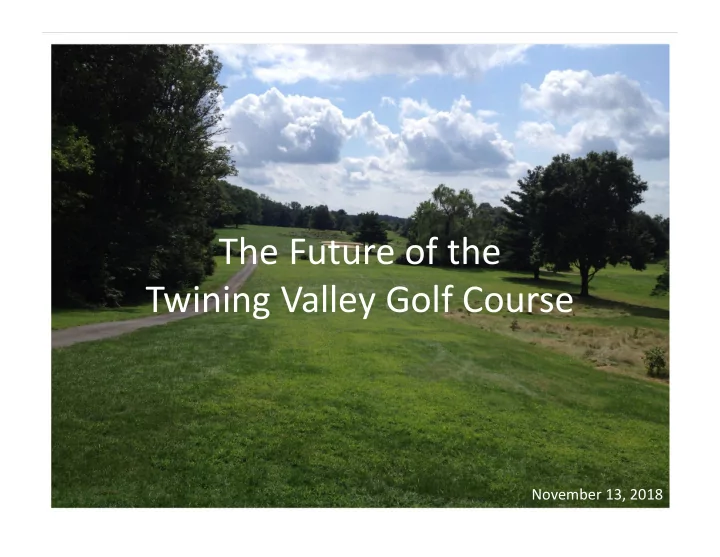
SLIDE 1 The Future of the Twining Valley Golf Course
November 13, 2018
SLIDE 2 Burn Brae Fire House Club House Fairview Cemetery Fire Training Grounds 87 Acres 18 Acres
SLIDE 3 Property Background
- 105 acres (split into 87 and 18 acre parcels)
- Includes Golf Course, Clubhouse, Burn Brae
Firehouse & Fire Training Grounds
- Previously Burn Brae Golf Course
- Township began acquiring land in 1963
- Last parcel (pool) acquired in 1981
- Township ran golf operations until 1981
- Contracted with Links Management, Inc.
- Lease expires on November 30, 2019
SLIDE 4
- 40% of UD households play golf*
- 49% play 1‐10 rounds per year*
- 22% play 20‐49 rounds per year*
- 16% of UD households have played at UD/TV*
- 30% play at other public courses, 22% play at private
courses*
- 20,000 annual rounds reportedly played at UD/TV
- Top reasons UD golfers play at UD/TV:
- Location (82%), Cost of fees (71%), Tee times (50%)*
- Top reasons UD golfers do not play at UD/TV:
- Conditions (57%), Design (32%), Aesthetics (31%)*
*2015 Feasibility Study
Golf Play in Upper Dublin
SLIDE 5 Fitness Center Use in Upper Dublin
- 60% of UD households go to a fitness center*
- 5% of UD households have used UDFC*
- Top reasons UD households use UDFC:
- Location (78%), Cost (62%), Equipment (35%)*
- Top reasons UD households do not use UDFC:
- Member elsewhere (62%), Cost (14%), Equipment
(13%)*
*2015 Feasibility Study
SLIDE 6 What is Important to UD Residents?
- Trails
- Preservation of Open Space
- Access to Open Space – Connection w/ nature
- Remain Tax Conscious
SLIDE 7 2005 to Present Parks & Open Space in UD
- Open Space Plan (2005)
- Open Space Referendum (2006 & 2008)
- Golf Course/Fitness Center Feasibility Study
(2015)
- Overwhelming public participation
- Study recommended conversion
- Parks & Recreation Use Survey (2016)
- Similar feedback to 2015 Feasibility Study
SLIDE 8
2015 Feasibility Study Master Plan
SLIDE 9 Options for Property
- Under new contract terms, continue to lease
building and course to third party vendor
- Sell the majority of the property
- Project 70 land sale restrictions
- Sell a portion of the property and convert the
remainder of the property to accessible open space
- Convert the entire property to accessible open
space/park and retain the building for rental
SLIDE 10 Why Convert the Property?
- Resident access
- Opportunities for trails
- Long‐term open space preservation
- Offer new active and passive recreation opportunities
- Create functional habitats – forest, meadow, wetlands
- Provide more opportunities for residents to connect
with nature
- 39% use UD parks to enjoy/explore nature (2016 survey)
- Studies indicate improved health with exposure to nature
- 87% of UD households have visited a UD park in the
last year (2016 survey)
SLIDE 11 What Do Residents Gain?
- Upon transfer of management, UD residents
immediately gain:
- Access to 18% of Township‐owned open space –
single largest Township‐owned parcel
- Opportunities for outdoor exploration –
hiking/walking, birding, relaxation
- A place to: exercise, picnic, drone use, kites,
sledding (in designated area), cross‐country skiing, snow‐shoeing, leashed dog access, etc.
- Additional space for stormwater management
SLIDE 12 Conversion Priorities
- Updated proposal encompasses:
– Combination of high ranking items identified during the feasibility study process (2015) – Community needs determined from the UD Parks & Recreation Use Survey (2016) – Emerging trends – Missing elements within our existing park system
- Maintain reduced capital budget expenses
- Design for minimal maintenance
SLIDE 13 Conversion Priorities 1 to 4
Complete in 2020*
Building an Infrastructure
- 1. Reuse/Rental of Clubhouse & Fitness Center
- 2. Reuse existing storage facility
- 3. Construct 2‐mile macadam trail loop and
connections to neighborhood sidewalks
- 4. Construct a 75 to 100 person pavilion
*Year(s) could vary based on funding
SLIDE 14
Priority 1 – Reuse of Clubhouse
SLIDE 15 Priority 1 – Reuse of Clubhouse
- Building is 13,060 ft2
- Over $100,000 invested since ‘09
- Source of revenue
- $60,000 per year generated in rent
- 10,000 ft2 x $.50
- Would require some tax payments to UDSD & County
- Tenant would be responsible for basic upkeep and
capital improvements
- Possible continued use of fitness facility
SLIDE 16
Priority 2 – Reuse of Storage Facility
SLIDE 17 Priority 2 – Reuse of Storage Facility
- Temporarily replaces facility Township is
currently renting
- Golf course facility is 3,456 ft2 – renting 1,600 ft2
- Operational budget savings – no rent
- $21,000+ per year
SLIDE 18
Priority 3 – Trail Loop
SLIDE 19 Priority 3 –Trail Loop
- 2‐mile, 16’ wide macadam trail
- Would include shorter loops and connector trails
- Alternative to Mondauk Common
- Connections to neighborhood sidewalks
- Potential operational revenue
- $4,000 to $6,000 per year – trail rentals
- $250,000* – Estimated approximate cost
*If Township staff completed the work.
SLIDE 20
Priority 4 – Pavilion
SLIDE 21 Priority 4 – Pavilion
- Would be equipped for 75 to 100 people
- Alternative to Mondauk Common
– Overflow for April to August & Saturdays in Fall
- Restrooms attached
- UDP&R program/event location
- Potential operational revenue
- $3,500 per year – pavilion rentals
- $300,000 – Estimated approximate cost
SLIDE 22 Conversion Priorities 5 to 8
Complete in 2021*
Expanding Opportunities
- 5. Expansion of parking lot
- 6. Develop single track/off‐road trails
- 7. Construct playscape/nature‐based
playground
- 8. Construct graduated bike park
*Year(s) could vary based on funding
SLIDE 23
Priority 5 – Expansion of Parking Lot
SLIDE 24 Priority 5 – Expansion of Parking Lot
- Expansion of 90 spaces to 200+ spaces
- $150,000* – Estimated approximate cost
Would consider 100 additional pervious spaces for special events *If Township staff completed the work.
SLIDE 25
Priority 6 – Single Track/Off‐Road Trails
SLIDE 26
Priority 6 – Single Track/Off‐Road Trails
SLIDE 27 Priority 6 – Single Track/Off‐Road Trails
- Develop 4+ miles of single track/off‐road trails
- 18” to 30” wide for off‐road/mountain biking
- Travels in one direction
- Can accommodate hiking
- Would be unique to this region
- Potential operational revenue
- $2,000 to $4,000 per year – rentals & programs
- $200,000 – Estimated approximate cost
SLIDE 28
SLIDE 29
SLIDE 30
SLIDE 31 Priority 7 – Playscape/Natural Playground
- Combination of manufactured equipment and
natural elements
- Option for water element(s)
- Offers a different play and sensory experience
- $350,000 – Estimated approximate cost
SLIDE 32 Priority 8 – Graduated Bike Park
- Safety Town – preschool‐aged riders
- Bike Playground – elementary‐aged riders
- Pump Track – all ages, but geared towards
middle school‐aged to adults
- Potential operational revenue
- $1,000 to $3,000 per year – rentals & programs
- $650,000 – Estimated approximate cost
SLIDE 33
Priority 8 – Graduated Bike Park Safety Town Priority 8 – Graduated Bike Park Safety Town
SLIDE 34
Priority 8 – Graduated Bike Park Safety Town Priority 8 – Graduated Bike Park Safety Town
SLIDE 35
Priority 8 – Graduated Bike Park Bike Playground Priority 8 – Graduated Bike Park Bike Playground
SLIDE 36
Priority 8 – Graduated Bike Park Bike Playground Priority 8 – Graduated Bike Park Bike Playground
SLIDE 37
Priority 8 – Graduated Bike Park Bike Playground Priority 8 – Graduated Bike Park Bike Playground
SLIDE 38
SLIDE 39
SLIDE 40
SLIDE 41 Conversion Priorities 9 & 10
Meeting Future Needs
- 9. Construct dog park (2022*)
- 10. Construct an event pavilion (2024*)
*Year(s) could vary based on funding
SLIDE 42
Priority 9 – Dog Park
SLIDE 43 Priority 9 – Construct Dog Park
- 5‐acre dog park
- Two, 2.25‐acre large dog areas (rotated seasonally)
- One, .5‐acre small dog area
- Current dog park too small and limited amenities
- Electronic access system
- Residents – free (deposit‐only for fob)
- Non‐residents ‐ nominal annual fee
- Potential operational revenue
- $2,500 to $5,000 per year – NR access fees
- $200,000 – Estimated approximate cost
SLIDE 44
SLIDE 45 Priority 10 – Event Pavilion
- Large pavilion (200+ people) for special events
– Strong desire for weddings in natural setting
- Would be located in secluded area
- Restrooms and catering space available for
events only
- Potential operational revenue
- $15,000 to $30,000 per year – pavilion rentals
- $450,000 – Estimated approximate cost
SLIDE 46 Is This Everything Proposed?
- Absolutely not! These are just the larger $$$
proposed projects.
- Future suggestions, community needs, etc.
and availability of funds will dictate other amenities.
- Process will provide opportunities for future
public feedback.
SLIDE 47 Return to Nature
- Create habitat
- Minimize maintenance
- Produce educational opportunities
- Cultivate connection with nature
- Stewardship/Volunteers
SLIDE 48
Return to Nature
SLIDE 49
Return to Nature
SLIDE 50 Return to Nature
Tall Pines State Preserve Sewell, NJ
SLIDE 51
Return to Nature
SLIDE 52
Return to Nature
SLIDE 53
SLIDE 54 Budget Impacts
– $3 million (includes 20% construction contingency) – What could affect overall cost?
- Township forces vs. Contractors
- Awarded Grants
- Operating Budget
– Expenses ‐ $124,000/yr
- $90,000 – 1 FTE (includes salary/fringe benefits) ‐ work in all parks
- $20,000 – Part‐time seasonal maintenance staff ‐ work in all parks
- $20,000 – On‐site seasonal staff – park attendant/event coordinator
- $15,000 – Park maintenance supplies
- ‐$21,000 – Reduced operating expenses (storage rental)
– Revenues ‐ $105,000/yr (rentals + programs/events)
- 84% cost recovery if all expenses included
- Current Lease Financial Return (1981 to 2019)
SLIDE 55 Funding Opportunities
- Open Space Fund
- Grants
- PA DCNR C2P2 (up to $250,000/cycle)
- Land & Water Conservation Fund ($500K to $1 million)
- Montco 2040 (about $100,000/cycle)
- Transportation and Community Development Initiative
- Transportation Alternatives Set Aside (minimum $50,000)
- Other Issue‐Specific Funding
- Vegetation plantings
- Riparian buffers
- Bicycle‐related
- Stormwater management
- Naming Rights for Certain Amenities
- Voter Approved Open Space Debt
SLIDE 56 Successful Conversion Needs
- Continue public involvement/feedback
- Reduce capital expenses from feasibility study
- $8.3 million to $3 million
- Construct as we obtain grants/have the money
- Focus on cost recovery methods
- Develop realistic Master Plan with phasing options
- Keep the majority of the site natural to minimize operating
budget impact
- Design/Build approach to stay within budget
- Plan so construction can occur without interrupting use of
the property
SLIDE 57 Proposed Conversion Timeline
- Jan to Apr ‘19 – Site Development/Master Plan
– Additional public input meetings (2) – Create site development plan & cost estimates – Presentation to BOC
- November 30, 2019 – Lease ends
- December 1, 2019 – Township management
begins
SLIDE 58 Next Steps
- November 17 – Budget Hearing
- Discuss funding of Master Plan
- December 11 – Budget Approval
- 2019 – Proceed as directed by BOC
SLIDE 59
Thank You
Derek Dureka Parks & Recreation Director Upper Dublin Township Ddureka@upperdublin.net (215) 643‐1600 x3239