The Future of Great Apes in Uganda: The Future of Great Apes in - - PowerPoint PPT Presentation

the future of great apes in uganda the future of great
SMART_READER_LITE
LIVE PREVIEW

The Future of Great Apes in Uganda: The Future of Great Apes in - - PowerPoint PPT Presentation

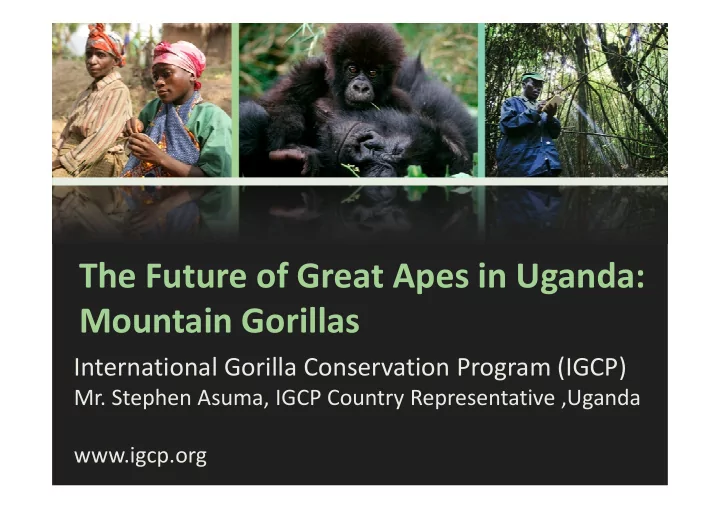
The Future of Great Apes in Uganda: The Future of Great Apes in Uganda: Mountain Gorillas International Gorilla Conservation Program (IGCP) Mr. Stephen Asuma, IGCP Country Representative ,Uganda www.igcp.org Gorilla beringei beringei


slide-1
SLIDE 1

The Future of Great Apes in Uganda: The Future of Great Apes in Uganda: Mountain Gorillas

International Gorilla Conservation Program (IGCP)

  • Mr. Stephen Asuma, IGCP Country Representative ,Uganda

www.igcp.org

slide-2
SLIDE 2

Gorilla beringei beringei

  • Mountain gorilla
  • ‘Critically Endangered’

according to the IUCN

  • Current total population is
  • Current total population is

Estimated at 780 in two populations

  • Not known to survive in zoos
slide-3
SLIDE 3

Distribution of mountain gorillas

slide-4
SLIDE 4

The Pluses

  • Population increasing
  • Increasing awareness on the plight
  • Has demonstrated economic significance
  • Increasing support for its conservation at
  • Increasing support for its conservation at

different levels

  • Regional collaboration for NRM incl: Gorilla

Conservation

slide-5
SLIDE 5

Virunga Pop trends 1972-2010

slide-6
SLIDE 6

Bwindi: Pop trends 1997-2006

slide-7
SLIDE 7

Threats to survival of Mt. Gorillas

  • Poaching
  • Disease
  • Habitat loss and degradation
  • Climate change
  • Climate change
  • Conflict and civil unrest
  • Disenfranchisement of local community
  • Insufficient regional collaboration
slide-8
SLIDE 8
  • 1. Habitat Loss and Degradation
  • Conversion for agriculture
  • Competition for limited

natural resources

  • Access to water
  • Access to water
  • Timber
  • Charcoal
slide-9
SLIDE 9
  • 2. Poaching
  • Poaching continues to jeopardize the gorillas’

survival.

  • Poaching of mountain gorillas for food is

extremely rare. extremely rare.

  • Largely the result of unselective hunting with

snares

slide-10
SLIDE 10

Poaching-Contd

  • In the ’60s and ’70s gorillas were poached for

sale to foreigners as trophies and captive

  • specimens. None survived in captivity
  • Hunting of mountain gorillas in order to
  • Hunting of mountain gorillas in order to

capture babies ‘commissioned’ by unscrupulous dealers remains a very real threat.

slide-11
SLIDE 11

Poaching trend

  • Everyday poaching threat from

snares left for antelope

  • Direct poaching of gorillas

– Civil unrest – Civil unrest

  • 1995 : 4 gorillas in Bwindi-

Community reprisal

  • 2002: An attempt thwarted in

Nkuringo

  • 2007 : 10 gorillas in Virunga NP

– Human-wildlife conflict

  • 2009 : 1 gorilla killed by stone
  • 2010: I BB spared in Bwindi
slide-12
SLIDE 12

Records of Gorilla death 2002-2010

slide-13
SLIDE 13
  • 3. Disease transmission

Disease most dramatic threat

  • Gorillas:

– closely related to humans, vulnerable to many of the same vulnerable to many of the same diseases. – have not developed necessary immunities. – live in small groups that may never recover from a sudden pop fall due to disease.

slide-14
SLIDE 14

Disease transmission-contd

  • Any human contact is potentially harmful,

even life-threatening.

  • Debris left behind in the park
  • Contact with surrounding community and their
  • Contact with surrounding community and their

livelihood activities-High pop density, malaria, respiratory and diarrheal diseases-majority diseases amongst adults and deaths amongst children

slide-15
SLIDE 15

Climate change

  • Reduction in habitable lands
  • Change in community production systems and

approaches

slide-16
SLIDE 16
  • 4. Success of Gorilla Tourism
  • Gorilla Tourism universally accepted,

supported and lucrative tool for Gorilla conservation:

  • Has raised conservation funding
  • Has raised conservation funding
  • Has generated publicity for the range states
  • Created employment
  • Earned national governments taxes
  • Made money for the private sector
  • BUT:
slide-17
SLIDE 17

Success of Gorilla Tourism-CONT

  • Success is leading to constant pressure to:
  • Habituate more
  • Lower safe guards for Gorilla health
  • Bringing thousands of people from all over the
  • Bringing thousands of people from all over the

world into proximity with ( 15,360ple for BINP at 80% occupancy)

  • Behavioral disturbance and stress leading to

immunosuppresiion

slide-18
SLIDE 18
  • 5. Conflict and civil unrest
  • Killing of gorillas
  • Abandonment or downscaling of management
  • Drop in Tourism
  • Exploitation of habitat
  • Exploitation of habitat
  • Quality of habitat- garbage
slide-19
SLIDE 19
  • 6. A feeling of disenfranchisement

among local communities,

  • Crop raiding

– Gorillas on community land – Annual losses around BINP 0.9m $

slide-20
SLIDE 20

A feeling of disenfranchisement among local communities

  • Limited benefits from Tourism

2% 4% 28% 13% 8% 13% 17% 15% 4% International Tourists( Consumer surplus International revenue National( non local) Park fees National Income( non local Impact) Govt tax Local Revenue Local income impact

slide-21
SLIDE 21
  • 7. Insufficient regional collaboration
slide-22
SLIDE 22
  • 1. Increase community stake in

conservation through related and dependant interventions

  • 2. Review penalties for poaching

Recommendations

  • 2. Review penalties for poaching
  • 3. Strengthen relationship and

collaboration with police, judiciary and media

  • 4. Research into and routinely

monitor their habitat and use information for adapting management

slide-23
SLIDE 23

Recommendations-Contd

  • 1. Rationalize land use around habitats
  • 2. Implement recommendations to minimize

disease spread:

1. Proper Garbage , and fecal matter disposal 1. Proper Garbage , and fecal matter disposal 2. Improving health status of local communities 3. Active sensitization campaign-Create a gorilla conscious tourism movement

slide-24
SLIDE 24

Recommendations-Contd

  • Continued sensitization on the danger to and

need and benefits of gorilla conservation

  • Awareness raising of tour operators and

continued training of PA staff in health issues continued training of PA staff in health issues

  • Investigate reasons for exits
  • Explore incentives and disincentives for good

Gorilla conservation practice for communities, private sector

slide-25
SLIDE 25

Recommendations-Contd

  • Ratify treaty for regional collaboration
  • Implement /roll out strategies for climate

change adaptation

slide-26
SLIDE 26

WHAT FROM HERE

What we can do together

slide-27
SLIDE 27

Website and blog: www.igcp.org

Email: sasuma@igcp.org or info@igcp.org Find us on Facebook, Twitter, Flickr, and YouTube