The Future of Council Housing: An analysis of the financial - - PowerPoint PPT Presentation

the future of council housing
SMART_READER_LITE
LIVE PREVIEW

The Future of Council Housing: An analysis of the financial - - PowerPoint PPT Presentation

The Future of Council Housing: An analysis of the financial sustainability of local authority provided social housing text 365,350 council houses and flats provided 22.2 per cent of the total Irish housing stock. Houses 8.7 per cent of all

slide-1
SLIDE 1

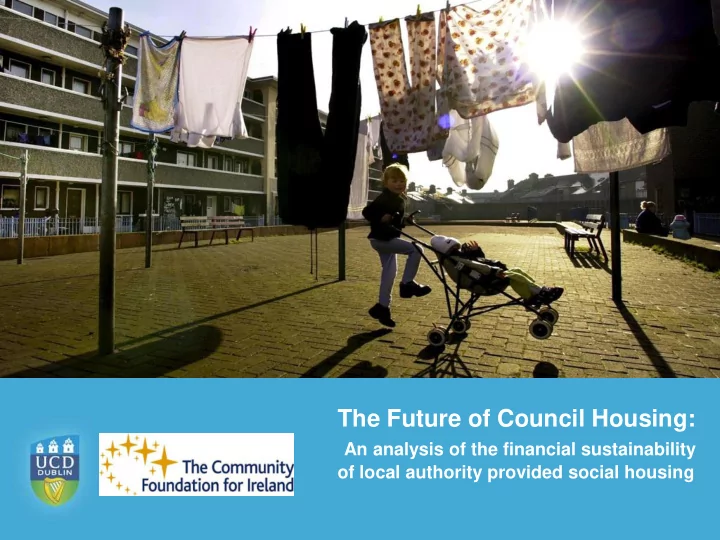
The Future of Council Housing: An analysis of the financial sustainability

  • f local authority provided social housing
slide-2
SLIDE 2

365,350 council houses and flats provided 22.2 per cent of the total Irish housing stock. Houses 8.7 per cent of all households and 30.4 per cent of all renters. Affordable, good-quality and secure accommodation. Increased the size and quality of the housing stock.

text

slide-3
SLIDE 3
slide-4
SLIDE 4

Rationale and Aims

▪ Government reports flag concerns about the affordability, efficiency and value for money of council housing. ▪ Some suggest that alternative sources of accommodation for low income households are better value and more flexible. ▪ Complex issue to assess and never done in a robust fashion. ▪ Report aims to assess the financial sustainability of council housing and generate recommendations to increase its future financial sustainability. ▪ Rebuilding Ireland promises greater investment in council housing - must do in a way which is affordable for the government and provides the high quality and affordable housing service for tenants

slide-5
SLIDE 5

Research Methods

▪ Review of policy and research. ▪ Interviews with national policy makers. ▪ Analysis of statistics and financial data on council housing: ▪

  • utput

capital and current expenditure

rental income and arrears

tenancies, waiting lists and empty dwellings.

management and maintenance quality and spending. ▪ Case studies of five local authorities. ▪ Workshop with council housing managers from around the country.

slide-6
SLIDE 6

Conclusions

More Council Housing is Required, Particularly in Urban Areas.

  • HAP and rent supplement operate effectively in weaker

housing markets.

  • They are not operating effectively in urban areas where rents

are high and housing supply limited.

  • AHB social housing provision is also valuable but

homelessness and waiting lists cannot be resolved successfully without higher rates of council housing output.

National Housing Policy and Funding Doesn’t Meet Local Housing Needs.

  • Most capital funding for council housing is provided by the

Department of Housing.

  • Slow and unnecessarily bureaucratic approvals system.
  • Property tax system redistributes revenue from local

authorities where housing need is high to areas of low housing need.

slide-7
SLIDE 7

Conclusions

Central Government Capital Grants are an Inefficient Mechanism for Funding Council Housing Provision

  • Challenging for the

Exchequer to afford particularly during recessions.

  • Resulted in a

boom/bust and pro- cyclical pattern of housing output.

  • Generates

inefficiencies in housing and land procurement and staffing

Capital Spending on New Council Housing Provision by Central Government and Local Authorities (€000s).

slide-8
SLIDE 8

Conclusions

Funding Model Requires Selling of Council Housing at a Loss

  • Local authorities are obliged by government policy to sell council

housing to tenants at a discount of up to 60 per cent of market value.

  • Local authorities rely on their income from sales to fund council housing

management and maintenance.

  • Accounting procedures disguise the full costs of this policy.

Rents Generate Inadequate Funding for Council Housing Management and Maintenance

  • Rents are linked to tenants’ incomes and averaged €50.63 a week per

dwelling in 2015.

  • Insufficient to fund planned maintenance and upgrading of dwellings.
  • Over reliance on central government regeneration and upgrading grants.
  • Inefficient funding model because:
  • dwellings which haven’t been maintained for 20 years, require more

spending to upgrade than dwellings which are regularly maintained.

  • no incentive to re-let dwellings swiftly when they become vacant.
slide-9
SLIDE 9

Recommendations

Minor Management and Administrative Changes

  • Require local authorities to ring fence income from rents to spend on

council housing.

  • Remove maximum rents from council housing rent determination

schemes.

  • Allow for the compulsory deduction of council housing rents from

social welfare payments.

  • Regularly conduct comprehensive condition surveys of the council

housing stock.

  • Review the Local Government Accounting Code of Practice to bring it

into line with international standards of transparency and disclosure for councils’ housing operations.

  • Value the council housing stock and record valuations in local

authorities’ accounts.

  • Condense and streamline the Department of Housing’s approval

process for new council housing developments.

slide-10
SLIDE 10

Recommendations

Medium Scale Reforms

  • Suspend the tenant purchase scheme

for council housing.

  • Remove the availability of successor

tenancies (i.e. the ability to inherit a council housing tenancy).

  • Build smaller council housing units to

enable tenants to downsize.

  • Enable urban local authorities to keep

more property tax revenue to spend on council housing.

  • Use income from property taxes on

council housing to establish sinking funds.

  • Extend the shared services model to
  • rganise some council housing services
  • n a regional basis.
slide-11
SLIDE 11

Recommendations

Radical Restructuring of Arrangements for Funding Council Housing

  • Link rents to the cost of

council housing provision not to tenants’ incomes. Make HAP available to council tenants who can’t afford to pay these ‘cost rents’.

  • Enable local authorities to

borrow some or all of the costs of council housing

  • provision. These loans would

be remunerated using ‘cost rents’ and the proceeds of property taxes.