Healthy housing for a sustainable future: The WHO Housing and health - - PowerPoint PPT Presentation

healthy housing for a sustainable future the who housing
SMART_READER_LITE
LIVE PREVIEW

Healthy housing for a sustainable future: The WHO Housing and health - - PowerPoint PPT Presentation

Healthy housing for a sustainable future: The WHO Housing and health guidelines 1 | Outline 1. Relevance of housing for sustainable development and public health 2. WHOs response to the increasing importance of housing: the WHO Housing


slide-1
SLIDE 1

1 |

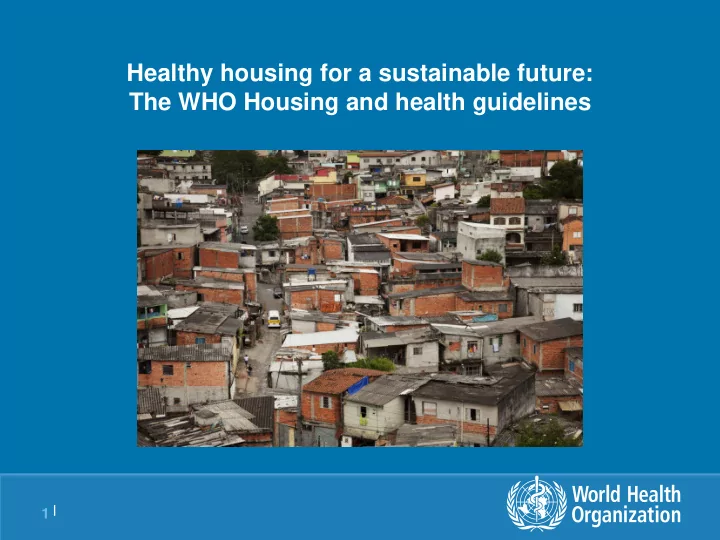
Healthy housing for a sustainable future: The WHO Housing and health guidelines
slide-2
SLIDE 2

2 |

Outline

1. Relevance of housing for sustainable development and public health 2. WHO’s response to the increasing importance of housing: the WHO Housing and health guidelines 3. Outlook: Implementation and stakeholder engagement

slide-3
SLIDE 3

3 |

Housing is becoming increasingly important

  • World’s urban population is expected to double by 2050 and will

require housing solutions (UN, 2016)

  • World’s population aged over 60 years of age, who tend to spend

more time at home, will also double by 2050 (WHO, 2015)

  • Changing weather patterns associated with climate change call for

housing providing protection from cold, heat and other extreme weather events

slide-4
SLIDE 4

4 |

Housing is a public health issue Healthy housing promotes the achievement of several SDGs

slide-5
SLIDE 5

5 |

Housing affects health in multiple ways

Source: Philippa Howden-Chapman, Elinor Chisholm and the WHO Housing and health guideline development group

slide-6
SLIDE 6

6 |

WHO’s response: the WHO Housing and health guidelines

slide-7
SLIDE 7

7 |

WHO Housing and health guidelines

  • Set norms and standards based on the

best available evidence

  • Focus on a sector = comprehensive

perspective on the topic of housing and health

  • Enable the health sector to inform other

sectors about how housing impacts health

  • Target policy-makers and implementing

actors

slide-8
SLIDE 8

8 |

WHO Guideline Development

  • Priority issue / Member State request
  • Standardized development procedure
  • Experts convened: Guideline Development Group,

Steering Committee, External Peer Reviewers

  • Systematic reviews commissioned to compile the

best available evidence

  • Evidence graded and complemented by

considerations of feasibility, costs, acceptability, benefits and harms

  • Formulation of recommendations by GDG
  • External review process
  • Guideline Review Committee approves guidelines
slide-9
SLIDE 9

9 |

WHO Housing and health guidelines

New recommendations and summary of existing WHO guidelines

slide-10
SLIDE 10

10 |

Window guards installed for each

  • perable window more

than two meters above ground level.

Focus: Housing accessibility

Guards installed for all

  • perable fireplaces,

fuel burning stoves and other hot surfaces.

  • Rise of functional impairments in ageing societies.

Yet, most homes are not built with accessibility in mind.

  • People with functional impairments face

discrimination and higher costs

  • Environmental factors determine whether an

impairment is perceived as disabling (WHO & World

Bank World Report on Disability, 2011):

  • Accessible housing improves a person’s

domain-specific functioning

  • Non-accessible housing increases the risk of

falls and injuries, restricts social participation, negatively affects quality of life, and increases the burden on caregivers and external social services

slide-11
SLIDE 11

11 |

Window guards installed for each

  • perable window more

than two meters above ground level.

Focus: Housing accessibility

Guards installed for all

  • perable fireplaces,

fuel burning stoves and other hot surfaces.

  • 22 times more cost-efficient to build housing that

includes key accessibility features than to retrofit

(Rashbrooke, 2009)

  • Accessible housing should consider other factors

related to healthy housing (immediate environment, social cohesion etc.), e.g. through universal design

  • Public and private sector required to work together
slide-12
SLIDE 12

12 |

Outlook

slide-13
SLIDE 13

13 |

Implementation of the guidelines

  • Work with partners to develop

an implementation strategy

  • Tools and guidance to adapt

the guidelines to country- specific priorities and needs

  • Collection of good practice

interventions, model legislation and regulation, case studies

  • Capacity-building and

information tools for multisectoral action taking a Health in All Policies approach

slide-14
SLIDE 14

14 |

Thank you

More information on WHO’s activities on housing: https://www.who.int/sustainable-development/housing/en/

Dr Ramona Ludolph Technical Officer Department of Public Health, Environmental and Social Determinants of Health Email: ludolphr@who.int

slide-15
SLIDE 15

Age Friendly Sausalito – Home Adaptation Building Permits WHO/IFA Promoting Healthy Spaces for all Ages ~ 8 February 2019

slide-16
SLIDE 16

How a Grass Roots Age Friendly Initiative Can Establish New Public Policies

Planning Program Policy

slide-17
SLIDE 17

21% of

  • f U.S. P

. Pop

  • pula

latio ion i is Age 60 or O Older ( (67million)

Marin County: 27% of population age 60 or older City of Sausalito: 34% of population is already age 60 Marin County Life Expectancy 87.3 year

*U.S. Census ACL 2017

slide-18
SLIDE 18

Community A Assessment Conduct cted b by t the A All- Volunteer T Taskforce ce

  • 25 questi

tion s survey to 2400 2400 residen ents Age ge 55 + 55 +

  • 50%

50% r rate of r return ( (119 1191 residen ents). ).

  • 95%

95% said aid it it was as im important t to s

  • stay

in their p pres esent t res esidence

  • 47% s

said the des esign o

  • f their

hom

  • me w

would ld ma make i it diffic icult f for

  • r

them em to to r remain i in it.

slide-19
SLIDE 19

Every 11 sec econ

  • nds, a

an Older A Adult lt is tr treated f for

  • r a

a Fall i in th the e Hos

  • spit

ital E l Emergency R Roo

  • om i

in th the U U.S.

  • One in four Americans aged 65+ falls each year.
  • Every 19 minutes, an older adult dies from a fall.
  • The Majority of Falls occur in the home
  • U.S. Centers for Disease Control
  • U.S. Department of Housing and Urban Development
slide-20
SLIDE 20

First Age Friendly Home Modification Community Meeting & Workshop

  • Age Friendly Sausalito, and partner Sausalito Village

held Workshop led by City Building Inspector and Age Friendly Architect.

  • The Community developed idea to ask

City to Review and Simplify Permits For Older Adults

slide-21
SLIDE 21

Cha hallen enge: H Housi sing Solution: S Share e and nd Improve e Access essibility

PROBLEM

  • In-Appropriate Housing for Aging in Place
  • Excessive Trip & Fall Injuries
  • Permit Policy may be disincentive to Modify
  • ACTIONABLE SOLUTION
  • Partner w/City Building Department to incentivize

and simplify Home Adaptation Process

  • POLICY RESULT
  • City Creates New Age Friendly Home

Adaptation Permit Policy for Older Adults

slide-22
SLIDE 22

Age Friendly Sausalito Home Adaptation Program

  • Reduced fee or no-cost permit based on the

project valuation cost of $10,000 for eligible adaptation improvements.

  • Eligibility:

Residents of Sausalito age 60 + or Younger Residents with a disability

  • Eligibility is established by proof of age 60, or for

younger adults, by standard proof of disability or limiting condition.

slide-23
SLIDE 23

Age Friendly Sausalito Home Adaptation Permit: Example

No-cost permit Resident Renter Age 74 Project Valuation - $6,350.00 (cost of labor and materials)

  • New Access Ramp to Front Door
  • With handrails
  • Non-slip surface
slide-24
SLIDE 24

Age Friendly Sausalito Home Adaptation Permit: Example

Reduced fee permit - Bathroom Remodel Total Project Valuation - $24,540 (cost of labor and materials):

  • Widening the doorway (33” or greater)
  • Installation of grab bars /Fold down seat in shower
  • Other upgrades and fixture improvements
slide-25
SLIDE 25

Sharing Age Fr Friendly Resources

slide-26
SLIDE 26

Planning Guides for Home Adaptations

Canadian Mortgage & Housing Corp. ENGLISH and FRANÇAIS https://www.cmhc-schl.gc.ca/ American Assoc of Retired Persons

English and Español

www.aarp.org/livable-communities/

slide-27
SLIDE 27

Advoc

  • cacy to Scale

e Up Up

  • Age Friendly Sausalito Promoted

program to State Representatives and County Commission on Aging

  • Bill Introduced to State Legislature

by Assembly Member in February, 2018

  • Age Friendly Sausalito, County

Commission on Aging Advocated for bill and testified at Legislative Hearings

slide-28
SLIDE 28

SCALIN ING U UP: REPLICATIO ION A AND SUSTAIN INABIL ILIT ITY

  • California State Bill AB 2132

Building Permit Fees Waiver for Seniors was passed by the State Assembly and Senate and signed into law by Governor Brown on 14 September 2018

  • County of Marin is now taking

action to be the first County in California to Implement the law. Creating a model for other Counties and Cities in California to follow.

slide-29
SLIDE 29

Sybil L. Boutilier agefriendlysausalito@gmail.com

Thank You!

slide-30
SLIDE 30

Age-friendly Housing: Promoting healthy spaces for all ages 2019 WHO/IFA Webinar Series 8th February 2019

slide-31
SLIDE 31
  • To provide technical, economic and technological support to city councils to

foster quality local services throughout the province.

  • Network of Municipalities: cooperation work model optimising human,

technical and material resources as well as encouraging the local use of new technologies and digital administration.

Barcelona provincial council, a network of municipalities

slide-32
SLIDE 32

Barcelona province Catalonia Spain

Area (km2) Population (inhab. 2017) Density (inhab./km2) 7,727 32,108 505,940 5,533,459 7,496,276 46,528,024 715 234 92 Population No. municipalities > 50,001 5,001 – 10,000 19 62 49 181 311 42% municipalities 79% population 58% municipalities 4% population 10,001 – 50,000 < 5,000 TOTAL

Barcelona province

slide-33
SLIDE 33

MISSION

Contribute, in cooperation and agreement with local councils, to ensuring public welfare, quality of life and social cohesion through services that cover every stage of people’s lives, giving special attention to the most vulnerable groups.

Department of Human Services Education, Equality and Citizenship Social Welfare Public Health and Consumer Affairs

Barcelona provincial council, Department of Human Services

slide-34
SLIDE 34

NETWORK

Economic support Technical and material support Training Technological support Municipalities Social

  • rganisations

Training Supervision Information system Provision of services Models Advice on planning and assessment

Barcelona provincial council, types of support to municipalities

slide-35
SLIDE 35

Home Refurbishment Programme

The aim of the Home Refurbishment Programme in the Barcelona province (except for the city of Barcelona itself) is to:

  • Guarantee minimum levels of accessibility, safety,

habitability and energy efficiency by carrying out refurbishment work in the homes of the most vulnerable elderly people.

  • Improving the well-being of elderly people by keeping

them in their natural environment, facilitating community’s ties, intergenerational relationship and a healthy ageing.

  • Strengthening and improving local authority social

welfare policies and actions in the Barcelona area.

slide-36
SLIDE 36

Refurbishment consists of repairs, small non-structural jobs and installing technical aids inside the home.

  • Bathroom refurbishment.
  • Kitchen refurbishment.
  • General refurbishment.
  • Additional actions to improve home energy

efficiency.

  • Technical aids.

Types of intervention

slide-37
SLIDE 37
  • Bathroom refurbishment

Types of intervention

slide-38
SLIDE 38

Target group

  • People aged over 65, proposed by the municipal social

services, who are in situations of fragility due to age, health, lack of personal autonomy, disability, dependence, vulnerability due to living alone or with another elderly person, or with financial difficulties.

  • People aged under 65 with special needs in terms of

physical or mental ability to carry out activities of daily living (ADL) in the home. Priority is given to:

  • People with financial difficulties.
  • People who have their disability or dependency status

accredited.

  • People over eighty years of age living alone or with

another elderly person.

slide-39
SLIDE 39
  • Barcelona Provincial Council; leads, coordinates, manages and finances the

programme.

  • Municipalities of Barcelona; territory project monitoring, identifying target

beneficiaries and homes for the programme and co-funding of the work (co- funding till 2018).

  • Company specialised in functional adaptation of homes: coordination and

technical monitoring of the implementation, requests’ validation.

  • Building Companies: works executions.
  • Beneficiaries: assessment.
  • Third sector social organisations specialised in care for vulnerable elderly people

and those with disabilities: designing and publicising the programme among their users and referring potential beneficiaries to participating local councils.

AGENTS FINANCING

  • Barcelona Provincial Council (80%) Since 2019: 100%.
  • Municipalities (20%). Since 2019: 0%

Average cost per intervention 1,400 euros

Agents and financing

slide-40
SLIDE 40

Territorial impact

  • Over the 2009–2015 period, a total of 153

local councils took part, covering over 85%

  • f the population in the Barcelona area.
  • Overt the 2016–2018 period, a total of 165

local councils took part, covering over 90%

  • f the population in the Barcelona area.
  • Since 2009, a total of 192 municipalities

have participated in the program.

slide-41
SLIDE 41

Autonomy Accessibility Security Comfort Life quality

  • 6,300 refurbishments have been carried out since 2009, benefiting a total of 10.500

people (70% women).

  • In 82% of cases, beneficiaries are people with certain level of autonomy, a fact that

confirms the preventative nature of the programme.

55% to 31% that need help for daily activities 65% to 46% that need help to access to some places of the house 2% to 80% that feels safe doing activities at home 2% to 94% that feel comfort doing activities at home 80% have improved a lot the quality of life, 20% have quite improved the quality of life

Outcomes

slide-42
SLIDE 42
  • Age-friendly housing solution for living in better conditions more time at
  • home. – Taking action on the environment (built environment)
  • Inter-government cooperation (provincial council and municipalities) and

public-private cooperation.

  • Multidisciplinary approach and person-centred functional adaptation

solutions.

  • Territorial equity: service to all municipalities in the Barcelona province,

including the smallest ones with an older population and few resources.

  • Social inclusion and gender perspective: the main beneficiaries of the

programme have been women and people aged over 80, thus impacting on the most vulnerable groups of elderly people.

Key aspects

slide-43
SLIDE 43

HOUSING WEBINAR

RAQUEL CASTELO BRANCO

PORTO

08 FEBRUARY 2019

slide-44
SLIDE 44

ACONCHEGO PROGRAM

slide-45
SLIDE 45

3

ENTITY RESPONSIBLE FOR THE PROJECT :

Porto City Hall (since 2004)

Porto

slide-46
SLIDE 46

WHY???

slide-47
SLIDE 47

POPULATION RESIDING IN THE MUNICIPALITY:

5

Total: 237.591

60-64 65-69 70-74 75-79 80-84 85+

16.738 15.958 12.406 9.347 8.257 11.384

Source: INE/Censos 2011

Total (more than 60): 74.090 Living alone (more than 65): 30.736

slide-48
SLIDE 48

58.000 students

slide-49
SLIDE 49

.

Two problems:

  • 1. High number of elderly people living alone
  • 2. High number of students looking for accommodation

One single solution:

Develop an housing system in which older people who have adequate housing conditions, host students (non residents in Porto) who need accommodation

slide-50
SLIDE 50

8

“Who does study have a home. Who owns a house has company” Fighting the isolation of seniors Home for those who study

slide-51
SLIDE 51

.

MAIN GOALS

  • Fighting loneliness and / or social isolation of seniors
  • Promoting cohesion and intergenerational solidarity
  • Supporting seniors in promoting their quality of life
  • Support the accommodation and integration of students

who come to a new city

slide-52
SLIDE 52

WHICH SENIORS CAN ADHERE

  • Citizens aged 60 or over
  • To be resident in the Municipality of Porto
  • Living alone or with spouse
  • Have

adequate housing conditions to accommodate a student of higher education

slide-53
SLIDE 53
  • Students enrolled in Higher Education;
  • Aged between 18 and 35;
  • Non resident in the Municipality of Porto;
  • Domain of the Portuguese language

WHICH STUDANTS CAN ADHERE

slide-54
SLIDE 54

OPERATIONALIZATION

  • Candidate selection (students and seniors)
  • Interviews with candidates for profile

evaluation

  • Match between student and senior
slide-55
SLIDE 55

OPERATIONALIZATION

  • First meeting between the student and the senior
  • Signing adhesion agreement
slide-56
SLIDE 56

OPERATIONALIZATION

  • Integration
slide-57
SLIDE 57

MONITORING

  • Regular home visits
  • Telephone and e-mail contacts
  • Organization
  • f

the Annual Meeting

  • f

the Aconchego Program´s adherents

slide-58
SLIDE 58

MONITORING

  • Control and manage unforeseen situations, allowing the

adoption of corrective measures

  • Evaluate compliance with the clauses contained in the

Adhesion Agreement and the Norms of the Aconchego Program

slide-59
SLIDE 59

EVALUATION Instruments Interviews (individual and /

  • r

collective);

  • bservation and application of questionnaires

Participants in the evaluation Seniors, students, families and technicians

slide-60
SLIDE 60

Results:

  • Responds effectively to the decrease of the feeling of

solitude and / or social isolation of the seniors

  • Contributes to the housing solution of students of higher

education

  • Promotes intergenerational relationships
  • Encourages the creation of informal networks of mutual

support

slide-61
SLIDE 61

Results

  • Increases the quality of life of seniors
  • Positive impact on the extended family of

both participants

slide-62
SLIDE 62

CHALLENGES

Find the right match, meaning choose the appropriate student to match with the appropriate older person.

20

slide-63
SLIDE 63

THANK YOU FOR YOUR ATTENTION www.cm-porto.pt dmcs@cm-porto.pt

21