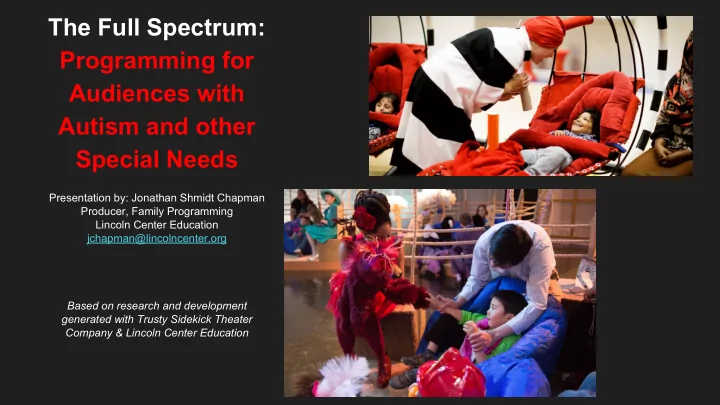
SLIDE 1 The Full Spectrum: Programming for Audiences with Autism and other Special Needs
Presentation by: Jonathan Shmidt Chapman Producer, Family Programming Lincoln Center Education jchapman@lincolncenter.org Based on research and development generated with Trusty Sidekick Theater Company & Lincoln Center Education
SLIDE 2 Sensory Sensitivity Challenges with Social Interaction and Communication Repetitive Behaviors Why is it challenging for young people
- n the Autism Spectrum to experience
live theater?
SLIDE 3
The same intrinsic value of the performing arts as any audience member Shared experience out in community Ability to engage naturally and be celebrated for who they are Repetitive Behaviors What are the benefits? Why is it important?
SLIDE 4 Challenges with understanding or expressing emotion / understanding the desires or needs of
Difficulty with transitions and change Sensory engagement Symbolic thinking and expression
Performing arts experiences can actually tap into addressing some key issues for people with autism and other social or developmental disabilities:
SLIDE 5
What is the current landscape of work being offered to this audience?
SLIDE 6
“Autism-Friendly / Relaxed / Sensory-Friendly”
SLIDE 7
Work Designed Especially For this audience...
SLIDE 8
Oily Cart - London, UK
SLIDE 9
Bamboozle Theatre - Leicester, UK
SLIDE 10
Replay Theatre Company - Northern Ireland, UK
SLIDE 11
Frozen Light - Norwich, UK
SLIDE 12
Sensorium - Western Australia
SLIDE 13
Trusty Sidekick Theater Company - New York, USA
SLIDE 14
Red Kite - Chicago, USA
SLIDE 15
Bluelaces - New York, USA
SLIDE 16
Rose Theater - Omaha, USA Yellow Finch Project - Croton Falls, USA Bricolage - Pittsburgh, USA
SLIDE 17
VIDEO LINKS
SENSORIUM: https://www.youtube.com/watch?v=5CaufLZFp_4 TRUSTY SIDEKICK: https://www.youtube.com/watch?v=QDCYGK4_yLM OILY CART: https://www.youtube.com/watch?v=MXUh4p3R8_4 REPLAY: https://vimeo.com/64087943
SLIDE 18 How can we design an environment that doesn’t dictate a “right” or “wrong” way to participate? How can we ensure that the entire experience is taking the needs
- f the audience into account?
How can the show adapt in the moment to a wide range of audience responses without compromising artistic integrity of the work? What kind of narrative content will actually connect with the audience?
SLIDE 19 “Ingredients” - Sensory-Friendly
- Reduction of loud or jarring sounds
- Reductions in flashing or strobe lights
- Modification of the house lights during the performance
- Accommodated house rules: audience members are free to talk or move
during the show
- Extra staff and volunteer support.
- Designated “Quiet Room” and “Take a Break Space”
- Guidance and sensory supports (fidgets, earplugs, noise cancelling
headphones) available in the lobby before the show
SLIDE 20
“Ingredients” - Sensory-Friendly
SLIDE 21
“Ingredients” - Designed Especially For...
SLIDE 22 1:1 Interaction and Adaptation
“Ingredients” -
Developed by Trusty Sidekick Theater Company
SLIDE 23 Immersive Space / Sensory-Friendly Environment
“Ingredients” -
Developed by Trusty Sidekick Theater Company
SLIDE 24 Multi-Sensory
“Ingredients” -
Developed by Trusty Sidekick Theater Company
SLIDE 25 Episodic Structure With Clear Schedule
“Ingredients” -
Developed by Trusty Sidekick Theater Company
SLIDE 26 Clearly Defined Characters
“Ingredients” -
Developed by Trusty Sidekick Theater Company
SLIDE 27 Repetition
“Ingredients” -
Developed by Trusty Sidekick Theater Company
SLIDE 28 Zoom In / Zoom Out Structure
“Ingredients” -
Developed by Trusty Sidekick Theater Company
SLIDE 29 Pre-Show Materials and Engagement
“Ingredients” -
Developed by Trusty Sidekick Theater Company
SLIDE 30
CHALLENGES - REASONS FOR “CAN’T”
Scale Funding Intensive time / care to conceptualizing venue and staff training
SLIDE 31
REWARDS - REASONS FOR “YES”
Audience Impact Audience Visibility / “Radical Hospitality” Ripple effect on venue, staff, other programming and wider community
SLIDE 32
QUESTIONS
How can we sustainably program this work and support its development? How can we collaborate nationally and internationally to make this more viable? How can we effectively advocate for impact over scale (not always but sometimes)?