The Extragalactic Radio Background from Dark Matter Annihilation - - PowerPoint PPT Presentation

the extragalactic radio background from dark matter
SMART_READER_LITE
LIVE PREVIEW

The Extragalactic Radio Background from Dark Matter Annihilation - - PowerPoint PPT Presentation

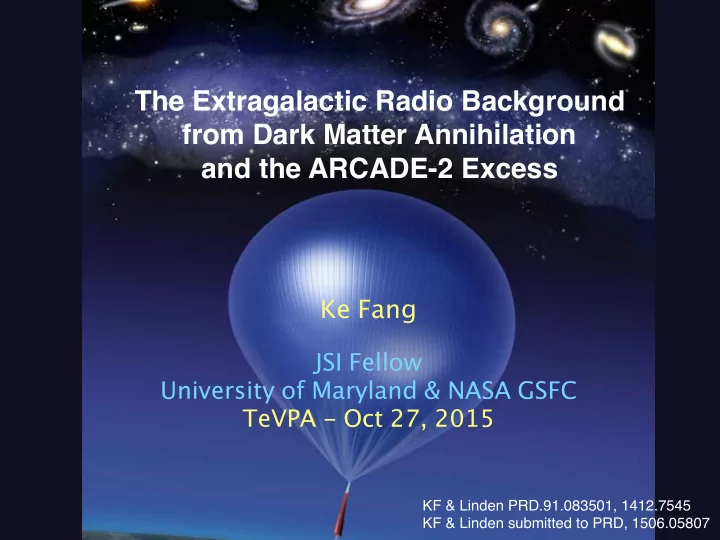
The Extragalactic Radio Background from Dark Matter Annihilation and the ARCADE-2 Excess Ke Fang JSI Fellow University of Maryland & NASA GSFC TeVPA - Oct 27, 2015 KF & Linden PRD.91.083501, 1412.7545 1 KF & Linden submitted to PRD,


slide-1
SLIDE 1

1

The Extragalactic Radio Background from Dark Matter Annihilation and the ARCADE-2 Excess

Ke Fang

JSI Fellow University of Maryland & NASA GSFC TeVPA - Oct 27, 2015

KF & Linden PRD.91.083501, 1412.7545 KF & Linden submitted to PRD, 1506.05807

slide-2
SLIDE 2

2

Fixsen et al, ApJ, 0901.0555 Kogut et al, ApJ, 734, 4, 2011 Singal et al, MNRAS, 409, 1172, 2010

22 MHz - 10 GHz

The ARCADE-2 Excess

slide-3
SLIDE 3

2

Fixsen et al, ApJ, 0901.0555 Kogut et al, ApJ, 734, 4, 2011 Singal et al, MNRAS, 409, 1172, 2010

22 MHz - 10 GHz

The ARCADE-2 Excess

Tarcade = 1.26 ⇣ ν GHz ⌘−2.6 K

slide-4
SLIDE 4

2

Fixsen et al, ApJ, 0901.0555 Kogut et al, ApJ, 734, 4, 2011 Singal et al, MNRAS, 409, 1172, 2010

22 MHz - 10 GHz

The ARCADE-2 Excess

Tsources = 0.23 ⇣ ν GHz ⌘−2.7 K

Tarcade = 1.26 ⇣ ν GHz ⌘−2.6 K

slide-5
SLIDE 5

2

Fixsen et al, ApJ, 0901.0555 Kogut et al, ApJ, 734, 4, 2011 Singal et al, MNRAS, 409, 1172, 2010

22 MHz - 10 GHz

The ARCADE-2 Excess

Tsources = 0.23 ⇣ ν GHz ⌘−2.7 K

Exceeds the isotropic galactic diffuse emission & flux of extragalactic radio sources

Tarcade = 1.26 ⇣ ν GHz ⌘−2.6 K

slide-6
SLIDE 6

3 Fornengo et al, PRL, 107 (2011) 271302 Hooper et al, PRD, 86.103003, 2012

Dark matter YES Dark matter annihilation —> electrons —> diffusive synchrotron emission

slide-7
SLIDE 7

3

1•104 2•104 3•104 L 0.01 0.10 [L(L+1)CL/2π]1/2 (∆T/T) VLA 4.9 GHz VLA 8.4 GHz ATCA 8.7 GHz

z=[0,1] z=[0,2] z=[5,10]

1 Mpc/h 2 Mpc/h

Planck 857 GHz

Fornengo et al, PRL, 107 (2011) 271302 Hooper et al, PRD, 86.103003, 2012 Holder, ApJ 780 (2014) 112

Dark matter YES Dark matter annihilation —> electrons —> diffusive synchrotron emission Dark matter NO Unusual smoothness of the unresolved radio background —> unlikely from large-scale structure

slide-8
SLIDE 8

4

1•104 2•104 3•104 L 0.01 0.10 [L(L+1)CL/2π]1/2 (∆T/T) VLA 4.9 GHz VLA 8.4 GHz ATCA 8.7 GHz

z=[0,1] z=[0,2] z=[5,10]

1 Mpc/h 2 Mpc/h

Planck 857 GHz

Holder, ApJ 780 (2014) 112

Anisotropy Constraints

slide-9
SLIDE 9

4

1•104 2•104 3•104 L 0.01 0.10 [L(L+1)CL/2π]1/2 (∆T/T) VLA 4.9 GHz VLA 8.4 GHz ATCA 8.7 GHz

z=[0,1] z=[0,2] z=[5,10]

1 Mpc/h 2 Mpc/h

Planck 857 GHz

Holder, ApJ 780 (2014) 112

Anisotropy Constraints

mass power spectrum

slide-10
SLIDE 10

4

1•104 2•104 3•104 L 0.01 0.10 [L(L+1)CL/2π]1/2 (∆T/T) VLA 4.9 GHz VLA 8.4 GHz ATCA 8.7 GHz

z=[0,1] z=[0,2] z=[5,10]

1 Mpc/h 2 Mpc/h

Planck 857 GHz

Holder, ApJ 780 (2014) 112

Anisotropy Constraints

C` ∝ ✓ δT Texcess ◆2 = ✓ δT TCMB TCMB Texcess ◆2

mass power spectrum

slide-11
SLIDE 11

4

1•104 2•104 3•104 L 0.01 0.10 [L(L+1)CL/2π]1/2 (∆T/T) VLA 4.9 GHz VLA 8.4 GHz ATCA 8.7 GHz

z=[0,1] z=[0,2] z=[5,10]

1 Mpc/h 2 Mpc/h

Planck 857 GHz

Holder, ApJ 780 (2014) 112

Anisotropy Constraints

C` ∝ ✓ δT Texcess ◆2 = ✓ δT TCMB TCMB Texcess ◆2

mass power spectrum CMB observation

slide-12
SLIDE 12

4

1•104 2•104 3•104 L 0.01 0.10 [L(L+1)CL/2π]1/2 (∆T/T) VLA 4.9 GHz VLA 8.4 GHz ATCA 8.7 GHz

z=[0,1] z=[0,2] z=[5,10]

1 Mpc/h 2 Mpc/h

Planck 857 GHz

Holder, ApJ 780 (2014) 112

Anisotropy Constraints

uncertainties in excess temperature above 5 GHz -> requires a consistent computation of intensity & anisotropy

C` ∝ ✓ δT Texcess ◆2 = ✓ δT TCMB TCMB Texcess ◆2

mass power spectrum CMB observation

slide-13
SLIDE 13

5

Intensity of the Extragalactic DM signals

Ando & Komatsu arXiv: 1301.5901, 0512217 KF & Linden PRD.91.083501, arXiv: 1412.7545

I(Es) = Z dχδ2(z) W[(1 + z)Es, χ]

slide-14
SLIDE 14

5

Intensity of the Extragalactic DM signals

Ando & Komatsu arXiv: 1301.5901, 0512217 KF & Linden PRD.91.083501, arXiv: 1412.7545

  • / hσvi dN

dEs I(Es) = Z dχδ2(z) W[(1 + z)Es, χ]

slide-15
SLIDE 15

5

Intensity of the Extragalactic DM signals

Ando & Komatsu arXiv: 1301.5901, 0512217 KF & Linden PRD.91.083501, arXiv: 1412.7545

Z dM dn(M, z) dM Z dV ρDM(r, M, z)2

  • / hσvi dN

dEs I(Es) = Z dχδ2(z) W[(1 + z)Es, χ]

slide-16
SLIDE 16

5

Intensity of the Extragalactic DM signals

Ando & Komatsu arXiv: 1301.5901, 0512217 KF & Linden PRD.91.083501, arXiv: 1412.7545

Z dM dn(M, z) dM Z dV ρDM(r, M, z)2

  • / hσvi dN

dEs

  • I(Es) =

Z dχδ2(z) W[(1 + z)Es, χ]

slide-17
SLIDE 17

5

Intensity of the Extragalactic DM signals

Ando & Komatsu arXiv: 1301.5901, 0512217 KF & Linden PRD.91.083501, arXiv: 1412.7545

Z dM dn(M, z) dM Z dV ρDM(r, M, z)2

  • / hσvi dN

dEs

  • I(Es) =

Z dχδ2(z) W[(1 + z)Es, χ]

slide-18
SLIDE 18

6

Anisotropy of the Extragalactic DM signals

C`(Es) = 1 I(Es)2 Z dχ χ2 W 2[(1 + z)Es, χ] P2(k, z)

Ando & Komatsu arXiv: 1301.5901, 0512217 KF & Linden PRD.91.083501, arXiv: 1412.7545

slide-19
SLIDE 19

6

Anisotropy of the Extragalactic DM signals

C`(Es) = 1 I(Es)2 Z dχ χ2 W 2[(1 + z)Es, χ] P2(k, z)

Ando & Komatsu arXiv: 1301.5901, 0512217 KF & Linden PRD.91.083501, arXiv: 1412.7545

slide-20
SLIDE 20

6

Anisotropy of the Extragalactic DM signals

C`(Es) = 1 I(Es)2 Z dχ χ2 W 2[(1 + z)Es, χ] P2(k, z)

  • P(k, z) = P1h(k, z) + P2h(k, z)

P1h(k, z) = Z dM dn dM |˜ u(k, M)|2

Ando & Komatsu arXiv: 1301.5901, 0512217 KF & Linden PRD.91.083501, arXiv: 1412.7545

slide-21
SLIDE 21

7

Substructure Contribution

  • ρ2

sync(r, M) = ρ2 DM(r, M)

ρB ρB + ρCMB

slide-22
SLIDE 22

7

Substructure Contribution

  • ρ2

sync(r, M) = ρ2 DM(r, M)

ρB ρB + ρCMB

  • 1 − fs(r) = 7 × 10⁻³

✓ ρh(r) ρh(r = 100 kpc) ◆−0.26

  • Kamionkowski+ PRD 81 043532 (2010)
slide-23
SLIDE 23

7

Substructure Contribution

  • ρ2

sync(r, M) = ρ2 DM(r, M)

ρB ρB + ρCMB

  • 1 − fs(r) = 7 × 10⁻³

✓ ρh(r) ρh(r = 100 kpc) ◆−0.26

  • Kamionkowski+ PRD 81 043532 (2010)
  • B(M, r) = B0

✓ M M0 ◆α " 1 + ✓ r rc ◆2#−3βη/2

Bsub = 4µG for M = 1014M

slide-24
SLIDE 24

8

Results with different DM models

KF & Linden PRD.91.083501, 1412.7545

slide-25
SLIDE 25

9

A Consistent Picture

KF & Linden PRD.91.083501, 1412.7545

slide-26
SLIDE 26

9

A Consistent Picture

KF & Linden PRD.91.083501, 1412.7545

slide-27
SLIDE 27

10

A Consistent Picture - model III

KF & Linden PRD.91.083501, 1412.7545

slide-28
SLIDE 28

11

KF & Linden submitted to PRD, 1506.05807

Alternative to Substructure - Alfven Re-acceleration in Galaxy Clusters

Image credit: Bonafede et. al. 2014

slide-29
SLIDE 29

11

KF & Linden submitted to PRD, 1506.05807

Alternative to Substructure - Alfven Re-acceleration in Galaxy Clusters

Image credit: Bonafede et. al. 2014

slide-30
SLIDE 30

11

KF & Linden submitted to PRD, 1506.05807

Alternative to Substructure - Alfven Re-acceleration in Galaxy Clusters

Image credit: Bonafede et. al. 2014

∂Wk(t) ∂t = −Γ(k)Wk(t) + IA(k, t) ∂f ∂t = 1 p ∂ ∂p  p2Dpp ∂f ∂p + Sp4f

slide-31
SLIDE 31

11

KF & Linden submitted to PRD, 1506.05807

Alternative to Substructure - Alfven Re-acceleration in Galaxy Clusters

Image credit: Bonafede et. al. 2014

  • ∂Wk(t)

∂t = −Γ(k)Wk(t) + IA(k, t) ∂f ∂t = 1 p ∂ ∂p  p2Dpp ∂f ∂p + Sp4f

slide-32
SLIDE 32

12

Conclusion

slide-33
SLIDE 33

12

Conclusion

  • Synchrotron emission from dark matter annihilations

could explain the ARCADE-2 excess while being consistent with anisotropy limits

slide-34
SLIDE 34

12

Conclusion

  • Synchrotron emission from dark matter annihilations

could explain the ARCADE-2 excess while being consistent with anisotropy limits

  • Need contribution from extended substructure & B-field

OR Alfvenic re-acceleration

slide-35
SLIDE 35

12

Conclusion

  • Synchrotron emission from dark matter annihilations

could explain the ARCADE-2 excess while being consistent with anisotropy limits

  • Need contribution from extended substructure & B-field

OR Alfvenic re-acceleration

slide-36
SLIDE 36

12

Conclusion

  • Synchrotron emission from dark matter annihilations

could explain the ARCADE-2 excess while being consistent with anisotropy limits

  • Need contribution from extended substructure & B-field

OR Alfvenic re-acceleration

slide-37
SLIDE 37

12

Conclusion

  • Synchrotron emission from dark matter annihilations

could explain the ARCADE-2 excess while being consistent with anisotropy limits

  • Need contribution from extended substructure & B-field

OR Alfvenic re-acceleration