The evolution of EDGE: incorporating scientific advances into - - PowerPoint PPT Presentation

the evolution of edge incorporating
SMART_READER_LITE
LIVE PREVIEW

The evolution of EDGE: incorporating scientific advances into - - PowerPoint PPT Presentation

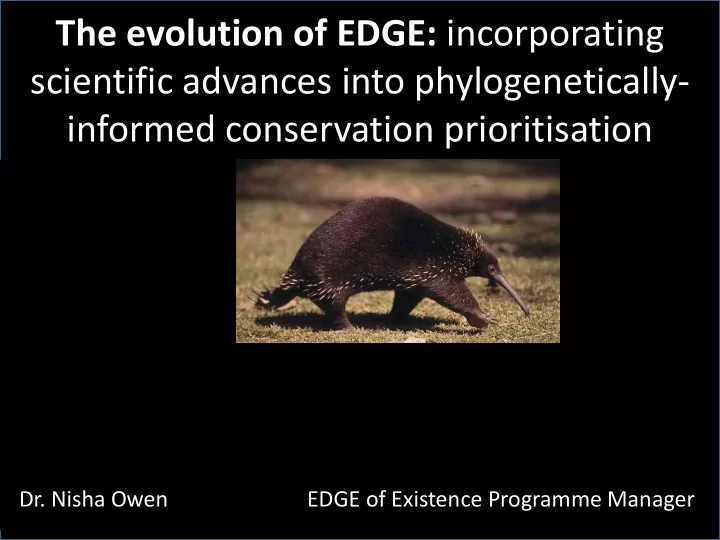
The evolution of EDGE: incorporating scientific advances into phylogenetically- informed conservation prioritisation Dr. Nisha Owen EDGE of Existence Programme Manager The agony of choice Conservation bias Threatened Keystone Umbrella

slide-1
SLIDE 1

The evolution of EDGE: incorporating scientific advances into phylogenetically- informed conservation prioritisation

  • Dr. Nisha Owen

EDGE of Existence Programme Manager

slide-2
SLIDE 2

The agony of choice

slide-3
SLIDE 3

Conservation bias

Threatened Flagship Umbrella Landscape Keystone Cultural value

slide-4
SLIDE 4
slide-5
SLIDE 5
slide-6
SLIDE 6
slide-7
SLIDE 7

Evolutionary Distinctiveness (ED)

A measure of value

A B C D E F G 5 4 3 2 1 Node age/MYBP ED 2.23 2.23 2.73 2.4 2.4 2.75 2.75

1

1 2 1 1 0.5 0.5 4.5 2 1 2 1

1

3 1 2 1 1 5 2 2 1 1 1

Global Endangerment (GE)

GE measures urgency of action

EDGE = ln(1+ED)+GE*ln(2)

Isaac et al. 2007

slide-8
SLIDE 8

Slide 8

time A B C

Evolutionarily Distinct…

slide-9
SLIDE 9

Evolutionarily Distinct…

Slide 9

time A B C

Evolutionarily Distinct…

slide-10
SLIDE 10

Slide 10

A B C time

Evolutionarily Distinct…

slide-11
SLIDE 11

The Challenge

  • unique species representing entire branches of the tree of life
  • on the verge of extinction
  • overlooked by the conservation agenda

ZSL’s EDGE of Existence programme: the only global conservation initiative focusing on species that are Evolutionarily Distinct and Globally Endangered

slide-12
SLIDE 12

EDGE species

  • Distinct in the way they look, live, behave & in genetic

make-up

  • Complementary conservation approach
  • Need phylogenetic tree + adequate IUCN assessments

Per taxonomic group:

  • > EDGE species (median ED & threatened)
  • > top 100
  • > high ED + DD / NE / NT species
slide-13
SLIDE 13

2007 2014 2011 2008 2016/2017 …

Isaac et. al 2012 Curnick et. al 2015 Jetz et. al 2014 Gumbs et. al in prep

EDGE lists

slide-14
SLIDE 14

EDGE Reptiles

Credit: Ryan M. Bolton

Credit: Vladimir Wrangel Credit: Nick Page

Clade All species Red Listed species # imputed spp (phylogeny) Crocodilians 25 23 2 (Oaks 2011) Squamates + tuatara 10,020 4,079 265 (Tonini et al. 2016) Testudines 346 219 214 (Hedges et al. 2015)

Gumbs et. al in prep

slide-15
SLIDE 15

Updated EDGE Lists

Clade All species Red Listed species # imputed spp (phylogeny) Amphibians 7,488 4,857 4,213 (Pyron 2014) Birds 10,960 10,960 967 (Jetz et al. 2014) Mammals 5,454 4,479 539 (Kuhn et al. 2011)

Gumbs et. al in prep

slide-16
SLIDE 16

Slide 16

slide-17
SLIDE 17

Slide 17

slide-18
SLIDE 18

Slide 18

ED: 16.61

slide-19
SLIDE 19
slide-20
SLIDE 20
slide-21
SLIDE 21

OUR VISION

The diversity of life is secured for future generations through locally led conservation initiatives THE SOLUTION

  • SCIENCE: a scientific approach for setting conservation

priorities

  • CAPACITY-BUILDING: supporting the next generation of

conservation leaders

  • CONSERVATION: of neglected EDGE species
  • AWARENESS-RAISING: of the most distinct and

threatened species on the planet

  • --- > maintaining the diversity of life
slide-22
SLIDE 22

EDGE Fellowships

Protect EDGE species by building conservation capacity in-country EDGE Fellows:

  • 2-year project on top-priority EDGE species
  • £10,000 grant
  • Training courses, support & mentoring
  • Produce survival blueprint for their species
slide-23
SLIDE 23
  • 68 Fellowship projects
  • 36 countries
  • 63 EDGE species
slide-24
SLIDE 24

Discovery of new species and populations

  • Horton plains red slender loris
  • Togo slippery frog

Conservation strategies, legislation and protected areas

  • Togo slippery frog
  • Sheath-tailed bat

Down-listing species on the red list

  • Ambystoma salamanders

Innovative technology

Impact (species)

slide-25
SLIDE 25

Impact (Fellows)

  • 100% of surveyed Fellows work in

conservation

  • 80% leverage matched funding for

their Fellowships

  • 76% still work on their EDGE species
  • 70% publish in scientific journals
  • 100% pass on their knowledge to peers

and colleagues

  • 500+ university students
  • 250+ gov. employees
  • 160+ conservation employees
  • 65+ teachers

76% 14% 10%

Continuing to work on their EDGE species

Still work on EDGE sp. Study changed focus Downlisted

EDGE investment in Fellowship Fellows- sourced match funding £489,000 £985,500

Match funding in the EDGE Fellowship

Data from 26 EDGE Fellows

slide-26
SLIDE 26

EDGE 2.0

Cutting-EDGE science: 2017 workshop on phylogenetically informed conservation to assess and refine EDGE prioritisation protocol – Addressing uncertainty

  • Extinction probabilities & limited RL assessments
  • Incomplete / unresolved phylogenies

– Incorporating complementarity (EDGE lineages)

  • robust prioritisation lists
  • lists for new taxonomic groups
  • enabling regular list updates (new species / assessments)
slide-27
SLIDE 27

EDGE Zones

slide-28
SLIDE 28

Conserving EDGE species?

Sitas et al. 2009 Washington et al. 2015

slide-29
SLIDE 29

Slide 29

slide-30
SLIDE 30

Slide 30

www.edgeofexistence.org