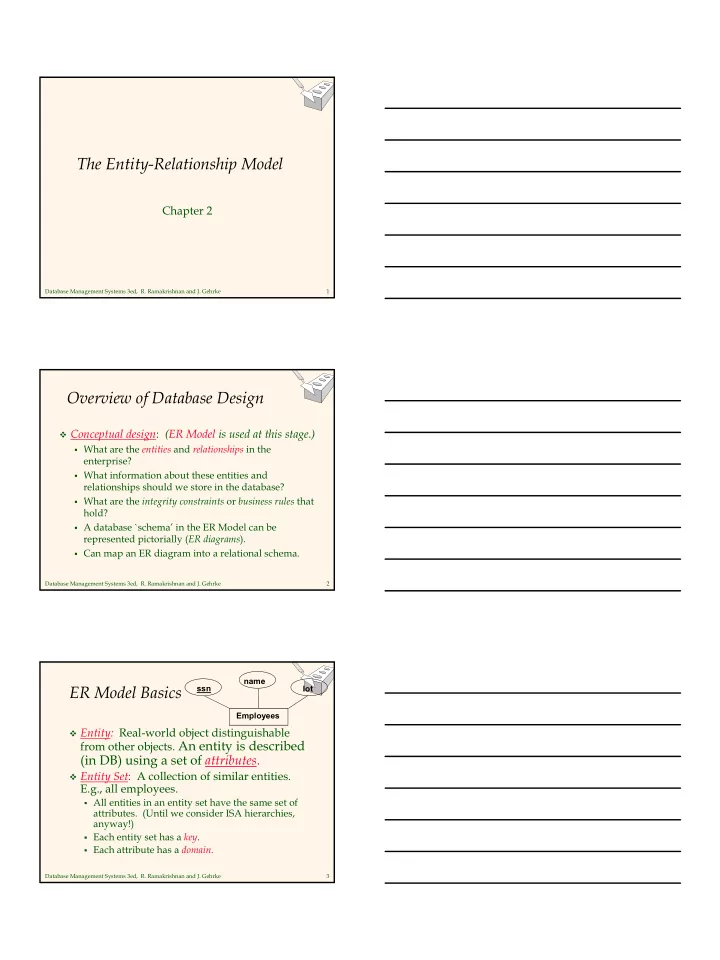
The Entity-Relationship Model Chapter 2 Database Management Systems - - PDF document

the entity relationship model
SMART_READER_LITE
LIVE PREVIEW

The Entity-Relationship Model Chapter 2 Database Management Systems - - PDF document

The Entity-Relationship Model Chapter 2 Database Management Systems 3ed, R. Ramakrishnan and J. Gehrke 1 Overview of Database Design Conceptual design : (ER Model is used at this stage.) What are the entities and relationships in the


slide-1
SLIDE 1

Database Management Systems 3ed, R. Ramakrishnan and J. Gehrke 1

The Entity-Relationship Model

Chapter 2

Database Management Systems 3ed, R. Ramakrishnan and J. Gehrke 2

Overview of Database Design

Conceptual design: (ER Model is used at this stage.)

What are the entities and relationships in the

enterprise?

What information about these entities and

relationships should we store in the database?

What are the integrity constraints or business rules that

hold?

A database `schema’ in the ER Model can be

represented pictorially (ER diagrams).

Can map an ER diagram into a relational schema.

Database Management Systems 3ed, R. Ramakrishnan and J. Gehrke 3

ER Model Basics

Entity: Real-world object distinguishable

from other objects. An entity is described

(in DB) using a set of attributes.

Entity Set: A collection of similar entities.

E.g., all employees.

All entities in an entity set have the same set of

  • attributes. (Until we consider ISA hierarchies,

anyway!)

Each entity set has a key. Each attribute has a domain.

Employees ssn name lot

slide-2
SLIDE 2

Database Management Systems 3ed, R. Ramakrishnan and J. Gehrke 4

ER Model Basics (Contd.)

Relationship: Association among two or more entities.

E.g., Attishoo works in Pharmacy department.

Relationship Set: Collection of similar relationships.

An n-ary relationship set R relates n entity sets E1 ... En;

each relationship in R involves entities e1 E1, ..., en En

  • Same entity set could participate in different

relationship sets, or in different “roles” in same set.

lot dname budget did since name Works_In Departments Employees ssn Reports_To lot name Employees subor- dinate super- visor ssn

Database Management Systems 3ed, R. Ramakrishnan and J. Gehrke 5

Key Constraints

Consider Works_In:

An employee can work in many departments; a dept can have many employees.

In contrast, each

dept has at most

  • ne manager,

according to the key constraint on Manages.

Many-to-Many 1-to-1 1-to Many Many-to-1 dname budget did since lot name ssn Manages Employees Departments

Database Management Systems 3ed, R. Ramakrishnan and J. Gehrke 6

Participation Constraints

Does every department have a manager?

If so, this is a participation constraint: the participation of

Departments in Manages is said to be total (vs. partial).

  • Every Departments entity must appear in an instance of the

Manages relationship.

lot name dname budget did since name dname budget did since Manages since Departments Employees ssn Works_In

slide-3
SLIDE 3

Database Management Systems 3ed, R. Ramakrishnan and J. Gehrke 7

Weak Entities

A weak entity can be identified uniquely only by considering

the primary key of another (owner) entity.

Owner entity set and weak entity set must participate in a one-to-

many relationship set (one owner, many weak entities).

Weak entity set must have total participation in this identifying

relationship set.

lot name age pname Dependents Employees ssn Policy cost

Database Management Systems 3ed, R. Ramakrishnan and J. Gehrke 8

ISA (`is a’) Hierarchies

Contract_Emps name ssn Employees lot hourly_wages ISA Hourly_Emps contractid hours_worked

As in C++, or other PLs,

attributes are inherited.

If we declare A ISA B, every A

entity is also considered to be a B entity.

Overlap constraints: Can Joe be an Hourly_Emps as well as

a Contract_Emps entity? (Allowed/disallowed)

Covering constraints: Does every Employees entity also have

to be an Hourly_Emps or a Contract_Emps entity? (Yes/no)

Reasons for using ISA: To add descriptive attributes specific to a subclass. To identify entitities that participate in a relationship.

Database Management Systems 3ed, R. Ramakrishnan and J. Gehrke 9

Aggregation

Used when we have

to model a relationship involving (entitity sets and) a relationship set.

Aggregation allows us

to treat a relationship set as an entity set for purposes of participation in (other) relationships.

Aggregation vs. ternary relationship:

Monitors is a distinct relationship,

with a descriptive attribute.

Also, can say that each sponsorship

is monitored by at most one employee.

budget did pid started_on pbudget dname until Departments Projects Sponsors Employees Monitors lot name ssn since

slide-4
SLIDE 4

Database Management Systems 3ed, R. Ramakrishnan and J. Gehrke 10

Conceptual Design Using the ER Model

Design choices:

Should a concept be modeled as an entity or an

attribute?

Should a concept be modeled as an entity or a

relationship?

Identifying relationships: Binary or ternary?

Aggregation?

Constraints in the ER Model:

A lot of data semantics can (and should) be captured. But some constraints cannot be captured in ER

diagrams.

Database Management Systems 3ed, R. Ramakrishnan and J. Gehrke 11

Entity vs. Attribute

Should address be an attribute of Employees or an

entity (connected to Employees by a relationship)?

Depends upon the use we want to make of address

information, and the semantics of the data:

  • If we have several addresses per employee, address

must be an entity (since attributes cannot be set- valued).

  • If the structure (city, street, etc.) is important, e.g., we

want to retrieve employees in a given city, address must be modeled as an entity (since attribute values are atomic).

Database Management Systems 3ed, R. Ramakrishnan and J. Gehrke 12

Entity vs. Attribute (Contd.)

Works_In4 does not

allow an employee to work in a department for two or more periods.

Similar to the problem of

wanting to record several addresses for an employee: We want to record several values of the descriptive attributes for each instance of this relationship. Accomplished by introducing new entity set, Duration.

name Employees ssn lot Works_In4 from to dname budget did Departments dname budget did name Departments ssn lot Employees Works_In4 Duration from to

slide-5
SLIDE 5

Database Management Systems 3ed, R. Ramakrishnan and J. Gehrke 13

Entity vs. Relationship

First ER diagram OK if

a manager gets a separate discretionary budget for each dept.

What if a manager gets

a discretionary budget that covers all managed depts?

Redundancy: dbudget

stored for each dept managed by manager.

Misleading: Suggests

dbudget associated with department-mgr combination.

Manages2 name dname budget did Employees Departments ssn lot dbudget since dname budget did Departments Manages2 Employees name ssn lot since Managers dbudget

ISA

This fixes the problem!

Database Management Systems 3ed, R. Ramakrishnan and J. Gehrke 14

Binary vs. Ternary Relationships

If each policy is

  • wned by just 1

employee, and each dependent is tied to the covering policy, first diagram is inaccurate.

What are the

additional constraints in the 2nd diagram?

age pname Dependents Covers name Employees ssn lot Policies policyid cost Beneficiary age pname Dependents policyid cost Policies Purchaser name Employees ssn lot

Bad design Better design

Database Management Systems 3ed, R. Ramakrishnan and J. Gehrke 15

Binary vs. Ternary Relationships (Contd.)

Previous example illustrated a case when two

binary relationships were better than one ternary relationship.

An example in the other direction: a ternary

relation Contracts relates entity sets Parts, Departments and Suppliers, and has descriptive attribute qty. No combination of binary relationships is an adequate substitute:

S “can-supply” P, D “needs” P, and D “deals-with” S

does not imply that D has agreed to buy P from S.

How do we record qty?

slide-6
SLIDE 6

Database Management Systems 3ed, R. Ramakrishnan and J. Gehrke 16

Summary of Conceptual Design

Conceptual design follows requirements analysis,

Yields a high-level description of data to be stored

ER model popular for conceptual design

Constructs are expressive, close to the way people think

about their applications.

Basic constructs: entities, relationships, and attributes

(of entities and relationships).

Some additional constructs: weak entities, ISA

hierarchies, and aggregation.

Note: There are many variations on ER model.

Database Management Systems 3ed, R. Ramakrishnan and J. Gehrke 17

Summary of ER (Contd.)

Several kinds of integrity constraints can be expressed

in the ER model: key constraints, participation constraints, and overlap/covering constraints for ISA

  • hierarchies. Some foreign key constraints are also

implicit in the definition of a relationship set.

Some constraints (notably, functional dependencies) cannot be

expressed in the ER model.

Constraints play an important role in determining the best

database design for an enterprise.

Database Management Systems 3ed, R. Ramakrishnan and J. Gehrke 18

Summary of ER (Contd.)

ER design is subjective. There are often many ways

to model a given scenario! Analyzing alternatives can be tricky, especially for a large enterprise. Common choices include:

Entity vs. attribute, entity vs. relationship, binary or n-

ary relationship, whether or not to use ISA hierarchies, and whether or not to use aggregation.

Ensuring good database design: resulting

relational schema should be analyzed and refined

  • further. FD information and normalization

techniques are especially useful.