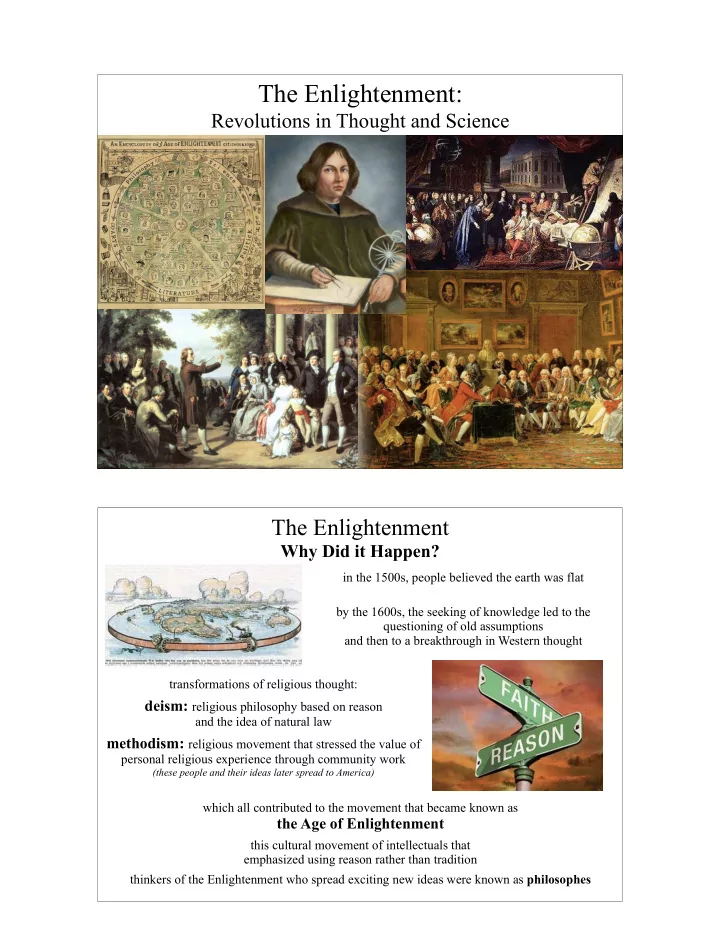
SLIDE 2 The Enlightenment: Revolution of Thought
natural law a universal moral law that could be understood by applying reason Thomas Hobbes (1588-1679) English political theorist said people form a social contract to live obediently under a ruler, because without a leader people naturally are violent and disorderly Leviathan (1651), showed a world without government in which life was “nasty, brutish, and short” Baron de Montesquieu (Charles-Louis de Secondat; 1689-1755) French political theorist who admired English government believed in the separation of powers legislative, executive, and judicial branches contributed to the Encyclopedie and wrote The Spirit of Laws (1748) Rene Descartes (1596-1650) French philosopher and mathematician believed truth must be reached through reason invented analytical geometry Discourse on Method (1637): “I think, therefore I am.” Jean-Jacques Rousseau (1712-1778) French philosopher born in Geneva to French Huguenot parents The Social Contract (1762): government should be made by the people Voltaire (Francois-Marie Arouet; 1694-1778) French satirist who was jailed twice for writing about the Church and insulting a nobleman Candide (1759): challenged the idea that everything works out for the best
“I disapprove of what you say, but I will defend to the death your right to say it.”
Immanuel Kant (1724-1804) German philosopher who claimed that there were two worlds the physical world, which is known through the senses the spiritual world, which is known through faith religion is real even though it can’t be scientifically explained
The Enlightenment: Revolution of Thought