The economic consequences of climate change, stock collapse, and - - PowerPoint PPT Presentation

the economic consequences of climate change stock
SMART_READER_LITE
LIVE PREVIEW

The economic consequences of climate change, stock collapse, and - - PowerPoint PPT Presentation

The economic consequences of climate change, stock collapse, and multi-species interactions in the Barents Sea fishery Do you like to cross disciplinary boundaries? We are looking for a motivated, open-minded, and qualified master student to


slide-1
SLIDE 1

The economic consequences of climate change, stock collapse, and multi-species interactions in the Barents Sea fishery

  • Do you like to cross disciplinary boundaries? We are looking for a

motivated, open-minded, and qualified master student to join our team

  • f two biologist (Dag Hjermann and Joel Durant) and one economist

(Florian Diekert).

  • Barents Sea north of Norway and Russia is a highly productive, yet

vulnerable ecosystem. It is home to one of Europe’s most important

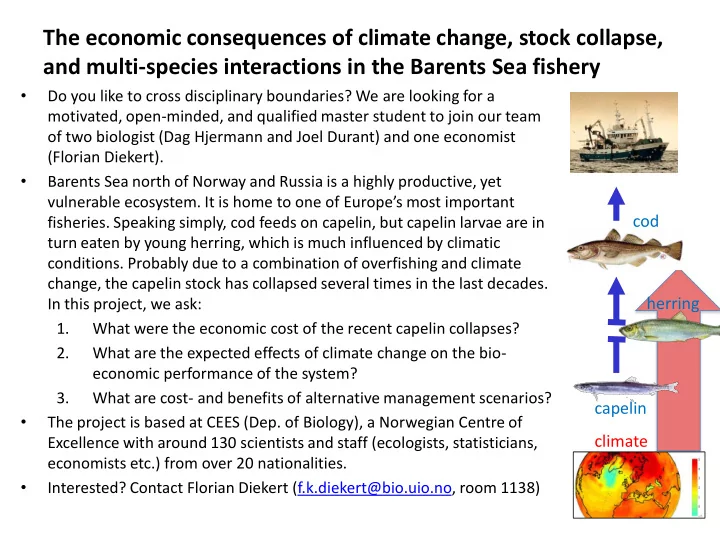
  • fisheries. Speaking simply, cod feeds on capelin, but capelin larvae are in

turn eaten by young herring, which is much influenced by climatic

  • conditions. Probably due to a combination of overfishing and climate

change, the capelin stock has collapsed several times in the last decades. In this project, we ask: 1. What were the economic cost of the recent capelin collapses? 2. What are the expected effects of climate change on the bio- economic performance of the system? 3. What are cost- and benefits of alternative management scenarios?

  • The project is based at CEES (Dep. of Biology), a Norwegian Centre of

Excellence with around 130 scientists and staff (ecologists, statisticians, economists etc.) from over 20 nationalities.

  • Interested? Contact Florian Diekert (f.k.diekert@bio.uio.no, room 1138)

cod capelin herring climate

slide-2
SLIDE 2

Possible topics

Andreas Kotsadam Room 1038 Andreas.Kotsadam@econ.uio.no

slide-3
SLIDE 3
  • Empirical development economics
  • E.g. Credit and risk, Evaluation of pension programs,

Effects of family law.

  • Trafficking and prostitution
  • E.g. Where are people trafficked from and why? What

determines the demand for prostitution?

  • Eldercare in Norway (possibilities for funding)
  • E.g. effects of informal care on employment.
slide-4
SLIDE 4

NINA (www.nina.no) coordinates an EU project entitled: “Assessing the role of economic instruments in policy mixes for biodiversity conservation and ecosystem services provision” (http://policymix.nina.no/). NINA is looking for 1-2 competent environmental economics master students as part of the Norwegian case study. Three specfic thesis tasks: – Cost-benefit analysis of expanding the voluntary forest conservation network in Norway – based

  • n empirical analysis of existing survey and other data.

– Assessment of distributional/equity impacts of state to municipal fiscal compensation for local conservation efforts. Some theory, some empirical analysis – Theoretical/conceptual issues in the economics of biodiversity and ecosystem services. Theoretical/conceptual thesis. The project will cover some costs and data collection and option for a desk at NINA at CIENS (right across the bridge from Blindern). There may be options for paid work on other projects. If interested, contact Henrik Lindhjem (henrik.lindhjem@nina.no) or David Barton (david.barton@nina.no).

Master project in environmental economics in coop. with Norwegian Institute for Nature Research (NINA)

slide-5
SLIDE 5
  • 1. CBA of forest conservation
  • What are the costs and benefits of

forest and biodiversity conservation in Norway?

  • Regression analysis on
  • Survey data on Willingness to pay for conservation
  • Various data on opportunity costs of conservation
  • Compare costs and benefits and

recommend ”optimal” level

  • Mostly empirical thesis
slide-6
SLIDE 6
  • 2. Incentives for local conservation efforts
  • Possible to reward municipalities

for conservation efforts

  • Based on disaggregated version of

the Norwegian Nature Index

  • Investigate distributional and
  • ther impacts of different designs of

the ”transfer key”.

  • Some theory, som empirical

analysis.

Source: Naturindeksen (DN 2010)

slide-7
SLIDE 7
  • 3. Theoretical issues in

ecosystem services regulation

  • Valuation and regulation of

biodiversity and ecosystem services  frontier in environmental economics

  • Thesis will discuss various

challenges to ES in economics

  • General equilibrium issues
  • Behavioural economics issues
  • Irreversibility, ”system flops”
  • Discounting
  • Etc

– Mostly theoretical/conceptual thesis

slide-8
SLIDE 8

Latin America projects

  • Gender effect of land titling and redistribution

– 1280 HH cross section, experiments, cualitative – How do women control HH income? – www.perulandgender.nibrinternational.no

  • Conflict over natural resources in Peru

– How minority blocks majority interests

  • ”Chavonomics”

– Political economy of polarized Venezuela

  • Like to join with master thesis?

– Send (i) CV (ii) grades/cources and (iii) 10 lines on your interest within these headlines to henrik.wiig@nibr.no – Support /contacts for fieldwork  but no financing  – Spanish an absolute and ”comparative” advantage

slide-9
SLIDE 9

Frischsenteret

Frisch and CREE scholarships

  • What is the Frisch Centre and CREE?
  • What do the scholarships involve?

– 20 000 NOK, office space (3-4 months) and supervision – Application deadline 1. March – Application should include

  • CV
  • Up-to-date grades
  • Description of planned subject area/research question
slide-10
SLIDE 10

Frischsenteret

What scholarships are available?

  • CREE scholarship (more info: cree.no)

– Thematically oriented: Environment, energy, climate – Up to 3 scholarships per year – Office space at the Frisch Centre, the Econ department or SSB (Statistics Norway)

  • Frisch scholarship (more info: frisch.no)

– Subject areas within the project portfolio of the Frisch Centre are prioritized (e.g., empirical labor economics, environment/energy) – Office space at the Frisch Centre

slide-11
SLIDE 11

11

Research Department at Statistics Norway Research areas and units

  • Energy and environmental economics

– Environmental economics (Taran Fæhn, tfn@ssb.no) – Energy economics (Mads Greaker, mgr@ssb.no)

  • Macroeconomics

– Macroeconomics (Torbjørn Eika, tea@ssb.no)

  • Microeconomics

– Microeconomics (Rolf Aaberge, roa@ssb.no) – Public economics (Nils Martin Stølen, nms@ssb.no)

  • Social and demographic research

– Social and demographic research (Kjetil Telle, tel@ssb.no)

  • Statistical methods and standards*

– Statistical methods and standards (Jan Bjørnstad, jab@ssb.no)

Web pages: English: http://www.ssb.no/english/research Norwegian: http://www.ssb.no/forskning

slide-12
SLIDE 12

12

Unit for Macroeconomics Research fields

  • Time-series econometrics

– Econometrics combines economic theory and statistics in the analysis and testing of economic

  • relations. Time series econometrics brings the temporal dimension into play, enabling a distinction

between short and longer-term relations between economic variables.

  • Macro econometric modelling

– Macro econometric modelling combines various econometric analyses of time series. Furthermore, the macro econometric models have input-output relations connecting the model’s product supply to its applications. There is an emphasis on using the conceptual and definitional terminology used for the national accounts.

  • Business cycle analysis and forecast

– Macroeconomic models and other methods are used to shed light on driving forces in the Norwegian economy over the short and medium term. Business cycle reports, including normally three- or four-year forecast, are published quarterly in Economic Survey. Analyses of historical developments are also conducted at irregular intervals.

slide-13
SLIDE 13

13

Unit for Macroeconomics Master thesis

  • Recent topics

– The housing market – Private consumption – Norwegian export and the Euro

  • Possible topics

– Modelling income flows in the housing sector – Business cycles – Norges Banks interest rate setting

  • Payed/unpayed
  • Interested?

– www.ssb.no/forskning og www.ssb.no/english/research – Contact Torbjørn Eika, tea@ssb.no