THE DEVELOPMENT OF THE GOSPEL TRADITION 1 The Development of the - - PDF document

the development of the gospel tradition
SMART_READER_LITE
LIVE PREVIEW

THE DEVELOPMENT OF THE GOSPEL TRADITION 1 The Development of the - - PDF document

Graduate Program in Pastoral Ministries PMIN 206 The Synoptic Gospels Dr. Catherine Murphy THE DEVELOPMENT OF THE GOSPEL TRADITION 1 The Development of the Gospel Tradition oral & written traditions developing 6 BCE 29 CE 51


slide-1
SLIDE 1

1

Graduate Program in Pastoral Ministries

PMIN 206 The Synoptic Gospels

  • Dr. Catherine Murphy

THE DEVELOPMENT OF THE GOSPEL TRADITION

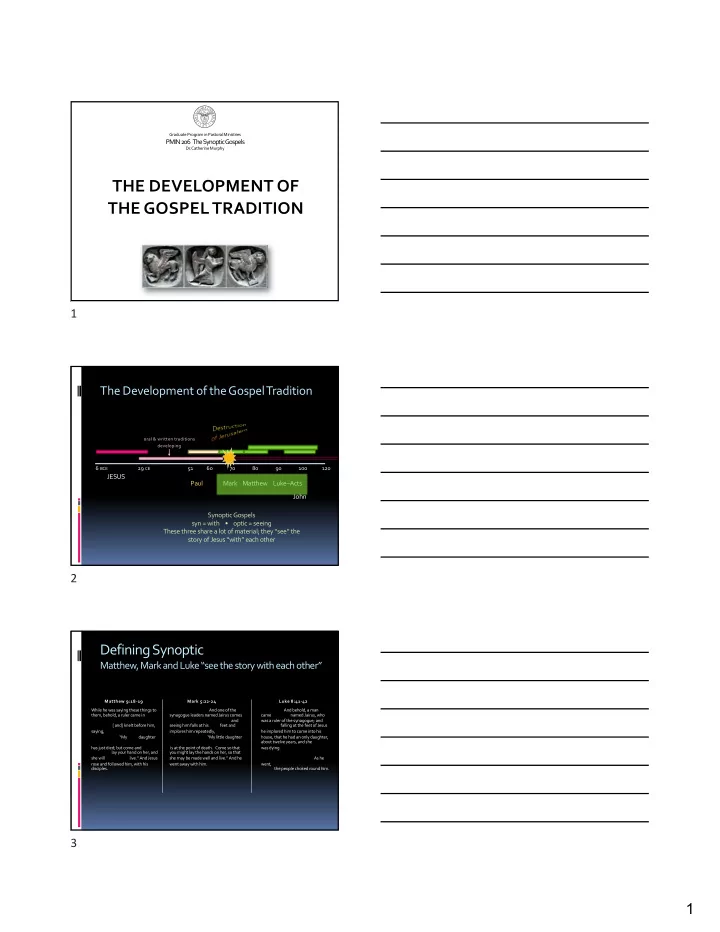
1 The Development of the Gospel Tradition

JESUS Mark Matthew

6 BCE 29 CE 51 60 70 80 90 100 120

Luke–Acts John Paul Synoptic Gospels syn = with • optic = seeing These three share a lot of material; they “see” the story of Jesus “with” each other

  • ral & written traditions

developing

2

Defining Synoptic

Matthew, Mark and Luke “see the story with each other”

While he was saying these things to them, behold, a ruler came in [ and] knelt before him, saying, “My daughter has just died; but come and lay your hand on her, and she will live.” And Jesus rose and followed him, with his disciples. Matthew 9:18-19 And one of the synagogue leaders named Jairus comes and seeing him falls at his feet and implores him repeatedly, “My little daughter is at the point of death. Come so that you might lay the hands on her, so that she may be made well and live.” And he went away with him. Mark 5:22-24 And behold, a man came named Jairus, who was a ruler of the synagogue; and falling at the feet of Jesus he implored him to come into his house, that he had an only daughter, about twelve years, and she was dying. As he went, the people choked round him. Luke 8:41-42

3

slide-2
SLIDE 2

1 What about John’s Gospel?

§ Only a handful of stories overlap § The parallels rarely parallel in vocabulary § There are entirely different stories recounted

nowhere else

§ The style and details are quite different

4

§ Jesus preexisted with God as the Word (John 1:1-5) and is conscious of it as a man (John 17:5) § John the Baptist does not baptize Jesus; they have simultaneous baptizing missions § the public ministry largely takes place in Jerusalem (3 trips), not Galilee § the kingdom of God teaching is largely absent § Jesus speaks in long discourses rather than episodic narrative and parables, and mostly about himself § there are no demonic possessions or exorcisms § there are very few miracles, and those include unique ones (Cana, man born blind, raising of Lazarus) § Jesus is arrested for reaction to raising Lazarus, not for cleansing Temple § there is no trial before the Sanhedrin, Jesus is not accused of blasphemy, and he dies on a different day John’s passion narrative exhibits only a 15.5% overlap with Mark’s passion narrative

Ways John Differs from the Synoptics

Raymond Brown, Introduction to the New Testament (New Haven, Connecticut: Yale University Press, 1997) 364-5

5

But John & Mark Share Some Interesting Features…

  • 1. Structure emphasizes the passion narrative

% of gospel before entry 63.8% 61.7% Triumphal entry into Jerusalem Mark 11:1–16:8 John 12:12–21:25 % of gospel in Jerusalem 36.2% 38.3% Mark John

  • 2. Focus on the revelation of the hidden messiah

% of gospel before arrest 87.2% 84.1% Arrest Mark 14:43-52 John 18:1-14 % of gospel after arrest 12.8% 15.9%

6

slide-3
SLIDE 3

3

Graduate Program in Pastoral Ministries

PMIN 206 The Synoptic Gospels

  • Dr. Catherine Murphy

THE SYNOPTIC PROBLEM & ITS SOLUTION

7

The Synoptic Gospels

§ Synoptic Gospels = Matthew-Mark-Luke

8

So What’s the Problem?

The Synoptic Problem

§ Matthew-Mark-Luke are SO similar that they must share some sources in common § But they are also different from each other § So how do we explain their literary relationship? This question is called the synoptic problem

9

slide-4
SLIDE 4

4 The Synoptic Gospels:

The Evidence

Case 1 Some material is shared by Mark, Matthew and Luke. This is called the Triple Tradition.

While he was thus speaking to them, behold, a ruler came in and knelt before him, saying, “My daughter has just died; but come and lay your hand on her, and she will live.” And Jesus rose and followed him, with his disciples. Matthew 9:18-19 Then came one of the rulers of the synagogue, Jairus by name; and seeing him, he fell at his feet, and besought him, saying, “My little daughter is at the point

  • f death.

Come and lay your hands on her, so that she may be made well, and live.” And he went with him. Mark 5:22-24 And there came a man named Jairus, who was a ruler of the synagogue; and falling at Jesus’ feet he besought him to come to his house, for he had an only daughter, about twelve years of age, and she was dying. As he went, the people pressed round him. Luke 8:41-42

10

The Synoptic Gospels:

The Evidence

Case 2 Some material is not in Mark at all, but is identical in Matthew and Luke. This is called the Double Tradition.

“He who loves father

  • r mother more than me is not worthy of

me; and he who loves son or daughter more than me is not worthy of me; and he who does not take his cross and follow me is not worthy of me. Matthew 10:37-38 Mark Now great multitudes accompanied him; and he turned and said to them, “If any one comes to me and does not hate his own father and mother and wife and children and brothers and sisters, yes, and even his own life, he cannot be my disciple. Whoever does not bear his own cross and come after me, cannot be my disciple. Luke 14:25-26

11

The Synoptic Gospels:

The Evidence

Case 3 Some material is only in Matthew, and some material is only in Luke.

Matthew Mark And he said, “There was a man who had two sons; and the younger of them said to his father, ‘Father, give me the share of property that falls to me.’ And he divided his living between them. Not many days later, the younger son gathered all he had and took his journey into a far country, and there he squandered his property in loose living. And when he had spent everything, a great famine arose in that country, and he began to be in want. So he went and joined himself to one of the citizens of that country, who sent him into his fields to feed swine. And he would gladly have fed on the pods that the swine ate; and no one gave him anything. But when he came to himself he said, ‘How many of my father’s hired servants have bread enough and to spare, but I perish here with hunger!...” Luke 15:11-32

12

slide-5
SLIDE 5

5 The Synoptic Gospels

The Consensus Solution: The Two-Source Hypothesis

The theory that the authors of Matthew and Luke used two shared sources for their gospels

  • the Gospel of Mark and
  • Q (from Quelle, German for “source” –

a list of sayings of Jesus) in addition to their own unique material. The theory is one way

  • f accounting for the synoptic problem.

13

The Synoptic Gospels

Why It’s the Consensus View

  • 1. Markan Priority
  • 2. “Q” (Q stands for Quelle, the German word for source)

¨

The style and theology of Mark’s gospel is rough. It’s easier to explain how later authors “cleaned up” Mark than to argue that Mark abbreviated the other gospels and created an inferior narrative.

¨

Matthew and Luke have all of Mark except 3 verses, and largely follow Mark’s order. Meanwhile, there’s a lot in Matthew and Luke that doesn’t appear in the other or in Mark.

¨

It’s reasonable to imagine that a list of Jesus’ sayings would have circulated.

¨

We’ve never found it, but the Gospel of Thomas is like it.

14

The Formation of the Gospels:

A Sketch

Matthew Luke M L 15

slide-6
SLIDE 6

6 The Synoptic Problem

Other Possible Solutions

Farrer Theory

Mark Matthew Luke

Two-Gospel Hypothesis

(or Griesbach Hypothesis)

A Protogospel

Matthew Luke Mark Matthew Mark Luke

Protogospel

16

The Synoptic Problem

The Two-Source Hypothesis

Matthew Mark Luke Q M

Parables: Wheat and Weeds (13:24-30, 36-43) Hidden Treasure (13:44) Pearl of Great Price (13:45-46) The Net (13:47-50) Unforgiving Servant (18:21-35) Laborers in the Vineyard (20:1-16) Two Sons (21:28-32) Wise & Foolish Virgins (25:1-13)

L

Some of the contents: Infancy stories (ch. 1–2) Parables: good Samaritan, friend at

midnight, rich fool, beatings, barren tree, guests/hosts, counting cost, lost sheep/ coin/son, shrewd manager, rich man and Lazarus, widow and judge, Pharisee and tax collector

Miracles: miraculous catch of fish, raising

  • f widow’s son, crippled woman, man

with dropsy, ten lepers

Passion Narrative: trial before Herod,

Emmaus, ascension

17

Graduate Program in Pastoral Ministries

PMIN 206 The Synoptic Gospels

  • Dr. Catherine Murphy

Q: SCOPE, COMMUNITY, TEACHING

18

slide-7
SLIDE 7

7 The Synoptic Problem

The Two-Source Hypothesis

Q

19

Q

§ What is it? § Where is it? § Who wrote it? § What are its characteristic themes, teachings,

motifs?

20

Q

What is it?

Definition: Q is a hypothetical oral or written source, primarily

  • f Jesus’ sayings, that Matthew and Luke utilized

in writing their gospels. Contents:

Preaching of John the Baptist 3:7-9 3:7-10 Temptation of Jesus 4:1-13 4:1-11 Beatitudes 6:20-23 5:3-12 Love of enemies 6:27-36 5:39-48; 7:12 On judging others 6:37-42 7:1-5; 10:24; 15:14 On bearing fruit 6:43-45 7:15-20 Parable of two builders 6:47-49 7:24-27 Healing of a centurion’s servant 7:1-10 8:5-10, 13 John the Baptist questions Jesus 7:18-35 11:2-19 Would-be disciples 9:57-60 8:19-22 Jesus’ missionary discourse 10:2-16 9:37-38; 10:9-15; 11:21-23 Thanksgiving to the Father 10:21-24 11:25-27; 13:16-17 The Lord’s Prayer 11:2-4 6:9-13 Asking and receiving 11:9-13 7:7-11 Jesus identified with Beelzebul 11:14-23 12:22-30 Return of an evil spirit 11:24-26 12:43-45 The sign of Jonah 11:29-32 12:38-42 On light 11:33-36 5:15; 6:22-23 Woe to the Pharisees 11:37-52 23:4-7, 13-36 Fear of humans and God 12:2-12 10:19; 26-33; 12:32 Do not worry about life 12:22-34 6:19-21, 25-33 Be ready for the master’s return 12:39-46 24:43-51 Divisions in the family 12:51-53 10:34-36 Signs of the times 12:54-56 16:2-3 Settle out of court 12:57-59 5:25-26 Parable of the leaven 13:20-21 13:33 The narrow door 13:23-30 7:13-14, 22-23; 8:11-12 Lament over Jerusalem 13:34-35 23:37-39 Parable of the banquet 14:15-24 22:1-14 Carrying the cross 14:26-27 10:37-38 Parable of the lost sheep 15:1-7 18:12-14 On serving two masters 16:13 6:24 Role of the law and prophets 16:16-17 5:18; 11:13 Rebuking and forgiving sin 17:1-4 18:6-7, 15, 20-22 The day of the Son of Man 17:23-27, 33-37 24:17-18, 26-28, 37-41 Parable of the talents 19:11-27 25:14-30 Luke Matthew Luke Matthew No birth story, call of disciples No passion or resurrection

21

slide-8
SLIDE 8

8

“He who loves father or mother more than me is not worthy of me; and he who loves son or daughter more than me is not worthy of me; and he who does not take his cross and follow after me is not worthy of me.” Matthew 10:37-38 Mark Great crowds accompanied him; and turning around he said to them, “If any one comes to me and does not hate his own father and mother and wife and children and brothers and sisters, yes, and even his own life, he is unable to be my disciple. Whoever does not bear his own cross and come after me, is not able to be my disciple.” Luke 14:25-26 Jesus said, “Whoever does not hate father and mother cannot be my disciple, and whoever does not hate brothers and sisters, and carry the cross as I do, will not be worthy of me.” Thomas 55

Q

Why does it follow Luke’s ch:vsorder and designations?

Found in the Nag Hammadi codices in

  • 1945. Though written in the mid-100s CE—

a century after Q—it has many Q sayings, and is ONL Y sayings (114 of them) Q 14:25-26

22

Q

Where is it?

§ We have never found a free-standing copy of it § But its “fingerprints” are in all those passages shared by Matthew and Luke § And the Gospel of Thomas, a list of 114 sayings, gives credence to the thesis of its existence § Was it an oral tradition, or written?

Robinson, Hoffmann and Kloppenborg The Critical Edition of Q Hermeneia Commentary (Minneapolis: Fortress, 2000) 581 pages

§ The sayings were likely organized for performance into clusters or speeches

23

Q

Who Wrote It?

§ Village scribes in the Galilee § Supporters of an early itinerant, radical tradition associated with following Jesus § To understand the attraction of Jesus’ call to follow him, we need to understand the pressures on village folk in the first century CE

24

slide-9
SLIDE 9

9

63 BCE Pompey takes region for Rome 40 BCE Roman senate appoints Herod ”King of the Jews” 37 BCE Herod secures control Judea Idumea Gaza Samaria Perea Galilee Gaulanitis Launches a huge building and infra- structure program, honoring the Emperor wherever he can 37 - 4 BCE

25 26

4 BCE Herod dies, and 3 sons split his kingdom; Philip builds Caesarea Philippi 6 CE Herod Archelaus can’t control the south, so the Romans take over direct administration Judea Idumea Gaza Samaria Perea Galilee Gaulanitis Herod Antipas builds the city of Tiberias to honor the new emperor in 20 CE

27

slide-10
SLIDE 10

10

  • The Herodian building program

in Galilee before and during Jesus’ time created social tensions

ü more effective tax collection ü progressive monetization of the economy ü increased trade ü increased cash cropping ü increased consolidation of landholding and consequent tenancy

  • Village scribes were adversely

affected

  • Q1 - Rhetoric of uprootedness

and inversion; ethos of communalism

Q

Who Wrote It?

28

Q

Teachings

§ A focus on Jesus as a teacher of wisdom § Itinerant radicalism

ú a call to a new orientation: God as ruler, Jesus as model ú renounce worldly security

§ No attention to cross and resurrection (past events) § Expectation of second coming or παρουσια (future event), when followers would be delivered and the wicked judged § Emphasis on covenant traditions of Jewish scripture, and to covenant renewal of community

29

Graduate Program in Pastoral Ministries

PMIN 206 The Synoptic Gospels

  • Dr. Catherine Murphy

REDACTION CRITICISM

30

slide-11
SLIDE 11

11 Practicing Redaction Criticism

Our Two Approaches So Far

Narrative Criticism

Study episode plotting for clues about the design of the narrative. This will yield some sense of the gospel’s core themes.

Redaction Criticism

Study how the later editor (Matthew or Luke) edited his source (Mark). This too will yield some sense

  • f the gospel’s core themes.

31

Redaction Defined

Redaction is the activity of collecting, arranging, editing, and modifying sources to adapt their message to new circumstances and to the redactor’s

  • wn theological perspective.

32

Are Matthew and Luke Mere Copiers?

§ It’s important to both of them to preserve tradition § It’s equally important to edit it

Redaction is the activity of collecting, arranging, editing, and modifying sources to adapt their message to new circumstances and to the redactor’s

  • wn theological perspective.

33

slide-12
SLIDE 12

12 Practicing Redaction Criticism

The Chief Tool: A Synopsis

(Workbook pp. 89-92)

  • How it’s arranged
  • Navigating a synopsis

34

A Synopsis

How It’s Arranged

35

A Synopsis

Navigating an Entry

  • 1. Passage header
  • 2. Running page header
  • 3. Synopsis # and title
  • 4. Compare (duplicate entry)
  • 5. Related passages (tiny

font)

  • 6. Absolute line numbers

(for all passages)

  • 7. Apparatus: major English

translations/versions

  • 8. Apparatus: Biblical

allusions

36

slide-13
SLIDE 13

13 A Synopsis

Introducing Redaction Criticism

  • 2. Identify similarities and

differences

  • 3. Rank differences from

most to least significant

  • 4. Propose a theory to

account for the later editor’s most significant change(s).

  • 1. Select your later editor and

identify the base text.

Matthew makes the questioners hostile, and changes scribe to Pharisees/lawyer Matthew removes the beginning

  • f Deuteronomy 6:5 (before the

actual commandment)

37

Practicing Redaction Criticism

The Chief Tool: A Synopsis

(Workbook pp. 89-92)

  • How to find your passage
  • Running header
  • Index of Gospel Parallels
  • Index of NT Passages

38

Practicing Redaction Criticism

Matthew as Redactor: A Shared Exercise on §47

  • Identify similarities and differences
  • Rank differences from most to least significant
  • Propose theory to account for later editor’s

changes

39

slide-14
SLIDE 14

14 Exercise for Next Class

Workbook p. 92

  • Identify similarities and differences
  • Rank differences from most to least significant
  • Propose theory to account for later editor’s changes
  • Select a passage in which Matthew depends on Mark

40