The Culture of Policing in Japan The difference between honor-based - - PowerPoint PPT Presentation

the culture of policing in japan
SMART_READER_LITE
LIVE PREVIEW

The Culture of Policing in Japan The difference between honor-based - - PowerPoint PPT Presentation

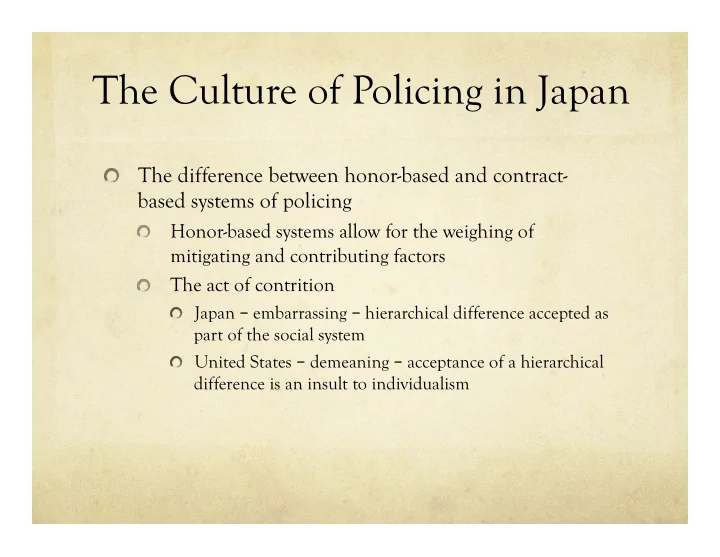
The Culture of Policing in Japan The difference between honor-based and contract- based systems of policing Honor-based systems allow for the weighing of mitigating and contributing factors The act of contrition Japan embarrassing


slide-1
SLIDE 1

The Culture of Policing in Japan

The difference between honor-based and contract-

based systems of policing

Honor-based systems allow for the weighing of mitigating and contributing factors The act of contrition

Japan – embarrassing – hierarchical difference accepted as

part of the social system

United States – demeaning – acceptance of a hierarchical

difference is an insult to individualism

slide-2
SLIDE 2

The Culture of Policing in Japan

Giri – duty; obligation Ninjo – sympathy one feels for another Meiyo – honor tied to reputation

slide-3
SLIDE 3

The Culture of Policing in Japan

Culture and Contrition Folktales and personal responsibility – moral different in Japan

Goldilocks asks forgiveness for her transgressions The wolf in Little Red Riding Hood is contrite

slide-4
SLIDE 4

The Culture of Policing in Japan

Clearance rates for serious crimes (1988):

Japan

Homicide 98% Rape 87% Robbery 78% Assault 93% Larceny 60%

United States 20.9%

Admission of guilt – prosecuted suspects (1989):

Japan 95% United State 50%

Admission of guilt all known crimes – overall (1989)

Japan 37% United States 5.3%

slide-5
SLIDE 5

The Culture of Policing in Japan

Incarceration rates (1987):

Japan 44.2 per 100,000 United States 228 per 100,000

Recidivism rates (1987):

Japan 47% within 3 years United State 41% within 3 years

The United States appears to incarcerate many who do need to be separated from society In Japan, incarceration is a last resort

Rate significantly lower, recidivism slightly higher

slide-6
SLIDE 6

The Culture of Policing in Japan

Justice system

Adversarial (US) vs. Inquisitorial (Japan—even though the system of justice is based on the US system)

In the United States the police officer enforces the law In Japan the police officer is a criminal catcher, teacher,

and a moralist

slide-7
SLIDE 7

The Culture of Policing in Japan

slide-8
SLIDE 8

Yakuza – Organized Crime Japanese Style

Yakuza (Boryokudan) roots

Bakuto – gamblers Tekiya – itinerant peddlers

Etymology

ya ku sa – eight, nine, three; a reference to a losing hand in the Japanese card game Oicho-Kabu

slide-9
SLIDE 9

Yakuza – Organized Crime Japanese Style

Why do Yakuza exist? They are functional to society Emile Durkheim – noted the functions of deviance Creates social borders Defines morality Clarifies cultural values Creates in and out groups Fosters social cohesion Brings about social innovation

slide-10
SLIDE 10

Yakuza – Organized Crime Japanese Style

The relationship between government and Yakuza

Yakuza thrive during times of social upheaval Gurentai service the underground economy – Black market hoodlums Tehaishi are Yakuza related labor-brokers

The main business of Yakuza – Protection

Protection from the harassment of others Protection from those who protect

slide-11
SLIDE 11

Yakuza – Organized Crime Japanese Style

Sokaiya - corporate blackmailers

Predatory Sokaiya - corporate blackmailers who disrupt shareholder meetings Protective Sokaiya those who stop others from disrupting shareholder meetings

Minbo – the violent intervention in civil affairs

Insurance scams and out of court settlements Debt collection Financial and corporate racketeering Crisis management

Jiage – land sharking

“Assisting” with lease terminations and property sales

slide-12
SLIDE 12

Yakuza – Organized Crime Japanese Style

Other sources of income

Tekiya – outdoor stalls Clubs, bars and massage houses – protection and occasionally

  • peration

Illegal disposing of industrial waste Bankruptcy management Real estate Money-lending Amphetamine dealing [frowned upon] Crisis management Internet scams

slide-13
SLIDE 13

Yakuza – Organized Crime Japanese Style

Relationships

Oyabun-Kobun (father-son) Kyodaibun (brother [older/younger])

slide-14
SLIDE 14

Yakuza – Organized Crime Japanese Style

Symbols of Yakusa

Yubitsume [enkozume] - finger amputation Irezumi - body tattoos

slide-15
SLIDE 15

Yakuza – Organized Crime Japanese Style

slide-16
SLIDE 16

Yakuza – Organized Crime Japanese Style

slide-17
SLIDE 17

Yakuza – Organized Crime Japanese Style

Commonality of Yakuza/other mafia enterprises All are honor-based enterprises Many of the same business enterprises

Protection; Violence (or the threat of); Gambling;

Prostitution; Distribution and Sale of Drugs; Bars; Money lending—especially to sub-prime candidates; Real estate “services;” Money Laundering; Scams; Socio-political Intermediaries, etc.

Operating outside the recognized and accepted juridical

apparatuses