
SLIDE 1
The continuum between consent to be bound and treaty interpretation
In the International Court of Justice
subsequent agreements subsequent practice
(VCLT)
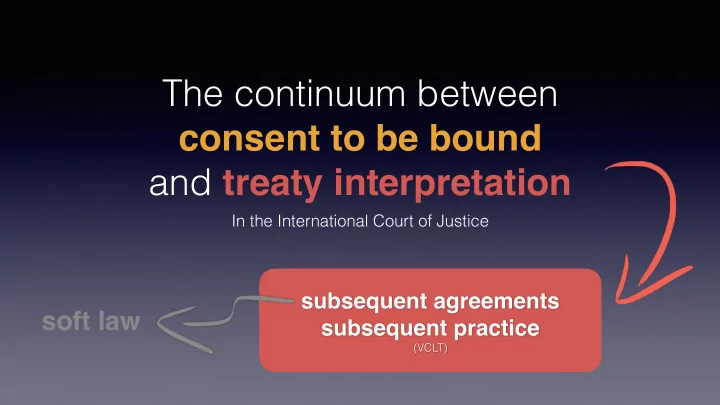
The continuum between consent to be bound and treaty interpretation - - PowerPoint PPT Presentation
The continuum between consent to be bound and treaty interpretation In the International Court of Justice subsequent agreements soft law subsequent practice (VCLT) Adv. Op. Wall in the Occupied Adv. Op. Certain Expenses Palestinian Territory
In the International Court of Justice
(VCLT)
Nuclear Test Cases Kasikili/Sedudu Island case Vienna Convention on the Law of Treaties
Dispute Regarding Navigational and Related Rights (Costa Rica v Nicaragua)
Whaling in the Antarctic
ILC’s draft conclusions on subsequent agreements and subsequent practice in relation to the interpretation of treaties
Vienna Convention on the Law of Treaties
Article 31 General rule of interpretation 1.A treaty shall be interpreted in good faith in accordance with the ordinary meaning to be given to the terms of the treaty in their context and in the light of its
2.The context for the purpose of the interpretation of a treaty shall comprise, in addition to the text, including its preamble and annexes: (a) any agreement relating to the treaty which was made between all the parties in connection with the conclusion
(b) any instrument which was made by one or more parties in connection with the conclusion of the treaty and accepted by the other parties as an instrument related to the treaty. 3.There shall be taken into account, together with the context: (a) any subsequent agreement between the parties regarding the interpretation of the treaty or the application of its provisions; (b) any subsequent practice in the application of the treaty which establishes the agreement of the parties regarding its interpretation; (c) any relevant rules of international law applicable in the relations between the parties. 4.A special meaning shall be given to a term if it is established that the parties so intended. Article 31 General rule of interpretation 1.A treaty shall be interpreted in good faith in accordance with the ordinary meaning to be given to the terms of the treaty in their context and in the light of its
2.The context for the purpose of the interpretation of a treaty shall comprise, in addition to the text, including its preamble and annexes: (a) any agreement relating to the treaty which was made between all the parties in connection with the conclusion
(b) any instrument which was made by one or more parties in connection with the conclusion of the treaty and accepted by the other parties as an instrument related to the treaty. 3.There shall be taken into account, together with the context: (a) any subsequent agreement between the parties regarding the interpretation of the treaty or the application of its provisions; (b) any subsequent practice in the application of the treaty which establishes the agreement of the parties regarding its interpretation; (c) any relevant rules of international law applicable in the relations between the parties. 4.A special meaning shall be given to a term if it is established that the parties so intended. Article 31 General rule of interpretation 1.A treaty shall be interpreted in good faith in accordance with the ordinary meaning to be given to the terms of the treaty in their context and in the light of its
2.The context for the purpose of the interpretation of a treaty shall comprise, in addition to the text, including its preamble and annexes: (a) any agreement relating to the treaty which was made between all the parties in connection with the conclusion
(b) any instrument which was made by one or more parties in connection with the conclusion of the treaty and accepted by the other parties as an instrument related to the treaty. 3.There shall be taken into account, together with the context: (a) any subsequent agreement between the parties regarding the interpretation of the treaty or the application of its provisions; (b) any subsequent practice in the application of the treaty which establishes the agreement of the parties regarding its interpretation; (c) any relevant rules of international law applicable in the relations between the parties. 4.A special meaning shall be given to a term if it is established that the parties so intended.
International Convention for the Regulation of Whaling
Judgement on Whaling In The Antarctic (Australia V. Japan: New Zealand intervening)
First, many IWC resolutions were adopted without the support
concurrence of Japan. Thus, such instruments cannot be regarded
subsequent practice establishing an agreement of the parties regarding the interpretation of the treaty within the meaning of subparagraphs
attempt to regulate the treaty?
Article 31 General rule of interpretation 1.A treaty shall be interpreted in good faith in accordance with the ordinary meaning to be given to the terms of the treaty in their context and in the light of its
2.The context for the purpose of the interpretation of a treaty shall comprise, in addition to the text, including its preamble and annexes: (a) any agreement relating to the treaty which was made between all the parties in connection with the conclusion
(b) any instrument which was made by one or more parties in connection with the conclusion of the treaty and accepted by the other parties as an instrument related to the treaty. 3.There shall be taken into account, together with the context: (a) any subsequent agreement between the parties regarding the interpretation of the treaty or the application of its provisions; (b) any subsequent practice in the application of the treaty which establishes the agreement of the parties regarding its interpretation; (c) any relevant rules of international law applicable in the relations between the parties. 4.A special meaning shall be given to a term if it is established that the parties so intended. Article 31 General rule of interpretation 1.A treaty shall be interpreted in good faith in accordance with the ordinary meaning to be given to the terms of the treaty in their context and in the light of its
2.The context for the purpose of the interpretation of a treaty shall comprise, in addition to the text, including its preamble and annexes: (a) any agreement relating to the treaty which was made between all the parties in connection with the conclusion
(b) any instrument which was made by one or more parties in connection with the conclusion of the treaty and accepted by the other parties as an instrument related to the treaty. 3.There shall be taken into account, together with the context: (a) any subsequent agreement between the parties regarding the interpretation of the treaty or the application of its provisions; (b) any subsequent practice in the application of the treaty which establishes the agreement of the parties regarding its interpretation; (c) any relevant rules of international law applicable in the relations between the parties. 4.A special meaning shall be given to a term if it is established that the parties so intended. Article 39 General rule regarding the amendment of treaties A treaty may be amended by agreement between the parties. The rules laid down in Part II apply to such an agreement except insofar as the treaty may otherwise provide.
attempt to regulate the treaty?
See H. Kelsen, Pure Theory of Law 348 (Knight trans. from German, 2d ed. 1967); K. Larenz, Methodenlehre der Rechtswissenschaft (5th ed. 1983)
In the International Court of Justice
(VCLT)
(paragraph 21 of the commentary to draft conclusion 7)
Paragraph 27