The Consensus Problem Roger Wattenhofer thread a lot of kudos to - - PowerPoint PPT Presentation

the consensus problem
SMART_READER_LITE
LIVE PREVIEW

The Consensus Problem Roger Wattenhofer thread a lot of kudos to - - PowerPoint PPT Presentation

Sequential Computation The Consensus Problem Roger Wattenhofer thread a lot of kudos to memory Maurice Herlihy and Costas Busch Distributed for some of Computing their slides Group object object Distributed Computing Group


slide-1
SLIDE 1

Distributed Computing Group

The Consensus Problem

Roger Wattenhofer a lot of kudos to Maurice Herlihy and Costas Busch for some of their slides

Distributed Computing Group Roger Wattenhofer 2

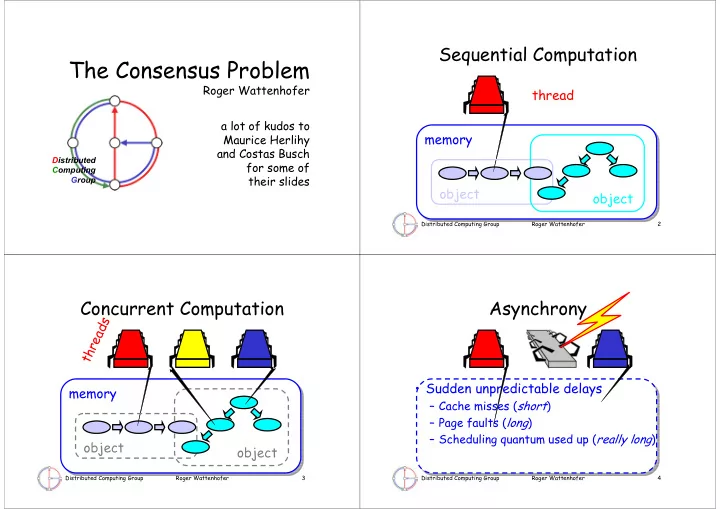
Sequential Computation

memory

  • bject
  • bject

thread

Distributed Computing Group Roger Wattenhofer 3

Concurrent Computation

memory

  • bject
  • bject

t h r e a d s

Distributed Computing Group Roger Wattenhofer 4

Asynchrony

  • Sudden unpredictable delays

– Cache misses (short) – Page faults (long) – Scheduling quantum used up (really long)

slide-2
SLIDE 2

Distributed Computing Group Roger Wattenhofer 5

Model Summary

  • Multiple threads

– Sometimes called processes

  • Single shared memory
  • Objects live in memory
  • Unpredictable asynchronous delays

Distributed Computing Group Roger Wattenhofer 6

Road Map

  • We are going to focus on principles

– Start with idealized models – Look at a simplistic problem – Emphasize correctness over pragmatism – “Correctness may be theoretical, but incorrectness has practical impact”

Distributed Computing Group Roger Wattenhofer 7

You may ask yourself …

I’m no theory weenie - why all the theorems and proofs?

Distributed Computing Group Roger Wattenhofer 8

Fundamentalism

  • Distributed & concurrent systems are

hard

– Failures – Concurrency

  • Easier to go from theory to practice

than vice-versa

slide-3
SLIDE 3

Distributed Computing Group Roger Wattenhofer 9

The Two Generals

Red army wins If both sides attack together

Distributed Computing Group Roger Wattenhofer 10

Communications

Red armies send messengers across valley

Distributed Computing Group Roger Wattenhofer 11

Communications

Messengers don’t always make it

Distributed Computing Group Roger Wattenhofer 12

Your Mission Design a protocol to ensure that red armies attack simultaneously

slide-4
SLIDE 4

Distributed Computing Group Roger Wattenhofer 13

Real World Generals

Date: Wed, 11 Dec 2002 12:33:58 +0100 From: Friedemann Mattern <mattern@inf.ethz.ch> To: Roger Wattenhofer <wattenhofer@inf.ethz.ch> Subject: Vorlesung Sie machen jetzt am Freitag, 08:15 die Vorlesung Verteilte Systeme, wie vereinbart. OK? (Ich bin jedenfalls am Freitag auch gar nicht da.) Ich uebernehme das dann wieder nach den Weihnachtsferien.

Distributed Computing Group Roger Wattenhofer 14

Real World Generals

Date: Mi 11.12.2002 12:34 From: Roger Wattenhofer <wattenhofer@inf.ethz.ch> To: Friedemann Mattern <mattern@inf.ethz.ch> Subject: Re: Vorlesung

  • OK. Aber ich gehe nur, wenn sie diese Email nochmals

bestaetigen... :-) Gruesse -- Roger Wattenhofer

Distributed Computing Group Roger Wattenhofer 15

Real World Generals

Date: Wed, 11 Dec 2002 12:53:37 +0100 From: Friedemann Mattern <mattern@inf.ethz.ch> To: Roger Wattenhofer <wattenhofer@inf.ethz.ch> Subject: Naechste Runde: Re: Vorlesung ... Das dachte ich mir fast. Ich bin Praktiker und mache es schlauer: Ich gehe nicht, unabhaengig davon, ob Sie diese email bestaetigen (beziehungsweise rechtzeitig erhalten). (:-)

Distributed Computing Group Roger Wattenhofer 16

Real World Generals

Date: Mi 11.12.2002 13:01 From: Roger Wattenhofer <wattenhofer@inf.ethz.ch> To: Friedemann Mattern <mattern@inf.ethz.ch> Subject: Re: Naechste Runde: Re: Vorlesung ... Ich glaube, jetzt sind wir so weit, dass ich diese Emails in der Vorlesung auflegen werde...
slide-5
SLIDE 5

Distributed Computing Group Roger Wattenhofer 17

Real World Generals

Date: Wed, 11 Dec 2002 18:55:08 +0100 From: Friedemann Mattern <mattern@inf.ethz.ch> To: Roger Wattenhofer <wattenhofer@inf.ethz.ch> Subject: Re: Naechste Runde: Re: Vorlesung ... Kein Problem. (Hauptsache es kommt raus, dass der Prakiker am Ende der schlauere ist... Und der Theoretiker entweder heute noch auf das allerletzte Ack wartet oder wissend das das ja gar nicht gehen kann alles gleich von vornherein bleiben laesst... (:-))

Distributed Computing Group Roger Wattenhofer 18

Theorem There is no non-trivial protocol that ensures the red armies attacks simultaneously

Distributed Computing Group Roger Wattenhofer 19

Proof Strategy

  • Assume a protocol exists
  • Reason about its properties
  • Derive a contradiction

Distributed Computing Group Roger Wattenhofer 20

Proof

1. Consider the protocol that sends fewest messages

  • 2. It still works if last message lost
  • 3. So just don’t send it

– Messengers’ union happy

  • 4. But now we have a shorter protocol!
  • 5. Contradicting #1
slide-6
SLIDE 6

Distributed Computing Group Roger Wattenhofer 21

Fundamental Limitation

  • Need an unbounded number of

messages

  • Or possible that no attack takes

place

Distributed Computing Group Roger Wattenhofer 22

You May Find Yourself …

I want a real-time YAFA compliant Two Generals protocol using UDP datagrams running on our enterprise-level fiber tachyion network ... I want a real-time YAFA compliant Two Generals protocol using UDP datagrams running on our enterprise-level fiber tachyion network ...

Distributed Computing Group Roger Wattenhofer 23

You might say

I want a real-time YAFA compliant Two Generals protocol using UDP datagrams running on our enterprise-level fiber tachyion network ... Yes, Ma’am, right away! Yes, Ma’am, right away!

Distributed Computing Group Roger Wattenhofer 24

You might say

I want a real-time dot-net compliant Two Generals protocol using UDP datagrams running on our enterprise-level fiber tachyion network ... Yes, Ma’am, right away!

Advantage:

  • Buys time to find another job
  • No one expects software to work

anyway

Advantage:

  • Buys time to find another job
  • No one expects software to work

anyway

slide-7
SLIDE 7

Distributed Computing Group Roger Wattenhofer 25

You might say

I want a real-time dot-net compliant Two Generals protocol using UDP datagrams running on our enterprise-level fiber tachyion network ... Yes, Ma’am, right away!

Advantage:

  • Buys time to find another job
  • No one expects software to work

anyway

Disadvantage:

  • You’re doomed
  • Without this course, you may

not even know you’re doomed

Disadvantage:

  • You’re doomed
  • Without this course, you may

not even know you’re doomed

Distributed Computing Group Roger Wattenhofer 26

You might say

I want a real-time YAFA compliant Two Generals protocol using UDP datagrams running on our enterprise-level fiber tachyion network ... I can’t find a fault-tolerant algorithm, I guess I’m just a pathetic loser. I can’t find a fault-tolerant algorithm, I guess I’m just a pathetic loser.

Distributed Computing Group Roger Wattenhofer 27

You might say

I want a real-time YAFA compliant Two Generals protocol using UDP datagrams running on our enterprise-level fiber tachyion network ... I can’t find a fault-tolerant algorithm, I guess I’m just a pathetic loser I can’t find a fault-tolerant algorithm, I guess I’m just a pathetic loser

Advantage:

  • No need to take course

Advantage:

  • No need to take course

Distributed Computing Group Roger Wattenhofer 28

You might say

I want a real-time YAFA compliant Two Generals protocol using UDP datagrams running on our enterprise-level fiber tachyion network ... I can’t find a fault-tolerant algorithm, I guess I’m just a pathetic loser I can’t find a fault-tolerant algorithm, I guess I’m just a pathetic loser

Advantage:

  • No need to take course

Advantage:

  • No need to take course

Disadvantage:

  • Boss fires you, hires

University St. Gallen graduate

Disadvantage:

  • Boss fires you, hires

University St. Gallen graduate

slide-8
SLIDE 8

Distributed Computing Group Roger Wattenhofer 29

You might say

I want a real-time YAFA compliant Two Generals protocol using UDP datagrams running on our enterprise-level fiber tachyion network ... Using skills honed in course, I can avert certain disaster!

  • Rethink problem spec, or
  • Weaken requirements, or
  • Build on different platform

Using skills honed in course, I can avert certain disaster!

  • Rethink problem spec, or
  • Weaken requirements, or
  • Build on different platform

Distributed Computing Group Roger Wattenhofer 30

Consensus: Each Thread has a Private Input

32 19 21

Distributed Computing Group Roger Wattenhofer 31

They Communicate

Distributed Computing Group Roger Wattenhofer 32

They Agree on Some Thread’s Input

19 19 19

slide-9
SLIDE 9

Distributed Computing Group Roger Wattenhofer 33

Consensus is important

  • With consensus, you can implement

anything you can imagine…

  • Examples: with consensus you can

decide on a leader, implement mutual exclusion, or solve the two generals problem

Distributed Computing Group Roger Wattenhofer 34

You gonna learn

  • In some models, consensus is possible
  • In some other models, it is not
  • Goal of this and next lecture: to learn

whether for a given model consensus is possible or not … and prove it!

Distributed Computing Group Roger Wattenhofer 35

Consensus #1 shared memory

  • n processors, with n > 1
  • Processors can atomically read or

write (not both) a shared memory cell

Distributed Computing Group Roger Wattenhofer 36

Protocol (Algorithm?)

  • There is a designated memory cell c.
  • Initially c is in a special state “?”
  • Processor 1 writes its value v1 into c,

then decides on v1.

  • A processor j (j not 1) reads c until j

reads something else than “?”, and then decides on that.

slide-10
SLIDE 10

Distributed Computing Group Roger Wattenhofer 37

Unexpected Delay

Swapped out back at

??? ???

Distributed Computing Group Roger Wattenhofer 38

Heterogeneous Architectures

??? ???

Pentium Pentium 286

yawn

(1)

Distributed Computing Group Roger Wattenhofer 39

Fault-Tolerance ??? ???

Distributed Computing Group Roger Wattenhofer 40

Consensus #2 wait-free shared memory

  • n processors, with n > 1
  • Processors can atomically read or

write (not both) a shared memory cell

  • Processors might crash (halt)
  • Wait-free implementation… huh?
slide-11
SLIDE 11

Distributed Computing Group Roger Wattenhofer 41

Wait-Free Implementation

  • Every process (method call)

completes in a finite number of steps

  • Implies no mutual exclusion
  • We assume that we have wait-free

atomic registers (that is, reads and writes to same register do not

  • verlap)

Distributed Computing Group Roger Wattenhofer 42

A wait-free algorithm…

  • There is a cell c, initially c=“?”
  • Every processor i does the following

r = Read(c); if (r == “?”) then Write(c, vi); decide vi; else decide r;

Distributed Computing Group Roger Wattenhofer 43

Is the algorithm correct?

time cell c

32 17

? ? ?

32 17 32! 17!

Distributed Computing Group Roger Wattenhofer 44

Theorem: No wait-free consensus

??? ???

slide-12
SLIDE 12

Distributed Computing Group Roger Wattenhofer 45

Proof Strategy

  • Make it simple

– n = 2, binary input

  • Assume that there is a protocol
  • Reason about the properties of any

such protocol

  • Derive a contradiction

Distributed Computing Group Roger Wattenhofer 46

Wait-Free Computation

  • Either A or B “moves”
  • Moving means

– Register read – Register write A moves B moves

Distributed Computing Group Roger Wattenhofer 47

The Two-Move Tree

Initial state Final states

Distributed Computing Group Roger Wattenhofer 48

Decision Values

1

1 1 1

slide-13
SLIDE 13

Distributed Computing Group Roger Wattenhofer 49

Bivalent: Both Possible

1 1 1 bivalent

1

Distributed Computing Group Roger Wattenhofer 50

Univalent: Single Value Possible

1 1 1 univalent

1

Distributed Computing Group Roger Wattenhofer 51

1-valent: Only 1 Possible

1 1 1 1-valent

1

Distributed Computing Group Roger Wattenhofer 52

0-valent: Only 0 possible

1 1 1 0-valent

1

slide-14
SLIDE 14

Distributed Computing Group Roger Wattenhofer 53

Summary

  • Wait-free computation is a tree
  • Bivalent system states

– Outcome not fixed

  • Univalent states

– Outcome is fixed – May not be “known” yet – 1-Valent and 0-Valent states

Distributed Computing Group Roger Wattenhofer 54

Claim

Some initial system state is bivalent (The outcome is not always fixed from the start.)

Distributed Computing Group Roger Wattenhofer 55

A 0-Valent Initial State

  • All executions lead to decision of 0

Distributed Computing Group Roger Wattenhofer 56

A 0-Valent Initial State

  • Solo execution by A also decides 0
slide-15
SLIDE 15

Distributed Computing Group Roger Wattenhofer 57

A 1-Valent Initial State

  • All executions lead to decision of 1

1 1

Distributed Computing Group Roger Wattenhofer 58

A 1-Valent Initial State

  • Solo execution by B also decides 1

1

Distributed Computing Group Roger Wattenhofer 59

A Univalent Initial State?

  • Can all executions lead to the same

decision?

1

Distributed Computing Group Roger Wattenhofer 60

State is Bivalent

  • Solo execution by A

must decide 0

  • Solo execution by B

must decide 1

1

slide-16
SLIDE 16

Distributed Computing Group Roger Wattenhofer 61

0-valent

Critical States

1-valent critical

Distributed Computing Group Roger Wattenhofer 62

Critical States

  • Starting from a bivalent initial state
  • The protocol can reach a critical

state

– Otherwise we could stay bivalent forever – And the protocol is not wait-free

Distributed Computing Group Roger Wattenhofer 63

From a Critical State

c

If A goes first, protocol decides 0 If B goes first, protocol decides 1 0-valent 1-valent

Distributed Computing Group Roger Wattenhofer 64

Model Dependency

  • So far, memory-independent!
  • True for

– Registers – Message-passing – Carrier pigeons – Any kind of asynchronous computation

slide-17
SLIDE 17

Distributed Computing Group Roger Wattenhofer 65

What are the Threads Doing?

  • Reads and/or writes
  • To same/different registers

Distributed Computing Group Roger Wattenhofer 66

Possible Interactions

? ? ? ?

y.write()

? ? ? ?

x.write()

? ? ? ?

y.read()

? ? ? ?

x.read() y.write() x.write() y.read() x.read()

Distributed Computing Group Roger Wattenhofer 67

Reading Registers

A runs solo, decides 0 B reads x

1

A runs solo, decides 1

c

States look the same to A

Distributed Computing Group Roger Wattenhofer 68

Possible Interactions

? ? no no

y.write()

? ? no no

x.write()

no no no no

y.read()

no no no no

x.read() y.write() x.write() y.read() x.read()

slide-18
SLIDE 18

Distributed Computing Group Roger Wattenhofer 69

Writing Distinct Registers

A writes y B writes x

1

c

The song remains the same A writes y B writes x

Distributed Computing Group Roger Wattenhofer 70

Possible Interactions

? no no no

y.write()

no ? no no

x.write()

no no no no

y.read()

no no no no

x.read() y.write() x.write() y.read() x.read()

Distributed Computing Group Roger Wattenhofer 71

Writing Same Registers

States look the same to A

A writes x B writes x

1

A runs solo, decides 1

c

A runs solo, decides 0 A writes x

Distributed Computing Group Roger Wattenhofer 72

That’s All, Folks!

no no no no

y.write()

no no no no

x.write()

no no no no

y.read()

no no no no

x.read() y.write() x.write() y.read() x.read()

slide-19
SLIDE 19

Distributed Computing Group Roger Wattenhofer 73

Theorem

  • It is impossible to solve consensus

using read/write atomic registers

– Assume protocol exists – It has a bivalent initial state – Must be able to reach a critical state – Case analysis of interactions

  • Reads vs others
  • Writes vs writes

Distributed Computing Group Roger Wattenhofer 74

What Does Consensus have to do with Distributed Systems?

Distributed Computing Group Roger Wattenhofer 75

We want to build a Concurrent FIFO Queue

Distributed Computing Group Roger Wattenhofer 76

With Multiple Dequeuers!

slide-20
SLIDE 20

Distributed Computing Group Roger Wattenhofer 77

A Consensus Protocol

2-element array FIFO Queue with red and black balls

8

Coveted red ball Dreaded black ball

Distributed Computing Group Roger Wattenhofer 78

Protocol: Write Value to Array

1

(3)

Distributed Computing Group Roger Wattenhofer 79

Protocol: Take Next Item from Queue

1

8

Distributed Computing Group Roger Wattenhofer 80

1

Protocol: Take Next Item from Queue

I got the coveted red ball, so I will decide my value I got the dreaded black ball, so I will decide the other’s value from the array

8

slide-21
SLIDE 21

Distributed Computing Group Roger Wattenhofer 81

Why does this Work?

  • If one thread gets the red ball
  • Then the other gets the black ball
  • Winner can take her own value
  • Loser can find winner’s value in array

– Because threads write array before dequeuing from queue

Distributed Computing Group Roger Wattenhofer 82

Implication

  • We can solve 2-thread consensus

using only

– A two-dequeuer queue – Atomic registers

Distributed Computing Group Roger Wattenhofer 83

Implications

  • Assume there exists

– A queue implementation from atomic registers

  • Given

– A consensus protocol from queue and registers

  • Substitution yields

– A wait-free consensus protocol from atomic registers

contradiction

Distributed Computing Group Roger Wattenhofer 84

Corollary

  • It is impossible to implement a two-

dequeuer wait-free FIFO queue with read/write shared memory.

  • This was a proof by reduction;

important beyond NP-completeness…

slide-22
SLIDE 22

Distributed Computing Group Roger Wattenhofer 85

Consensus #3 read-modify-write shared mem.

  • n processors, with n > 1
  • Wait-free implementation
  • Processors can atomically read and

write a shared memory cell in one atomic step: the value written can depend on the value read

  • We call this a RMW register

Distributed Computing Group Roger Wattenhofer 86

Protocol

  • There is a cell c, initially c=“?”
  • Every processor i does the following

RMW(c), with

if (c == “?”) then Write(c, vi); decide vi; else decide c;

atomic step

Distributed Computing Group Roger Wattenhofer 87

Discussion

  • Protocol works correctly

– One processor accesses c as the first; this processor will determine decision

  • Protocol is wait-free
  • RMW is quite a strong primitive

– Can we achieve the same with a weaker primitive?

Distributed Computing Group Roger Wattenhofer 88

Read-Modify-Write more formally

  • Method takes 2 arguments:

– Variable x – Function f

  • Method call:

– Returns value of x – Replaces x with f(x) f(x)

slide-23
SLIDE 23

Distributed Computing Group Roger Wattenhofer 89

public abstract class public abstract class RMW { RMW { private int private int value; value; public void public void rmw(function f) { rmw(function f) { int int prior = prior = this. this.value; value; this. this.value = f( value = f(this. this.value); value); return return prior; prior; } }

Read-Modify-Write

Return prior value Apply function

Distributed Computing Group Roger Wattenhofer 90

public abstract class public abstract class RMW { RMW { private int private int value; value; public void public void read() { read() { int int prior = prior = this. this.value; value; this. this.value = value = this. this.value; value; return return prior; prior; } }

Example: Read

identity function

Distributed Computing Group Roger Wattenhofer 91

public abstract class public abstract class RMW { RMW { private int private int value; value; public void public void TAS() { TAS() { int int prior = prior = this. this.value; value; this. this.value = value = 1; return return prior; prior; } }

Example: test&set

constant function

Distributed Computing Group Roger Wattenhofer 92

public abstract class public abstract class RMW { RMW { private int private int value; value; public void public void fai() { fai() { int int prior = prior = this. this.value; value; this. this.value = value = this. this.value+ value+1; return return prior; prior; } }

Example: fetch&inc

increment function

slide-24
SLIDE 24

Distributed Computing Group Roger Wattenhofer 93

public abstract class public abstract class RMW { RMW { private int private int value; value; public void public void faa(int faa(int x) { ) { int int prior = prior = this. this.value; value; this. this.value = value = this. this.value+ value+x; return return prior; prior; } }

Example: fetch&add

addition function

Distributed Computing Group Roger Wattenhofer 94

public abstract class public abstract class RMW { RMW { private int private int value; value; public void public void swap(int swap(int x) { ) { int int prior = prior = this. this.value; value; this. this.value = value = x; return return prior; prior; } }

Example: swap

constant function

Distributed Computing Group Roger Wattenhofer 95

public abstract class public abstract class RMW { RMW { private int private int value; value; public void public void CAS(int CAS(int old, int ld, int new) { ew) { int int prior = prior = this. this.value; value; if ( if (this. this.value == old) value == old) this.value = new; this.value = new; return return prior; prior; } }

Example: compare&swap

complex function

Distributed Computing Group Roger Wattenhofer 96

“Non-trivial” RMW

  • Not simply read
  • But

– test&set, fetch&inc, fetch&add, swap, compare&swap, general RMW

  • Definition: A RMW is non-trivial if

there exists a value v such that v ≠ f(v)

slide-25
SLIDE 25

Distributed Computing Group Roger Wattenhofer 97

Consensus Numbers (Herlihy)

  • An object has consensus number n

– If it can be used

  • Together with atomic read/write registers

– To implement n-thread consensus

  • But not (n+1)-thread consensus

Distributed Computing Group Roger Wattenhofer 98

Consensus Numbers

  • Theorem

– Atomic read/write registers have consensus number 1

  • Proof

– Works with 1 process – We have shown impossibility with 2

Distributed Computing Group Roger Wattenhofer 99

Consensus Numbers

  • Consensus numbers are a useful way
  • f measuring synchronization power
  • Theorem

– If you can implement X from Y – And X has consensus number c – Then Y has consensus number at least c

Distributed Computing Group Roger Wattenhofer 100

Synchronization Speed Limit

  • Conversely

– If X has consensus number c – And Y has consensus number d < c – Then there is no way to construct a wait-free implementation of X by Y

  • This theorem will be very useful

– Unforeseen practical implications!

slide-26
SLIDE 26

Distributed Computing Group Roger Wattenhofer 101

Theorem

  • Any non-trivial RMW object has

consensus number at least 2

  • Implies no wait-free implementation
  • f RMW registers from read/write

registers

  • Hardware RMW instructions not just

a convenience

Distributed Computing Group Roger Wattenhofer 102

Proof

public class public class RMWConsensusFor2 RMWConsensusFor2 implements implements Consensus { Consensus { private RMW r; private RMW r; public public Object Object decide() { decide() { int int i = Thread.myIndex(); i = Thread.myIndex(); if if (r.rmw(f) == v) (r.rmw(f) == v) return return this. this.announce[i]; announce[i]; else else return return this. this.announce[1-i]; announce[1-i]; }} }}

Initialized to v Am I first? Yes, return my input No, return

  • ther’s input

Distributed Computing Group Roger Wattenhofer 103

Proof

  • We have displayed

– A two-thread consensus protocol – Using any non-trivial RMW object

Distributed Computing Group Roger Wattenhofer 104

Interfering RMW

  • Let F be a set of functions such that

for all fi and fj, either

– They commute: fi(fj(x))=fj(fi(x)) – They overwrite: fi(fj(x))=fi(x)

  • Claim: Any such set of RMW objects

has consensus number exactly 2

slide-27
SLIDE 27

Distributed Computing Group Roger Wattenhofer 105

Examples

  • Test-and-Set

– Overwrite

  • Swap

– Overwrite

  • Fetch-and-inc

– Commute

Distributed Computing Group Roger Wattenhofer 106

Meanwhile Back at the Critical State c

0-valent 1-valent A about to apply fA B about to apply fB

Distributed Computing Group Roger Wattenhofer 107

Maybe the Functions Commute c

0-valent A applies fA B applies fB A applies fA B applies fB

1

C runs solo C runs solo 1-valent

Distributed Computing Group Roger Wattenhofer 108

Maybe the Functions Commute c

0-valent A applies fA B applies fB A applies fA B applies fB

1

C runs solo C runs solo 1-valent

These states look the same to C These states look the same to C

slide-28
SLIDE 28

Distributed Computing Group Roger Wattenhofer 109

Maybe the Functions Overwrite c

0-valent A applies fA B applies fB A applies fA

1

C runs solo C runs solo 1-valent

Distributed Computing Group Roger Wattenhofer 110

Maybe the Functions Overwrite c

0-valent A applies fA B applies fB A applies fA

1

C runs solo C runs solo 1-valent

These states look the same to C These states look the same to C

Distributed Computing Group Roger Wattenhofer 111

Impact

  • Many early machines used these

“weak” RMW instructions

– Test-and-set (IBM 360) – Fetch-and-add (NYU Ultracomputer) – Swap

  • We now understand their limitations

– But why do we want consensus anyway?

Distributed Computing Group Roger Wattenhofer 112

public class public class RMWConsensus RMWConsensus implements implements Consensus { Consensus { private RMW r; private RMW r; public public Object Object decide() { decide() { int int i = Thread.myIndex(); i = Thread.myIndex(); int int j = r.CAS(-1,i); j = r.CAS(-1,i); if if (j == -1) (j == -1) return return this. this.announce[i]; announce[i]; else else return return this. this.announce[j]; announce[j]; }} }}

CAS has Unbounded Consensus Number

Initialized to -1 Am I first? Yes, return my input No, return

  • ther’s input