SLIDE 1
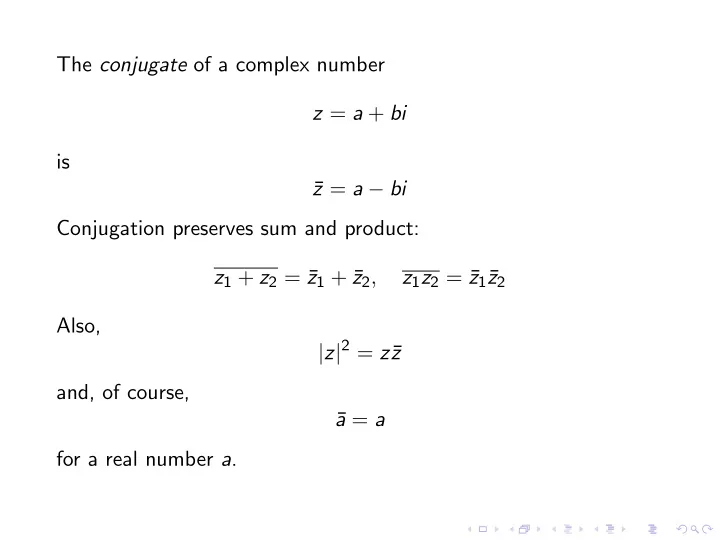
The conjugate of a complex number z = a + bi is ¯ z = a − bi Conjugation preserves sum and product: z1 + z2 = ¯ z1 + ¯ z2, z1z2 = ¯ z1¯ z2 Also, |z|2 = z ¯ z and, of course, ¯ a = a for a real number a.
SLIDE 2
Consequently, if p(x) = anxn + an−1xn−1 + · · · + a1x + a0 is a polynomial with real coefficients a0, . . . , an ∈ R, then p(z) = p(¯ z) for a complex number z. Thus, if α + βi is a complex root of p(x), then so is α − βi. I.e., properly complex roots of a real polynomial come in conjugate pairs α ± βi.
SLIDE 3 Examples: (a) The roots of x2 + 1 are ±i. (b) The roots of x3 + x2 − 2 are 1 and −1 ± i. (c) The roots of x2 + x + 1 are 1
2(−1 ± i
(d) The roots of x4 + 2x2 + 1 are ±i, each with multiplicity 2.
SLIDE 4 To handle complex roots of the auxiliary polynomial, we need the complex exponential ez =
∞
zn n! This power series is absolutely convergent of all z ∈ C, and hence
- convergent. It behaves basically like the usual exponential
function, i.e., ez+w = ezew For an imaginary number ix, we get eix =
∞
(ix)n n! =
∞
inxn n! =
∞
(−1)kx2k (2k)! + i
∞
(−1)kx2k+1 (2k + 1)! = cos(x) + i sin(x)
SLIDE 5
and in general, ex+iy = exeiy = ex cos(y) + i sin(y)
SLIDE 6 For a complex number m = α + βi, we look at the function emx = e(α+βi)x = eαx cos(βx) + i sin(βx)
(emx)′ = memx So if m is a complex root of an auxiliary polynomial, then emx is a solution of sorts to the differential equation, just not of the kind we would prefer.
SLIDE 7 But as ¯ m = α − βi is also a root, e ¯
mx = e(α−βi)x = eαx
cos(βx) − i sin(βx)
- is also a solution to the differential equation, and if we combine
them properly, all references to complex numbers disappear: eαx cos(βx) = 1
2
cos(βx)+i sin(βx)
cos(βx)−i sin(βx)
eαx sin(βx) = 1
2i
cos(βx)+i sin(βx)
cos(βx)−i sin(βx)
SLIDE 8 All in all, we get that a pair α ± βi of properly complex roots to the auxiliary polynomial gives us a pair eαx cos(βx), eαx sin(βx)
- f solutions to the corresponding differential equation.
SLIDE 9
Example: For y′′ + y = 0 we have the auxiliary polynomial m2 + 1 with complex roots ±i. Thus, we get solutions e0x cos(x) = cos(x) and e0x sin(x) = sin(x) and a general solution y = a cos(x) + b sin(x)
SLIDE 10
Example: We consider the IVP given by y′′ − 2y′ + 2y = 0, y(0) = 1, y′(0) = 0 The auxiliary polynomial for the differential equation is m2 − 2m + 2 = (m − 1)2 + 1 with complex roots 1 ± i, so we get a fundamental set ex cos(x), ex sin(x) and a general solution y = ex a cos(x) + b sin(x)
SLIDE 11 The first of the initial conditions now is y(0) = a = 1 And since y′ = ex (a + b) cos(x) + (b − a) sin(x)
y′(0) = a + b = 0 so b = −1 and the solution to the IVP is y = ex cos(x) − sin(x)
SLIDE 12
SLIDE 13 Let us verify that y1 = ex cos(x) is a solution: We have y′
1 = ex cos(x) − ex sin(x) = ex
cos(x) − sin(x)
y′′
1 = ex
cos(x) − sin(x)
− sin(x) − cos(x)
so y′′
1 − 2y′ 1 + 2y1 =
− 2ex sin(x) − 2ex cos(x) − sin(x)
SLIDE 14
Example: Consider the differential equation y′′′ − 5y′′ + 9y′ − 5 = 0 The auxiliary polynomial is m3 − 5m2 + 9m − 5 = (m − 1)(m2 − 4m + 5) which has roots 1 and 4 ± √−4 2 = 4 ± 2i 2 = 2 ± i so we get a fundamental system ex, e2x cos(x), e2x sin(x) and a general solution y = aex + be2x cos(x) + ce2x sin(x)
SLIDE 15
Example: We look at y(4) + 6y′′ + 25y = 0 The auxiliary polynomial is m4 + 6m2 + 25 = (m2 + 2x + 5)(m2 − 2x + 5) with roots ±2 ± √−16 2 = ±2 ± 4i 2 = ±1 ± 2i so we get a fundamental system ex cos(2x), ex sin(2x), e−x cos(2x), e−x sin(2x) and a general solution y = aex cos(2x) + bex sin(2x) + ce−x cos(2x) + de−x sin(2x)
SLIDE 16 That leaves only multiple complex roots: xn + an−1xn−1 + · · · + a1x + a0 =
k > 1 Here, we get solutions xie(α±βi)x, 0 ≤ i < k which we rearrange to get xieαx cos(βx), xieαx sin(βx), 0 ≤ i < k
SLIDE 17
Example: We look at y(4) + 2y′′ + y = 0 The auxiliary equation is m4 + 2m2 + 1 = (m2 + 1)2 = 0 so the solutions are ±i, both with multiplicity 2. Thus, a fundamental set is cos(x), x cos(x), sin(x), x sin(x) and the general solution is y = a cos(x) + bx cos(x) + c sin(x) + dx sin(x)
SLIDE 18
Initial conditions at x0 = 0 are y(0) = y0 = a y′(0) = y1 = b + c y′′(0) = y2 = −a + 2d y′′′(0) = y3 = −3b − c showing that the functions are linearly independent.