The characteristic features of Chinese Syntax 1. Topic oriented vs - - PDF document

the characteristic features of chinese syntax 1 topic
SMART_READER_LITE
LIVE PREVIEW

The characteristic features of Chinese Syntax 1. Topic oriented vs - - PDF document

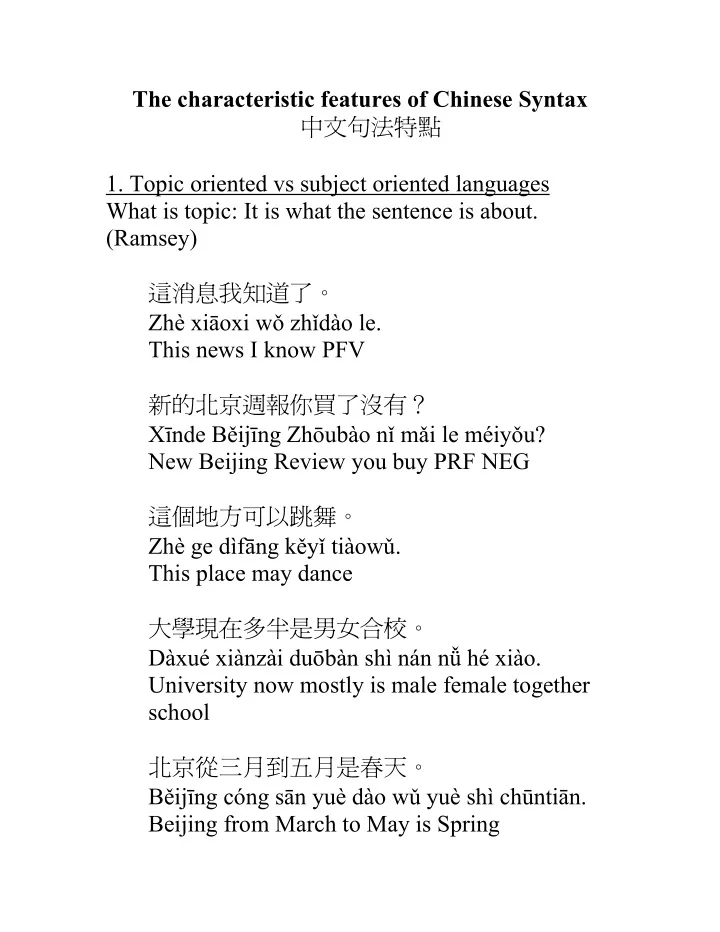
The characteristic features of Chinese Syntax 1. Topic oriented vs subject oriented languages What is topic: It is what the sentence is about. (Ramsey) Zh xi oxi w zh do le. This news I

slide-1
SLIDE 1

The characteristic features of Chinese Syntax 中文句法特點

  • 1. Topic oriented vs subject oriented languages

What is topic: It is what the sentence is about. (Ramsey) 這消息我知道了。 Zhè xiāoxi wǒ zhǐdào le. This news I know PFV 新的北京週報你買了沒有? Xīnde Běijīng Zhōubào nǐ mǎi le méiyǒu? New Beijing Review you buy PRF NEG 這個地方可以跳舞。 Zhè ge dìfāng kěyǐ tiàowǔ. This place may dance 大學現在多半是男女合校。 Dàxué xiànzài duōbàn shì nán nǚ hé xiào. University now mostly is male female together school 北京從三月到五月是春天。 Běijīng cóng sān yuè dào wǔ yuè shì chūntiān. Beijing from March to May is Spring

slide-2
SLIDE 2

那兩個人,一個姓張,一個姓李。 Nà liǎng ge rén, yī ge xìng Zhāng, yī ge xìng Lǐ. that two person, one MW surname Zhang, one MW surname Li

slide-3
SLIDE 3
  • 2. Ellipsis (topic deletion in context)

(他)還沒來? (Tā) hái méi lái? (He has) not come yet? (你吃什麼?) (Nǐ chī shénme?) (What are your eating?) 我是冰淇淋。 Wǒ shì bīngqílín. I am ice-cream. (這個女人的丈夫是美國人。) Zhè ge nǚrén de zhàngfu shì Měiguó rén. This woman’s husband is American. 她也是美國丈夫。 Tā yě shì Měiguó zhàngfu. She is also an American husband.

slide-4
SLIDE 4
  • 3. No tense, but aspect is marked

Perfective Aspect marker 了:A bounded event (Li and Thmpson, 1981) Verbal aspect suffix –le expresses perfectivity, that is, it indicates that an event is being viewed in its entirety or as a whole. An event is viewed in its entirety if it is bounded temporarily, spatially, or conceptually. 他畢業了。 Tā bìyè le. he graduate PFV A quantified event: 他睡了三個鐘頭。 Tā shuì le sān ge zhōngtóu. he sleep PFV three MW hour 我見到了她。 Wǒ jiàn dào le tā. I see PFV her 他去年死了。 Tā qùnián sǐ le. he last year die PFV

slide-5
SLIDE 5

LE: Imminent action 他快來了。 Tā kuài lái le. he soon come LE LE: Change of status 雨不下了。 Yǔ bú xià le. rain not descend LE LE: Sentence-end particle 我們走了。 Wǒmen zǒu le. we leave LE. Durative (Progressive) 在 and 著

  • Only “activity” verbs can take 在 to indicate the

durative aspect. 张三在解释文法。 Zhāng Sān zài jiěshì wénǎ Zhang San DUR explain grammar

  • An activity verb that signals a state associated

with is activity meaning takes 著 as the durative aspect marker.

slide-6
SLIDE 6

他在屋子里坐著。 Tā zài wūzi lǐzuò zhe. He at room PL sit DUR Experiential 過: means an event has been experienced with respect to some reference time. When the reference is left unspecified, the –guo signals that the event has been experienced at least

  • nce at some indefinite time, which is usually the

indefinite past. 我吃過日本飯。 I eat EXP Japan food. Wǒ chī guò Rìběn fàn. LE is not Past Tense 喝了它! Drink it! Hē le tā! 明天我就走了。 I will leave tomorrow. Míngtiān wǒ jiù zǒu le. 我吃了中飯再走。 I will leave after lunch. Wǒ chī le zhōngfàn zài zǒu.

slide-7
SLIDE 7
  • 4. Measure words (classifiers)大量的量詞

For Animals

一條狗 – yī tiáo gǒu a dog 一頭牛– yī tóu niú a cow 一匹馬 – yī pī mǎ a horse 一條魚,一尾魚 – yī tiáo yú, yī wéi yú a fish 一只蚊子 – yī zhī wénzi a mosquito For Human 一個人– yī ge rén a person 一個老師 – yī ge lǎoishī a teacher 一位教授 – yī wèi jiàoshòu a professor 一位客人 – yī wèi kèrén a guest 一名記者 – yī míng jìzhě a newspaper reporter For Things 一棟(幢、所)房子-yī dòng (zhuàng, suǒ) fángzi a house 一把椅子 – yī bǎ yǐzi a chair 一扇窗戶 – yī shàn chuānghù a window 一管牙膏 – yī guǎn yágāo a tube of tooth paste 一封信 – yī fēng xìn a letter

slide-8
SLIDE 8
  • 4. Modifications (Left-branching vs. right branching)

modifier-head (Chinese, Japanese) vs. head-modifier (English) Adjective 紅的蘋果 hóng de píngguǒ red apple 漂亮的姑娘 piàoliang de gūniang beautiful girl Relative clause (specific) 我買的書 wǒ mǎi de shū I buy DE book 賣了的房子 mài le de fángzi sell PRF DE house 昨天到這兒來的那個人 zuótiān dào zhèr lái de nà ge rén yester to here come DE that MW person Prepositional phrase 在圖書館看書 zài túshūguǎn kàn shū in library read book 給他打電話 gěi tā dǎ diànhuà to him make phone-call

slide-9
SLIDE 9
  • 5. Predicates: Adjectives and nouns can be predicates

中文不僅動詞作謂語,形容詞名詞都可以作謂語 Verbal predicate 我吃飯 I eat meal Verbs can be negated by using ‘bù’ 可以用“不”否定(沒有) Verbs can be attached by ‘le’ ‘zhe’ and ‘guo’ to express aspects ‘perfective’, ‘durative’ or ‘experiential.’ 可以加“了”“著”“過” Adjectival predicate 這幢 房子 很 漂亮 This house very beautiful. The following adjectives can be predicates 小心 to be careful 好 to be good 甜 to be sweet 白 to be white, to white Nominal predicate

slide-10
SLIDE 10

他二十歲。 he twenty years-old 今天星期一。 Today Monday 這本書二十塊。 This book twenty dollars 張三好人。 Zhang San good person