
SLIDE 1
The Changing Politics of Organic Food in North America
- Dr. Lisa F. Clark
- Dept. of Bioresource Policy and
Business Economics University of Saskatchewan
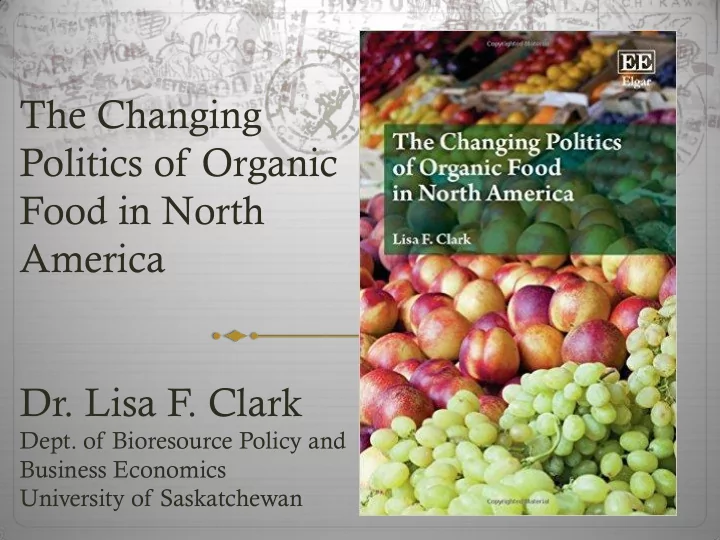
The Changing Politics of Organic Food in North America Dr. Lisa - - PowerPoint PPT Presentation
The Changing Politics of Organic Food in North America Dr. Lisa F. Clark Dept. of Bioresource Policy and Business Economics University of Saskatchewan Current State of Organics Global market for organic products worth $72 billion
Business Economics University of Saskatchewan
Global market for organic products – worth $72 billion (USD) in 2013
Canada – $3.25 billion (1.7% of grocery sales) 870,000 hectares of land for certified organic crops and grazing 3,713 certified organic operations in 2011 (census data) Canada imports 74% of retail certified organic products from US US imports 42% of Canada’s certified organic exports
Perceptions of what organic means differs from what regulations cover (organic v. certified organic) Confusion between food quality and food safety Ways organic is produced, distributed and consumed has changed Diversification of actors in organic sector Integration of organic food policy into ‘conventional’ decision-making structures
Changing Politics of Organic looks at how organic food developed from fringe fad to a multi-billon dollar industry in Canada and the US from 1915-2015. It traces the
emergence of co-existing process-based and product-based definitions of organic development of the ‘organic philosophy’ corporatization of organic sector changing organic food policies and standards organic social movement’s evolving response to industrialized food system and globalization
Experimentation with different agricultural techniques to limit chemical inputs Lady Eve Balfour, Sir Albert Howard, Robert Rodale- return nutrients to the soil without the use of synthetic fertilizers; focus on ‘health of the soil’ Developed principles, standards and practices to guide
Later, limited use of synthetic pesticides and other inputs (GMOs)
Local producer organizations developed standards based on bioregional specifications Third-party certifiers emerge in US; also certified Canadian
Trust-based system of authenticity was no longer adequate as value chain expanded geographically; needed enforceable, traceable form of verification 1970s- state-level certifiers emerged as organic food markets expand (California, Oregon, Washington) 1980s- province-level certification established (Quebec, BC)
Local food chains
Closely linked with the environmental, sustainable agriculture and ‘back to land’ movements of the 1960s Rejected industrializing processes of agriculture and agribusiness Distance from ‘conventional’ agri-food sector and government institutions Growing mainstream interest in organics attracted ‘conventional’ market actors Focus shifted from sociopolitical change through organic agricultural processes to promoting marketable qualities of
‘Conventional’ corporate agribusiness invests in organic value chains (Coca- Cola, General Mills, Kellogg, Nestle) Strategies include brand introduction, mergers/acquisitions, strategic alliances, partial equity 1st notable merger – 1980 – Safer Way Natural Foods and Clarksville Natural Grocer merge to form Whole Foods Market 2000 – 14 major corporate mergers in the organic food sector; 12 in 2012 Today, 4 companies have significant decision-making power over organic food sector in North America:
Hain-Celestial Group, United Natural Foods International, Whole Foods Market, Kurig Green Mountain (collective earnings over $5.3 billion (USD) in 2014)
Product- based; no synthetic inputs (fertilizer, pesticides, GMOs) Some definitions are more substantive – include animal welfare, limit additives and ingredients
USDA – Organic Food Production Act (2000) CFIA - Organic Production Regime (2009)
Controversies over regulatory scope and stakeholder involvement
Bifurcation of the sector – third-party process certifications v. product based standards and regulations Two conceptions of organic now coexist Pro-organic v. pro-GMO Organic v. natural Health v. safety Labelling GMOs? Links with fair trade, food security, food sovereignty, slow food & local food movements
Ag-WestBio (Jackie Robin) and Innovation Place William Kerr Peter Phillips Neil Hibbert Kari Doerksen Cami Ryan