The cause of keys not turning in the locks is usually one of these - - PDF document

the cause of keys not turning in the locks is usually one
SMART_READER_LITE
LIVE PREVIEW

The cause of keys not turning in the locks is usually one of these - - PDF document

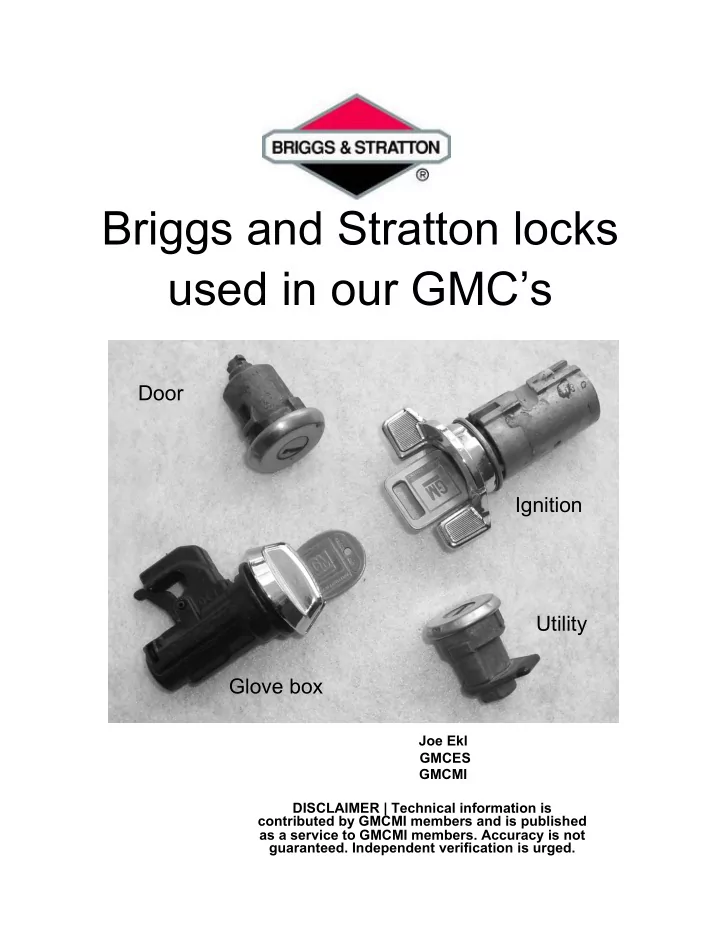
Briggs and Stratton locks used in our GMCs Door Ignition Utility Glove box Joe Ekl GMCES GMCMI DISCLAIMER | Technical information is contributed by GMCMI members and is published as a service to GMCMI members. Accuracy is not


slide-1
SLIDE 1

Briggs and Stratton locks used in our GMC’s

Joe Ekl

GMCES GMCMI DISCLAIMER | Technical information is contributed by GMCMI members and is published as a service to GMCMI members. Accuracy is not

  • guaranteed. Independent verification is urged.

Door Ignition Glove box Utility

slide-2
SLIDE 2

The cause of keys not turning in the locks is usually one of these 3 things.

  • 1. Inserting the wrong key.
  • 2. Worn key.
  • 3. Wafer retainer damaged.
slide-3
SLIDE 3

Solutions

  • 1. Use the right key.
  • Check to see if you might be trying to use a key

from another GM vehicle. GM used the same letter keys in all GM cars and trucks from 1967 to 1994.The sequence of the letter keys were repeated every 4 years.

  • 2. Get a key cut to factory size.
  • Go to a locksmith or GM dealer.
  • Do not duplicate a worn key.
  • 3. Repair or replace the lock.
slide-4
SLIDE 4

Components of the door locks. This lock is a side-bar wafer lock.

Keys shown for comparison of size of components. The size of the springs are .085” dia. X .437 long

slide-5
SLIDE 5

Components of the ignition cylinder. This lock is a side-bar wafer lock.

slide-6
SLIDE 6

Side bar wafer locks

The side bar is out when the key is removed, and the plug will not turn. When the correct key is inserted, the bar retracts and plug can rotate.

slide-7
SLIDE 7

Bad Ignition cylinder

Spring and wafer retainer, note twisted springs

Good cylinder Bad cylinder

slide-8
SLIDE 8

Letter keys 1973 to 1978

“B” 1975 “A” 1975 “C”1976 “D” 1976 “E” 1973 and 1977 “H” 1973 and 1977 “J” 1974 and 1978 “K” 1974 and 1978

slide-9
SLIDE 9

Depth of cuts on keys

#1 cut =.250” #2 cut =.225” #3 cut = .200” #4 cut = .175” #5 cut = .150”

Sometimes worn keys will still work even though they are worn up to .012”. The depth between cuts are .025”

slide-10
SLIDE 10

Components of the glove box lock. This is a disc tumbler lock.

slide-11
SLIDE 11

Removal of glove box lock

This is the disc you push in Usually it is silver in color.

To remove plug push in disc while pulling out cylinder.

slide-12
SLIDE 12

Components of utility door locks. This lock is a disc tumbler lock.

The lock case has 2 slots for the disc to go into. This is so you can remove the keys in 2 different places.

slide-13
SLIDE 13

Location of codes on locks and keys

slide-14
SLIDE 14

Number of different codes on locks

  • There are 6 cuts and 5 depths per key.
  • 5 X 5 X 5 X 5 X 5 X 5 = 15,625 possible codes
  • There were only 3,000 codes that GM
  • could use.
  • You can not use all 1s or all 2s or all 3s etc.
  • You can not use a 1 cut with a 4 or 5 cut
  • because of the angle on the cuts, nor can you
  • use a 2 cut with a 5 cut.
slide-15
SLIDE 15

Page from the code book

slide-16
SLIDE 16

Cutters used to cut keys from code

Curtis clipper Pak-A- Punch

slide-17
SLIDE 17

Cleaning and lubing locks

This cleaner dissolves oil and the dirt runs out

  • f the lock. It dries fast and leaves no residue.

Use only powdered graphite to lube locks.

slide-18
SLIDE 18

Products not to use in locks

Do not use any product that contains oil