SLIDE 1
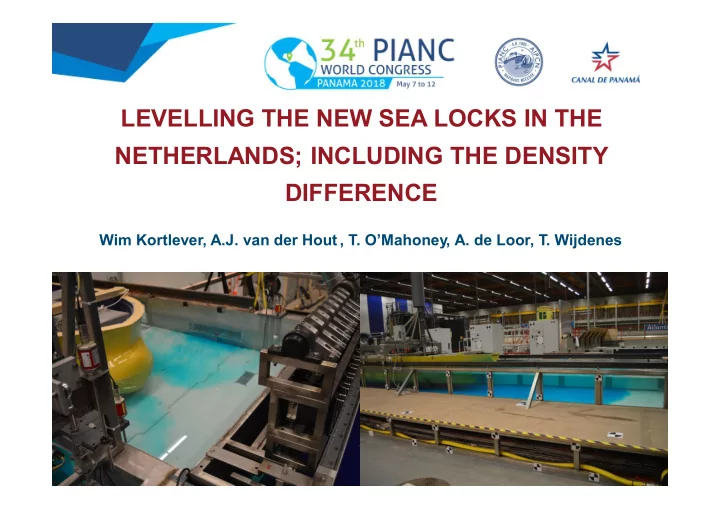
LEVELLING THE NEW SEA LOCKS IN THE NETHERLANDS; INCLUDING THE DENSITY DIFFERENCE
Wim Kortlever, A.J. van der Hout , T. O’Mahoney, A. de Loor, T. Wijdenes
SLIDE 2
North Sea - IJmuiden Locks – Canal
SLIDE 3
North Sea Western Scheldt Estuary Terneuzen Locks Ghent-Terneuzen Canal
SLIDE 4
Mean spring tide Dh = - 0.3 m Û 1.6 m Short culverts in lock heads gate openings
IJmuiden North Lock (1929), 400x50x15m3
SLIDE 5
Terneuzen West Lock (1965), 355x40x13m3
Canal = mean sea level + 2.1 m Mean spring tide Dh = - 4.3 m Û 0.6 m Longitudinal filling system to reduce translatory waves and density currents
SLIDE 6 Design Approach
Type of levelling system
- Through-the-gate or short
culverts
IJmuiden daily Dh = 1.4 m Terneuzen daily Dh = 4 m through-the-gate/short culverts
SLIDE 7 Design Approach
Dimensions
LOCKFILL: 1-D flow-force model incl. translatory waves, jets, density currents
WANDA: 1-D model for nonstationary flow and pressures in closed conduits (without Dr)
Vertical position
Dh at start of opening gate Inlets/outlets at half the water depth Reduction of residual moment, horizontal force on gate, incoming translatory wave
SLIDE 8
Design Approach
Hydraulic design
Streamlining, shaping using 2-D/3-D CFD incl. turbulence Stationary flow Ø Flow conditions Ø Detachment points Ø Flow distribution Ø Loss coefficients Repeat 1-D LOCKFILL/WANDA using loss coefficients from CFD Nonstationary
Density currents
Different flow pattern during levelling Additional longitudinal/transverse forces on vessel Indicative CFD simulation with density currents
SLIDE 9
Lock exchange at North Lock
SLIDE 10
Design Approach
Scale model 40 to 1 / 30 to 1
SLIDE 11
Design Approach
Hydrodynamic force criterion
SLIDE 12
Reference Design New IJmuiden Lock
Lock chamber: 545 m x 70 m x 17.25 m
SLIDE 13
Ducts in gates or short culverts 14 ducts (14x2.2x3m2) or 4 culverts (4x4x5m2) at half the water depth
Reference IJmuiden
Approach Chamber
SLIDE 14
Reference Design IJmuiden
Scale model
Ø Longitudinal and transverse forces exceed criterion due to density component Ø Valve speeds had to be reduced Ø Longer levelling times with gate ducts than with short culverts
SLIDE 15
New IJmuiden Lock Final Design
SLIDE 16
Final Design IJmuiden
SLIDE 17
Reference Design New Terneuzen Lock
Lock chamber: 452 m x 55 m x 16.44m
SLIDE 18
Reference Design Terneuzen
Ducts in gate Short culverts
SLIDE 19 Reference Design Terneuzen
Longitudinal system with bottom grids Culverts 8 m x 4 m, total area at valves 60 m2
Account for residual Dh, residual forces on the gate
Chamber Culverts Gates Gates Bottom grid
SLIDE 20
Reference Design Terneuzen
Hydraulic design
SLIDE 21
Final Design Terneuzen
Requirements Discharge capacity: mA = 34.5 m2 Distribution between grids: 45%/55% Overtravel: 0.25 m Aiming at levelling time 15 min at Dh = 4 m Contractor: ‘balancing the flow by bottom grids’
SLIDE 22 Conclusions
- Include the density effect
- New IJmuiden Lock
Dh = 1.4 m, T = 15-20 min, filling with salt water: ducts in gate
Dh = 4 m, T = 15-20 min, filling with fresh water: longitudinal system
- Residual head: link between levelling system design and gate
design Terneuzen gates: extend initial phase, moving at creep speed
SLIDE 23
Thank you!