The Cathedral and the Bazaar Background by Eric S. Raymond Eric - - PowerPoint PPT Presentation

the cathedral and the bazaar background
SMART_READER_LITE
LIVE PREVIEW

The Cathedral and the Bazaar Background by Eric S. Raymond Eric - - PowerPoint PPT Presentation

The Cathedral and the Bazaar Background by Eric S. Raymond Eric Raymond, by 1993, had contributed to UNIX . . and open source community for 10 years. Information Systems Big


slide-1
SLIDE 1

12/13/09

  • 1

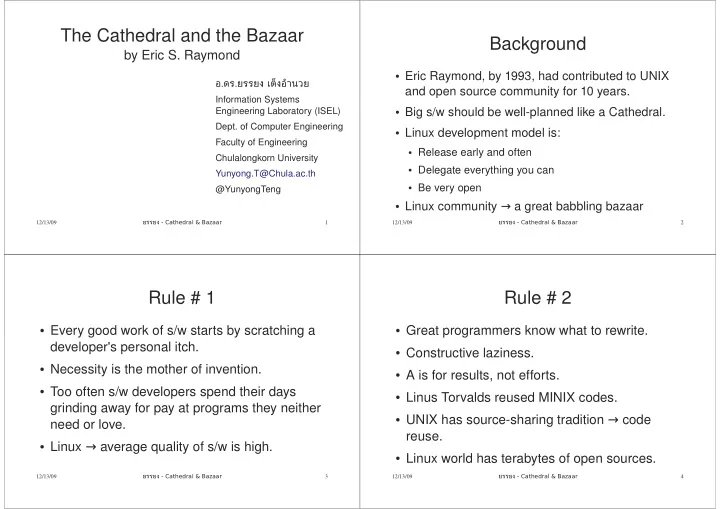
The Cathedral and the Bazaar

by Eric S. Raymond

..

  • Information Systems

Engineering Laboratory (ISEL)

  • Dept. of Computer Engineering

Faculty of Engineering Chulalongkorn University Yunyong.T@Chula.ac.th @YunyongTeng

12/13/09

  • 2

Background

Eric Raymond, by 1993, had contributed to UNIX

and open source community for 10 years.

Big s/w should be well-planned like a Cathedral. Linux development model is:

Release early and often Delegate everything you can Be very open

Linux community

a great babbling bazaar

  • 12/13/09
  • 3

Rule # 1

Every good work of s/w starts by scratching a

developer's personal itch.

Necessity is the mother of invention. Too often s/w developers spend their days

grinding away for pay at programs they neither need or love.

Linux

average quality of s/w is high.

  • 12/13/09
  • 4

Rule # 2

Great programmers know what to rewrite. Constructive laziness. A is for results, not efforts. Linus Torvalds reused MINIX codes. UNIX has source-sharing tradition

code

  • reuse.

Linux world has terabytes of open sources.

slide-2
SLIDE 2

12/13/09

  • 5

Rule # 3

Plan to throw away your s/w. You will not understand the problem until after

the 1

st time you implement a solution. Be ready to start over at least once. .'s Law – 1-byte end-to-end 12/13/09

  • 6

Rule 4 & 5

If you have the right attitude, interesting

problems will find you.

When you lose interest in a program, your last

duty to it is to hand it off to a competent successor.

12/13/09

  • 7

Rule # 6

Users as co-developers

rapid code

  • improvement and debugging

UNIX & Linux

users are hackers too

  • Encourage users to diagnose problems &

suggest fixes

Linux Torvalds: “I'm basically a very lazy person

who likes to get credit for things other people actually do.” Lazy like a fox.

  • 12/13/09
  • 8

Rule # 7

Release early & often & listen to users In 1991 Torvalds released new kernels more

than once a day.

Torvalds did not invent rule#7 but push this

UNIX development model to the limit to match Linux complexity.

slide-3
SLIDE 3

12/13/09

  • 9

12/13/09

  • 10

12/13/09

  • 11

Rule # 8

Given enough eyeballs, all bugs are shallow.

  • Linus' Law.

Cathedral builders – few – long – arduous

  • disappointments

Bazaar – many – short – bugs are shallow

more

  • corrections ** positive attitude **

Bugs are natural – don't worry! Debugging is parallelizable. - Jeff Dutky

12/13/09

  • 12

Analogy to BT

Rule # 8 is similar to BitTorrent phenomenon Popular content is quickly delivered by the

aggregate bandwidth of all bitTorrent peers.

A large content is delivered by the Internet The Linux kernel is developed by the Internet

slide-4
SLIDE 4

12/13/09

  • 13

12/13/09

  • 14

Rule # 9

Smart data structures and dumb code work

better.

12/13/09

  • 15

Testing the Theory

Release early & often (less then 10 days) Add everyone to the beta list Chatty announcement to beta list to encourage

participation

Ask opinion and praise beta testers

popclient

12/13/09

  • 16

Rule # 10

Treat beta testers as the most valuable

resource

High quality reports Bug fixes Thoughtful criticism Fan mail Feature suggestions

slide-5
SLIDE 5

12/13/09

  • 17

Mature Bazaar-Style Project

Beta list peaked at ~300 People got off the list because the s/w is

working so well.

12/13/09

  • 18

Rule # 11

Good ideas from others are better than your

  • wn.

If you are honest with how you owe others,

  • thers will think you are great, e.g. Linus of

Linux and Larry Wall of Perl.

12/13/09

  • 19

Rule # 12

Innovation comes from realizing that your

concept of the problem was wrong

You are not asking the right question 12/13/09

  • 20

Rule # 13

Perfection arises from nothing more to take

away from the design

Antoine de Saint-Exuprey (aviator & aircraft

designer)

When your code is getting both better &

simpler, then you know it is right.

slide-6
SLIDE 6

12/13/09

  • 21

Rule # 14 & 15

Great tool has unexpected uses Gateway s/w must disturb data stream as little

as possible.

12/13/09

  • 22

Initial Condition

Bazaar-style project – Project coordinator

Plausible promise Recognize good design ideas Good people skills

12/13/09

  • 23

Evolution of S/W in Bazaar

Fred Brooks's The Mythical Man-Month Gerald Weinberg's The Psychology of Computer

Programming

Egoless Programming Code territory

UNIX can not do this:

Licenses Trade secrets No Internet

12/13/09

  • 24

No Internet

Limited talent pools

UC Berkeley AT&T's Bell Lab MIT's AI Lab

slide-7
SLIDE 7

12/13/09

  • 25

Linux was the first project to make a conscious and successful effort to use the entire world as its talent pool.

12/13/09

  • 26

The Internet

Anarchist's paradise Severe effort of many converging wills Principle of command vs. principle of

understanding

Egoboo – pleasure from public recognition of

voluntary work.

12/13/09

  • 27

Future of Open Source

Open source will win because commercial world cannot win an evolutionary arm race with

  • pen-source communities that can put orders
  • f magnitude more skilled time into a problem.

Open source s/w is developed by the Internet.

..