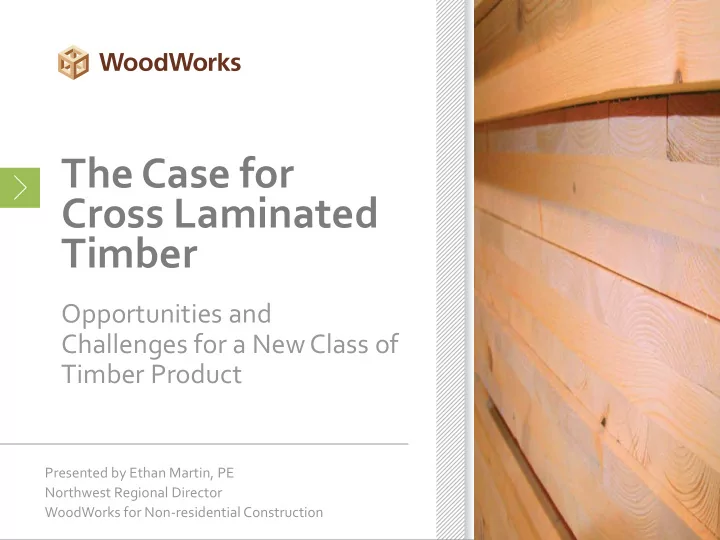
The Case for Cross Laminated Timber Opportunities and Challenges - - PowerPoint PPT Presentation

the case for cross laminated timber
SMART_READER_LITE
LIVE PREVIEW

The Case for Cross Laminated Timber Opportunities and Challenges - - PowerPoint PPT Presentation

The Case for Cross Laminated Timber Opportunities and Challenges for a New Class of Timber Product Presented on [Date] by [Authors Name] Presented by Ethan Martin, PE Northwest Regional Director (Edit the Master Slide to change this


slide-1
SLIDE 1

Presented on [Date] by [Author’s Name] (Edit the Master Slide to change this text)

The Case for Cross Laminated Timber

Opportunities and Challenges for a New Class of Timber Product

Presented by Ethan Martin, PE Northwest Regional Director WoodWorks for Non-residential Construction

slide-2
SLIDE 2

What is Cross Laminated Timber (CLT)?

  • Layers of dimension lumber stacked crosswise and glued on their

wide faces. Adhesives follow requirements of Glulam beams.

  • Width/thickness of laminations vary (2 1/2-9 1/2” wide, 5/8 -2” thick).
  • Lumber is ~12% MC prior to manufacture .
  • Two way slab with odd number of layers identifying

primary strength direction.

  • Manufactured panels are typically 8-10’ wide and

up to 20” thick and up to 64’ long.

  • Finished panels are planed, sanded,

cut to size. Then openings are cut with precise CNC routers.

  • Third party inspection at factory.
  • Custom engineered for

material efficiency.

  • Custom designed for

project.

slide-3
SLIDE 3

Large Timber Structures

  • Incorporating timber plate elements
  • Including large timber elements such as solid sawn, LVL, LSL, glulam,

and CLT

  • A structural system resisting both vertical and lateral loads

The new mass timber movement is motivated by….

  • Demand for lower impact structures
  • Manufacturing Technology
  • Material Technology
  • Advances in Pre-fabrication
  • Sophisticated Suppliers
slide-4
SLIDE 4

How to use CLT - Assembly

slide-5
SLIDE 5

Stadhaus, London, UK Architect: Waugh Thistleton Architects Photo credit: Waugh Thistleton Architects

Volume of wood used 950 m3 Carbon sequestered and stored (CO2e) 760 metric tons Avoided greenhouse gases (CO2e) 320 metric tons Total potential carbon benefit (CO2e) 1,080 metric tons Carbon savings from the choice of wood in this one building are equivalent to: 1,615 passenger vehicles off the road for a year Enough energy to operate a home for 803 years

Reduced Embodied Carbon

slide-6
SLIDE 6

Minimal Waste

slide-7
SLIDE 7

Fire Test Results

4.5 in 6.9 in 6.9 in 9.6 in

slide-8
SLIDE 8

Structural Flexibility

slide-9
SLIDE 9

75% Lighter Weight Than Concrete

slide-10
SLIDE 10

Aqualux Hotel, Bardolino, Italy Architect: Rama Architettura

  • 180K sqft
  • Luxury Hotel
  • Construction time

was 3 mo. vs. 2 yr. w/ concrete

  • Wall system was

2” thinner with CLT

slide-11
SLIDE 11

Forte’, Victoria Harbor, Melbourne, Australia Architect: Lend Lease

  • Completed in 2012
  • 10 stories
  • ~ 105 ft. tall, > 18.6 K sqft.
  • 3 million in R&D
  • Poor soils required a much

lighter building

slide-12
SLIDE 12

Forte’, Victoria Harbor, Melbourne, Australia Architect: Lend Lease

slide-13
SLIDE 13

Product Availability

  • Three North American producers of structural CLT
  • ~425,000 ft3 of annual production capacity (structural CLT)
  • 2-3 US Companies pursuing manufacturing facilities
  • Non-commodity based product
  • Standardized manufacture but custom fabrication
slide-14
SLIDE 14

Building Code -Product Standard

APA/ANSI PRG 320

  • 7 stress classes
  • Quality assurance testing
  • Identification marking
slide-15
SLIDE 15

Code Approvals – Product Reports

slide-16
SLIDE 16

US CLT Handbook

  • 1. Introduction
  • 2. Manufacturing
  • 3. Structural
  • 4. Lateral
  • 5. Connections
  • 6. DOL and Creep
  • 7. Vibration
  • 8. Fire
  • 9. Sound

10.Enclosure 11.Environmental 12.Lifting

slide-17
SLIDE 17

Questions?

Ethan Martin, PE WoodWorks ethan@woodworks.org toll free 855.USE.WOOD (873.9663) cell 206.678.2086