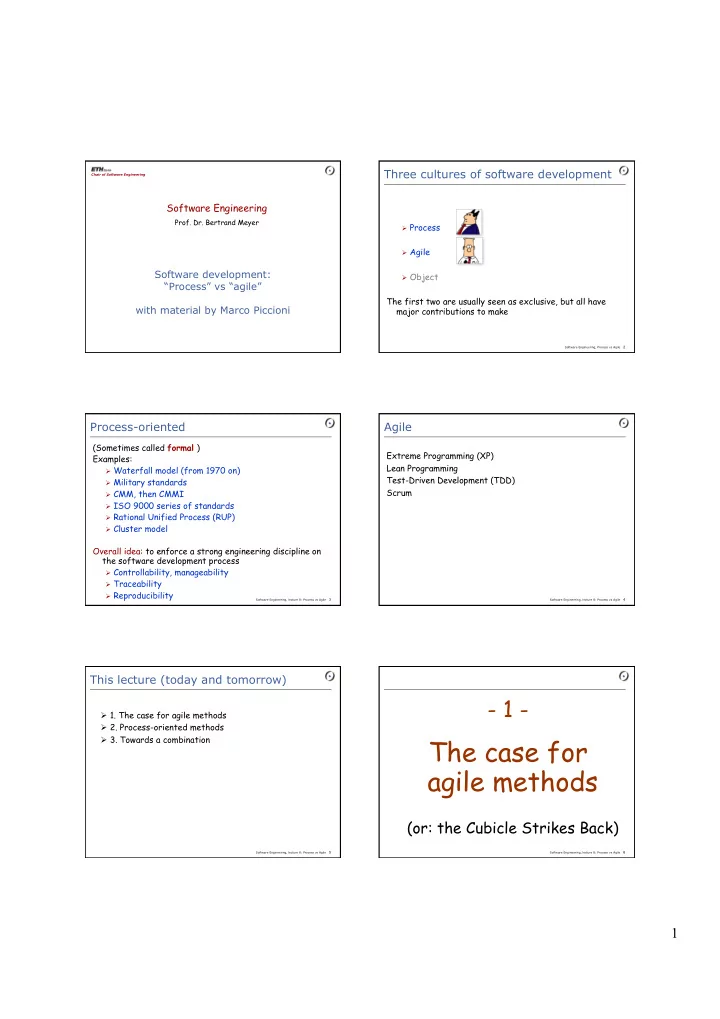
SLIDE 2 2
Software Engineering, lecture 8: Process vs Agile 7
“The agile manifesto”
We are uncovering better ways of developing software by doing it and helping others do it. Through this work we have come to value:
- Individuals and interactions over processes and
tools
- Working software over comprehensive
documentation
- Customer collaboration over contract negotiation
- Responding to change over following a plan
That is, while there is value in the items on the right, we value the items on the left more. agilemanifesto.org
Software Engineering, lecture 8: Process vs Agile 8
Scheme 1: predictable manufacturing
Assembly-line production is possible:
- Define specifications and constructions steps
- Build some instances and perform measurements
- On the basis of that experience, estimate &
schedule future production
Software Engineering, lecture 8: Process vs Agile 9
Scheme 2: new model development
Each model specific, evolving process:
- Requirements change between races
- Static reasons (specific tracks)
- Dynamic reasons (weather, competitors)
- High level of competition
- Continuous experimenting
Prototypes rather than products
Software Engineering, lecture 8: Process vs Agile 10
Assembly-line vs prototype
Assembly-line manufacturing Prototype-style manufacturing
Specify, then build Hard to freeze specifications Reliable effort and cost estimates are possible, early on Estimates only become possible late, as empirical data emerge Can identify schedule and order all activities Activities emerge as part of the process Stable environment Many parameters change; need creative adaptation to change
- C. Larman Agile & Iterative Development A Manager guide Addison Wesley 2003
Software Engineering, lecture 8: Process vs Agile 11
What about software?
In the agile view, most software development is not a predictable, mass-manufacturing problem, but falls under the new product development model
Software Engineering, lecture 8: Process vs Agile 12
Agile methods: basic concepts
Principles:
- Iterative development
- Customer involvement
- Support for change
- Primacy of code
- Self-organizing teams
- Technical excellence
- Search for simplicity
Practices:
- Evolutionary requirements
- Customer on site
- User stories
- Pair programming
- Design & code standards
- Test-driven development
- Continuous refactoring
- Continuous integration
- Timeboxing
- Risk-driven development
- Daily tracking
- Servant-style manager
Shunned: “big upfront requirements”; plans; binding documents; diagrams (e.g. UML); non- deliverable products