The California Neil Maizlish, PhD, MPH Healthy Places Index Senior - - PowerPoint PPT Presentation

the california
SMART_READER_LITE
LIVE PREVIEW

The California Neil Maizlish, PhD, MPH Healthy Places Index Senior - - PowerPoint PPT Presentation

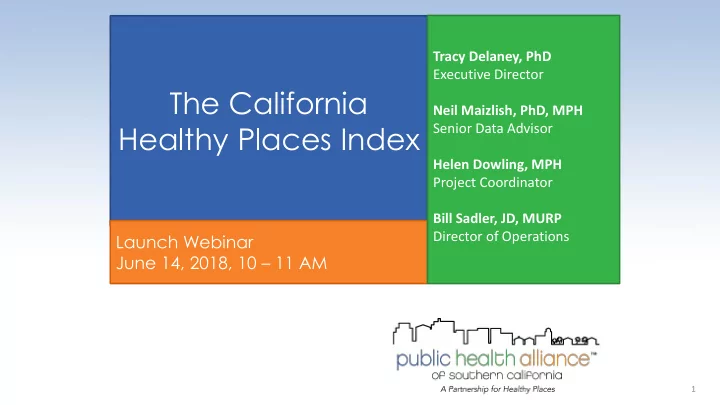
Tracy Delaney, PhD Executive Director The California Neil Maizlish, PhD, MPH Healthy Places Index Senior Data Advisor Helen Dowling, MPH Project Coordinator Bill Sadler, JD, MURP Director of Operations Launch Webinar June 14, 2018, 10


slide-1
SLIDE 1

The California Healthy Places Index

Launch Webinar June 14, 2018, 10 – 11 AM

Tracy Delaney, PhD Executive Director Neil Maizlish, PhD, MPH Senior Data Advisor Helen Dowling, MPH Project Coordinator Bill Sadler, JD, MURP Director of Operations

1

slide-2
SLIDE 2

Your Presenters

2

Tracy Delaney, PhD

Executive Director

Neil Maizlish, PhD, MPH

Senior Data Advisor

Bill Sadler, JD, MURP

Director of Operations

Helen Dowling, MPH

Project Coordinator

slide-3
SLIDE 3

Need Help? Use Chat

3

slide-4
SLIDE 4

Need Help? Use Chat

4

slide-5
SLIDE 5

Public Health Alliance of Southern California

5

8 LOCAL HEALTH DEPARTMENTS

  • Long Beach
  • Los Angeles
  • Pasadena
  • Riverside
  • Santa Barbara
  • San Bernardino
  • San Diego
  • Ventura

Nearly Of CA Population

50%

All Southern California communities are healthy, vibrant and sustainable places to live, work and play.

OUR VISION

slide-6
SLIDE 6

Public Health Alliance of Southern California

6

Healthy Neighborhoods Data in Action Healthy Food and Water Systems Equity and Opportunities for All Healthy Planet, Healthy People Public Health and Prevention Infrastructure

slide-7
SLIDE 7

Agenda

I. Introduction

  • II. The California Healthy Places Index (HPI)
  • III. Communication Tools
  • IV. Map Demo
  • V. Who’s Using HPI?
  • VI. Expert Services
  • VII. Wrap Up & Live Q&A

7

slide-8
SLIDE 8

Purpose of the California Healthy Places Index

Develop a tool to support informed prioritization of resources and allocations to areas with less healthy community conditions

8

slide-9
SLIDE 9

Community Conditions

Neighborhood and Built Environment Health and Health Care Social and Community Context Education Economic Stability

Social Determinants of Health Centers for Disease Control

9

slide-10
SLIDE 10

Process of Creating the HPI

10

Steering Committee: Alliance & BARHII Data Committees, CDPH, Others (TCE & Kaiser funded)

Social Determinants of Health Literature Review Domains Indicators/ Geographic Unit Index Production Data Sources Communication/ Dissemination User Feedback

slide-11
SLIDE 11

Indicator Selection

  • Criteria:

▪ Informed by literature ▪ Statewide data publicly available at the census tract ▪ Continuity with HDI 1.1 ▪ Actionable for policy, systems, and environmental change ▪ Optimize association with life expectancy

11

slide-12
SLIDE 12

HPI’s Unique Approach

  • Glaring disparities in life expectancy – 10 or more years within

a 20 min. walk

  • Social determinants of health, including neighborhood

conditions, drive these disparities

  • Life expectancy is empirically integrated into the HPI

methodology

  • Other indices do not have this explicit coupling

12

slide-13
SLIDE 13

Life Expectancy at Birth in Los Angeles

13

slide-14
SLIDE 14

Index Construction

14

  • Indicator scores are standardized (Z score)
  • Policy Action Area score (mean of indicators)
  • Policy Action Area weights (predictive of life expectancy)
  • Final HPI calculated by

▪ Multiplying each policy action area score with its weight ▪ Summing across eight policy action areas:

HPI = Economic + Education + Transportation + Social + Neighborhood + Clean Enviro + Housing + Ins

slide-15
SLIDE 15

HPI Policy Action Areas & Indicators

* Sourced from California Department of Public Health Climate Change and Health Vulnerability Indicators for California 15

Economic

32%

  • Employed*
  • Income
  • Above

Poverty*

Social

10%

  • Two Parent

Household

  • Voting in

2012

Transportation

16%

  • Automobile

Access*

  • Active

Commuting

Education

19%

  • In Pre-

School

  • In High

School

  • Bachelor’s

Education

  • r Higher*

Neighborhood

8%

  • Retail Density
  • Park Access
  • Tree Canopy*
  • Supermarket

Access

  • Alcohol

Outlets

Healthcare Access

5%

  • Insured*

Housing

5%

  • Low-Income

Renter Severe Housing Cost Burden

  • Low-Income

Homeowner Severe Housing Cost Burden

  • Housing

Habitability

  • Uncrowded

Housing

  • Homeowner-

ship

Clean Environment

5%

  • Ozone*
  • PM 2.5*
  • Diesel PM
  • Water

Contaminants

slide-16
SLIDE 16

Communication Tools: Target Audience Briefs

16

slide-17
SLIDE 17

Policy Guides

17

` Employed Median Income Above Poverty Preschool Enrollment HS Enrollment Bachelor’s Education Automobile Access Active Commuting 2-Parent Households Voting Retail Density Park Access Tree Canopy Supermarket Access Alcohol Availability Low-Income Renter Housing Cost Burden Low-Income Homeowner Housing Cost Burden Housing Habitability Uncrowded Housing Homeownership Ozone Fine Particulate Matter Diesel Particulate Matter Safe Drinking Water Insured Adults Extreme Heat Impervious Surfaces Outdoor Workers Public Transit Access Sea Level Rise

slide-18
SLIDE 18

Introduction to HPI Map Tool

map.healthyplacesindex.org

18

slide-19
SLIDE 19

Who’s Using HPI at the State?

  • Grant Programs

– Caltrans: SB 1 Planning Grants: $ 25 Million/ year – 50% to disadvantaged communities – Strategic Growth Council: Transformative Climate Communities – California Transportation Commission: Active Transportation Program

  • Plans/Guidelines

– Governor’s Office of Planning and Research:

  • General Plan Guidelines
  • Integrated Climate Adaptation & Resiliency Program: Resiliency Guidebook

– California Transportation Commission: Regional Transportation Plan Guidelines

  • Studies

– CDPH - Black Infant Health- Birth Outcomes

  • Mapping Tools

– California State Parks Community Fact Finder

19

slide-20
SLIDE 20

Who’s Using HPI in Local Government?

  • Community Profiles

– Los Angeles County Dept. Public Health

  • Community Health Needs Assessments:

– Santa Barbara County – Sutter County

  • Prioritizing Investments:

– Riverside County: prioritization of youth intervention and behavioral health projects, siting of a food distribution center – HEAL-U Strategic Plan for targeting community investments

  • Data Tools:

– SCAG: Active Transportation Database

  • Accreditation

– Data for local health department accreditation

20

slide-21
SLIDE 21

Tell Us How You’re Using HPI!

21

HealthyPlacesIndex.org/tell-us/

slide-22
SLIDE 22

How We Can Help: Expert Services

  • There’s a lot you can do for free on the HPI website
  • Map accounts available for a small fee
  • If you want to go more in-depth, the Alliance can offer:

– Webinars and How-To Guides – Integrating HPI into Plans & Assessments, including:

  • General Plans
  • CHA/CHNAs

– Generating Reports – Capacity Building – Policy Actions – Grant Application Technical Assistance

  • Contact us at PHASoCal@PHI.org to learn about how we can help you!

22

slide-23
SLIDE 23

THANK YOU!

Connect with the Alliance: PHASoCal.org | PHASoCal@PHI.org HPI on the web: HealthyPlacesIndex.org | Map.HealthyPlacesIndex.org

23