The Beauty and Joy of The Beauty and Joy of Computing Computing - - PowerPoint PPT Presentation

the beauty and joy of the beauty and joy of computing
SMART_READER_LITE
LIVE PREVIEW

The Beauty and Joy of The Beauty and Joy of Computing Computing - - PowerPoint PPT Presentation

The Beauty and Joy of The Beauty and Joy of Computing Computing Lectur Lecture #23 e #23 Limits of Computing Limits of Computing UC Berkeley EECS UC Berkeley EECS Youll have the opportunity for extra credit on your project! After you


slide-1
SLIDE 1

The Beauty and Joy of The Beauty and Joy of Computing Computing

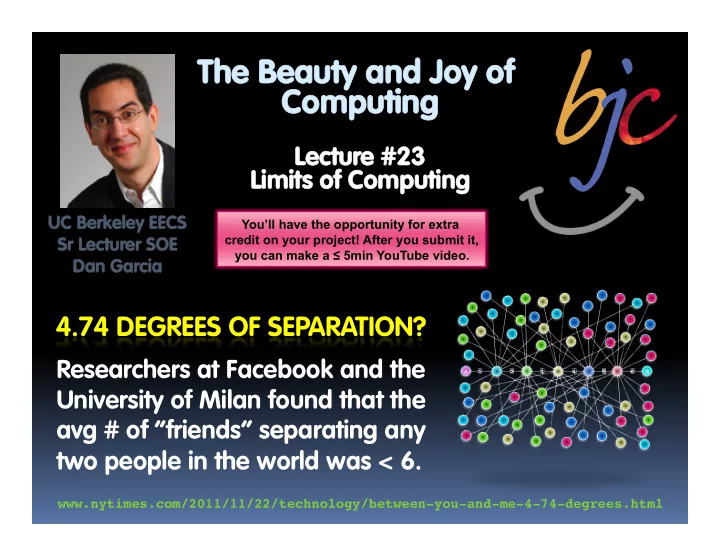
Lectur Lecture #23 e #23 Limits of Computing Limits of Computing Researchers at Facebook and the University of Milan found that the avg # of “friends” separating any two people in the world was < 6.

UC Berkeley EECS UC Berkeley EECS Sr Lectur Sr Lecturer SOE er SOE Dan Gar Dan Garcia cia

www.nytimes.com/2011/11/22/technology/between-you-and-me-4-74-degrees.html

  • You’ll have the opportunity for extra

credit on your project! After you submit it, you can make a ≤ 5min YouTube video.

slide-2
SLIDE 2

UC Berkeley “The Beauty and Joy of Computing” UC Berkeley “The Beauty and Joy of Computing” : Limits of Computability : Limits of Computability (2) (2)

Gar Garcia cia

§ CS research areas:

ú Artificial Intelligence ú Biosystems & Computational Biology ú Database Management Systems ú Graphics ú Human-Computer Interaction ú Networking ú Programming Systems ú Scientific Computing ú Security ú Systems ú Theory

 Complexity theory

ú …

Computer Science … A UCB view

slide-3
SLIDE 3

UC Berkeley “The Beauty and Joy of Computing” UC Berkeley “The Beauty and Joy of Computing” : Limits of Computability : Limits of Computability (3) (3)

Gar Garcia cia

§ Problems that…

ú are tractable with efficient

solutions in reasonable time

ú are intractable ú are solvable approximately,

not optimally

ú have no known efficient

solution

ú are not solvable

Let’s revisit algorithm complexity

slide-4
SLIDE 4

UC Berkeley “The Beauty and Joy of Computing” UC Berkeley “The Beauty and Joy of Computing” : Limits of Computability : Limits of Computability (4) (4)

Gar Garcia cia

§ Recall our algorithm

complexity lecture, we’ve got several common orders of growth

ú Constant ú Logarithmic ú Linear ú Quadratic ú Cubic ú Exponential

§ Order of growth is

polynomial in the size

  • f the problem

§ E.g.,

ú Searching for an item in

a collection

ú Sorting a collection ú Finding if two numbers

in a collection are same

§ These problems are

called being “in P” (for polynomial)

Tractable with efficient sols in reas time

slide-5
SLIDE 5

UC Berkeley “The Beauty and Joy of Computing” UC Berkeley “The Beauty and Joy of Computing” : Limits of Computability : Limits of Computability (5) (5)

Gar Garcia cia

§ Problems that can be

solved, but not solved fast enough

§ This includes

exponential problems

ú E.g., f(n) = 2n

 as in the image to the right

§ This also includes

poly-time algorithm with a huge exponent

ú E.g, f(n) = n10

§ Only solve for small n

Intractable problems

slide-6
SLIDE 6

UC Berkeley “The Beauty and Joy of Computing” UC Berkeley “The Beauty and Joy of Computing” : Limits of Computability : Limits of Computability (7) (7)

Gar Garcia cia

§ A problem might have

an optimal solution that cannot be solved in reasonable time

§ BUT if you don’t need

to know the perfect solution, there might exist algorithms which could give pretty good answers in reasonable time

Solvable approximately, not optimally in reas time

slide-7
SLIDE 7

UC Berkeley “The Beauty and Joy of Computing” UC Berkeley “The Beauty and Joy of Computing” : Limits of Computability : Limits of Computability (8) (8)

Gar Garcia cia

§ Solving one of them

would solve an entire class of them!

ú We can transform one

to another, i.e., reduce

ú A problem P is “hard”

for a class C if every element of C can be “reduced” to P

§ If you’re “in NP” and

“NP-hard”, then you’re “NP-complete”

§ If you guess an

answer, can I verify it in polynomial time?

ú Called being “in NP” ú Non-deterministic (the

“guess” part) Polynomial

Have no known efficient solution

slide-8
SLIDE 8

UC Berkeley “The Beauty and Joy of Computing” UC Berkeley “The Beauty and Joy of Computing” : Limits of Computability : Limits of Computability (9) (9)

Gar Garcia cia

§ This is THE major

unsolved problem in Computer Science!

ú One of 7 “millennium

prizes” w/a $1M reward

§ All it would take is

solving ONE problem in the NP-complete set in polynomial time!!

ú Huge ramifications for

cryptography, others

If P ≠NP, then

§ Other NP-Complete

ú Traveling salesman who

needs most efficient route to visit all cities and return home

The fundamental question. Is P = NP?

slide-9
SLIDE 9

UC Berkeley “The Beauty and Joy of Computing” UC Berkeley “The Beauty and Joy of Computing” : Limits of Computability : Limits of Computability (10) (10)

Gar Garcia cia

imgs.xkcd.com/comics/np_complete.png

slide-10
SLIDE 10

UC Berkeley “The Beauty and Joy of Computing” UC Berkeley “The Beauty and Joy of Computing” : Limits of Computability : Limits of Computability (11) (11)

Gar Garcia cia

imgs.xkcd.com/comics/travelling_salesman_problem.png

slide-11
SLIDE 11

UC Berkeley “The Beauty and Joy of Computing” UC Berkeley “The Beauty and Joy of Computing” : Limits of Computability : Limits of Computability (12) (12)

Gar Garcia cia

§ Decision problems

answer YES or NO for an infinite # of inputs

ú E.g., is N prime? ú E.g., is sentence S

grammatically correct?

§ An algorithm is a

solution if it correctly answers YES/NO in a finite amount of time

§ A problem is decidable

if it has a solution

Problems NOT solvable

June 23, 2012 was his 100th birthday celebration!!

slide-12
SLIDE 12

UC Berkeley “The Beauty and Joy of Computing” UC Berkeley “The Beauty and Joy of Computing” : Limits of Computability : Limits of Computability (13) (13)

Gar Garcia cia

§ Infinitely Many Primes? § Assume the contrary, then

prove that it’s impossible

ú Only a finite # of primes ú Number them p1, p2, …, pn ú Consider the number q

 q = (p1 * p2 * … * pn) + 1  Dividing q by any prime would give a remainder of 1  So q isn’t composite, q is prime  But we said pn was the biggest, and q is bigger than pn

ú So there IS no biggest pn

Review: Proof by Contradiction

slide-13
SLIDE 13

UC Berkeley “The Beauty and Joy of Computing” UC Berkeley “The Beauty and Joy of Computing” : Limits of Computability : Limits of Computability (14) (14)

Gar Garcia cia

§ Given a program and

some input, will that program eventually stop? (or will it loop)

§ Assume we could

write it, then let’s prove a contradiction

ú 1. write Stops on Self? ú 2. Write Weird ú 3. Call Weird on itself

Turing’s proof : The Halting Problem

slide-14
SLIDE 14

UC Berkeley “The Beauty and Joy of Computing” UC Berkeley “The Beauty and Joy of Computing” : Limits of Computability : Limits of Computability (15) (15)

Gar Garcia cia

§ Complexity theory

important part of CS

§ If given a hard

problem, rather than try to solve it yourself, see if others have tried similar problems

§ If you don’t need an

exact solution, many approximation algorithms help

§ Some not solvable!

Conclusion