
SLIDE 1
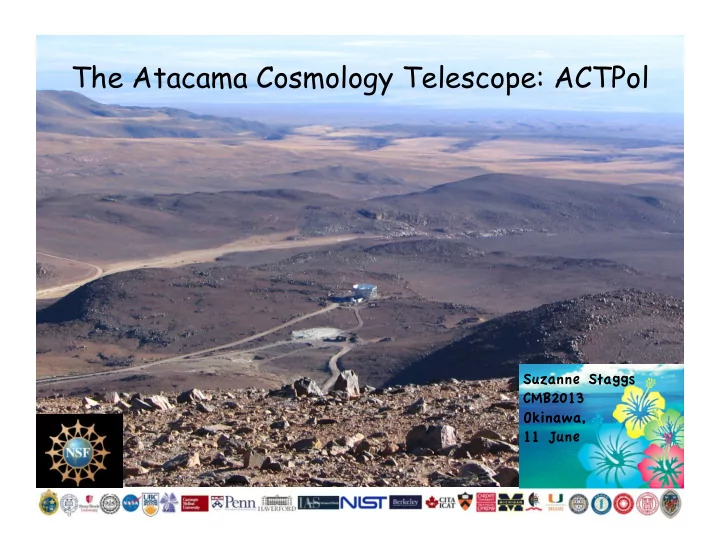
The Atacama Cosmology Telescope: ACTPol
Suzanne Staggs CMB2013 Okinawa, 11 June
The Atacama Cosmology Telescope: ACTPol Suzanne Staggs CMB2013 - - PowerPoint PPT Presentation
The Atacama Cosmology Telescope: ACTPol Suzanne Staggs CMB2013 Okinawa, 11 June The Atacama Cosmology Telescope 6m off-axis Gregorian telescope 2m primary Located at 5200 m (0.5 mm PWV) Latitude -23 o The Atacama Cosmology
Suzanne Staggs CMB2013 Okinawa, 11 June
Reflector Secondary Reflector
ACT ground screens: large co- moving screen and 13 m
Staggs; Okinawa 2013
2000 4000 0.01 0.1 1 10 BB EE ACT Wide ACT Deep Planck
Wide survey (~4000 deg2); Deep survey (5 fields, each 25 deg2) Details in Niemack et al, arXiv:1006.5049
Cluster Catalog -
Improved power spectra –
Maps –
Staggs; Okinawa 2013
EE Power Spectrum
polarized; dust is 1-2% polarized.
improvements over forecasts for Planck (TT and EE) on:
Recall YHe impacts the high-l spectrum because those modes enter the horizon while He is not yet fully ionized.
Forecasts relatively simple so far.
Staggs; Okinawa 2013
evident for polarization
lensing
From Zaldarriaga & Seljak, 1998 Note also enhancement at high l
EE and BB and Deflection Field Maps
ACTPol BB errors Planck BB errors
Staggs; Okinawa 2013
Deflection Field Power Spectrum and Maps
CMB Lensing is going to explode as a field in the next few years
25 50 75 100
4 6 7 20 50 70 100
ACT
ACT Full SPT
SPT Full Planck +ACTpol/SPTPol ACTpol Large Sky
S i g n a l
s e
Staggs; Okinawa 2013
Deflection Field Power Spectrum and Maps
Plot from Smith, Cooray, Das, Dore et al, 2009 White Paper.
Sherwin et al, 2011
Staggs; Okinawa 2013
Deflection Field Power Spectrum and Maps
Planck Collaboration, XVII, 2013
Plot from Smith, Cooray, Das, Dore et al, 2009 White Paper.
Staggs; Okinawa 2013
Assuming no systematics other than instrumental noise, these plots show the signal and noise power spectra for the Deep and Wide configurations.
ACTPOL-DEEP: 150 sq-deg @ 3 µK-arcmin (temp) and 5 µK-arcmin (pol)
ACTPOL-WIDE: 4000 sq-deg @ 20 µK-arcmin (temp) and 28 µK-arcmin (pol)
Signal
Optimal Noise
Signal
Optimal Noise
Staggs; Okinawa 2013
Temperature E-mode B-mode primordial lensing 10 100 1000 104 102 100 10
BICEP DASI CAPMAP QUAD MAXIPOL BOOMERANG WMAP ACBAR SPT ACT QUIET
dashed horizontal lines- limits on B-modes solid vertical lines - measurements of T and E
measurements
CBI
Staggs; Okinawa 2013
ACT has great dynamic range (cross-linking, ML maps little filtering) ... but ACTPol’s guaranteed capability in the GW quest is delensing because large angles are hard with large telescopes.
25,000 deg2 available; wide survey will overlap with SDSS-III BOSS; deep surveys may
HyperSuprime Camera
=> excellent image quality – Need good AR coating
( Datta, Niemack, McMahon et al. in prep. )
150 GHz ABS single detector
5mm ( ABS: Essinger-Hileman et al. LTD 2009, SPTPol: Bleem et al. JLTP 2012, ACTPol: Niemack et al. SPIE 2010 ) 1 mm
Old ACT detector
previously) 150 GHz paths
Better detectors + optics + cryogenics => ~ 4x increase in sensitivity (16x mapping speed)
Silicon feedhorn array Sub-array with 255 TES Polarimeter 90/150 GHz path
5mm
Staggs : Okinawa 2013
Staggs : Okinawa 2013
ABSTRACT: ACTPol is a polarization-sensitive receiver upgrade to the Atacama Cosmology Telescope, located at an elevation of 5200 meters in the
Atacama Desert in Chile. With the new receiver, we will make millimeter wavelength measurements of the small-scale polarization anisotropies of the Cosmic Microwave Background (CMB) to explore structure formation, constrain the sum of the neutrino masses, probe early dark energy, and perform other cosmological tests. ACTPol will employ three arrays of transition edge sensor (TES) bolometer detectors. The detectors, with a target transition temperature of 150 mK, will be operated at a bath temperature of ~100 mK provided by a dilution refrigerator. One array operating at a central frequency of 150 GHz and consisting of 1020 TESes has recently been installed in the telescope at the ACT site.. We anticipate fielding a second identical array and a multi-chroic array that simultaneously measures 90 GHz and 150 GHz near the end of this observing season.
Emily Grace1 for the ACTPol Collaboration
1Department of Physics, Princeton University, Jadwin Hall, Princeton, NJ 08544 (Email:egrace@princeton.edu)
Staggs; Okinawa 2013
Observing the sky with the receiver at 17kft Putting the receiver into the telescope cabin ~ last week!
Staggs; Okinawa 2013
Many thanks to many collaborators for slides, figures & slide concepts.