The Additive Marker in complementizer pronominal Conversational - - PowerPoint PPT Presentation

the additive marker in
SMART_READER_LITE
LIVE PREVIEW

The Additive Marker in complementizer pronominal Conversational - - PowerPoint PPT Presentation

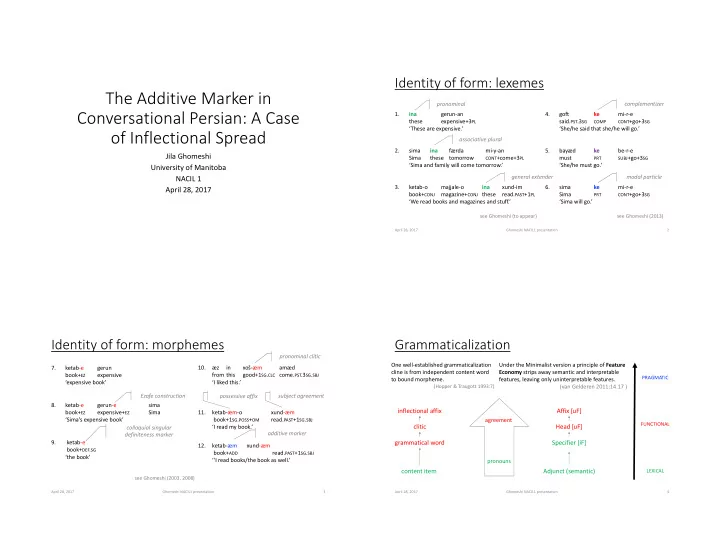
Identity of form: lexemes The Additive Marker in complementizer pronominal Conversational Persian: A Case 1. ina gerun-an 4. goft ke mi-r-e these expensive+3 PL said. PST .3 SG CONT +go+3 SG COMP These are expensive. She/he


slide-1
SLIDE 1

The Additive Marker in Conversational Persian: A Case

  • f Inflectional Spread

Jila Ghomeshi University of Manitoba NACIL 1 April 28, 2017

Identity of form: lexemes

April 28, 2017 Ghomeshi NACIL1 presentation 2

4. goft ke mi-r-e said.PST.3SG

COMP CONT+go+3SG

‘She/he said that she/he will go.’ 5. bayæd ke be-r-e must

PRT SUBJ+go+3SG

‘She/he must go.’ 6. sima ke mi-r-e Sima

PRT CONT+go+3SG

‘Sima will go.’ 1. ina gerun-an these expensive+3PL ‘These are expensive.’ 2. sima ina færda mi-y-an Sima these tomorrow

CONT+come+3PL

‘Sima and family will come tomorrow.’ 3. ketab-o majjale-o ina xund-im book+CONJ magazine+CONJ these read.PAST+1PL ‘We read books and magazines and stuff.’ pronominal general extender associative plural complementizer modal particle

see Ghomeshi (to appear) see Ghomeshi (2013)

Identity of form: morphemes

April 28, 2017 Ghomeshi NACIL1 presentation 3

7. ketab-e gerun book+EZ expensive ‘expensive book’ 8. ketab-e gerun-e sima book+EZ expensive+EZ Sima ‘Sima’s expensive book’ 9. ketab-e book+DEF.SG ‘the book’ 10. æz in xoš-æm amæd from this good+1SG.CLC come.PST.3SG.SBJ ‘I liked this.’ 11. ketab-æm-o xund-æm book+1SG.POSS+OM read.PAST+1SG.SBJ ‘I read my book.’ 12. ketab-æm xund-æm book+ADD read.PAST+1SG.SBJ ‘‘I read books/the book as well.’ Ezafe construction colloquial singular definiteness marker pronominal clitic additive marker subject agreement possessive affix

see Ghomeshi (2003, 2008)

Grammaticalization

April 28, 2017 Ghomeshi NACIL1 presentation 4

LEXICAL FUNCTIONAL PRAGMATIC

content item grammatical word clitic inflectional affix

One well-established grammaticalization cline is from independent content word to bound morpheme.

(Hopper & Traugott 1993:7)

Adjunct (semantic) Head [uF] Affix [uF] Specifier [iF]

Under the Minimalist version a principle of Feature Economy strips away semantic and interpretable features, leaving only uninterpretable features. (van Gelderen 2011:14.17 ) pronouns agreement

slide-2
SLIDE 2

Grammaticalization

April 28, 2017 Ghomeshi NACIL1 presentation 5

LEXICAL FUNCTIONAL PRAGMATIC

Last Merge Principle Merge as late as possible.

(van Gelderen 2011:14.17)

TP T’ T This is consistent with Chomsky’s (1995, 2001) ‘merge-over- move’ principle according to which it is preferable to merge an element in a higher position than to merge it lower in a syntactic structure and then move it higher. This principle has been invoked to explain the change from main verb to auxiliary. VP V’ V

I have a car. I have travelled a lot. I am happy to meet you. I am travelling a lot.

Grammaticalization

April 28, 2017 Ghomeshi NACIL1 presentation 6

LEXICAL FUNCTIONAL PRAGMATIC

Head Preference Principle (HPP) Be a head, rather than a phrase.

(van Gelderen 2004, 2011:13.15)

CP C’ C

relative pronoun complementizer

This principle explains, for example, the tendency for relative or demonstrative pronouns (merged as specifiers within CP) to be reanalyzed as complementizers (merged as C-heads). a. that

[i-loc] [i-phi]

> b. CP > c. CP that

[i-phi] [i-T]

C that

[u-T] pre-OE to the present Old and Middle English Late Middle English to now van Gelderen 2011:261, Fig. 7.4

I know that an ideal password is one where it looks like my cat took a 12- hour nap on the keyboard. (Brook 2011:5)

Grammaticalization: ke in Persian

April 28, 2017 Ghomeshi NACIL1 presentation 7

LEXICAL FUNCTIONAL PRAGMATIC

  • 13. introducing a purpose clause

un mænzel-o foruxt-æn [(ke) be-r-æn amrika ] that house +OM sold+3PL that

SUBJ+go+3PL America

‘They sold that house [in order/so that] to go to America.’ 14.introducing a clause with a temporal reading [term and example from Perry 2007:996] hænuz vared=na-shode bud-im [ke ma-ra did ] yet enter=NEG+become.PTCPL was+1PL that us+OM saw+3SG ‘We had not yet entered when he saw us.’

  • 15. introducing a clause with a causal reading [term and example from Perry 2007:996]

bo-ro birun [ke sobh shod ]

IMP+go

  • utside

that morning became+3SG ‘Go out, for it is morning.’ bæ’d æz in ke ‘after’ (lit. after that which); chun ke ‘because’; bæra-ye in ke, ‘for, because’ (lit. for that which); ta ke ‘so that’; ægær ke ‘although’, bælke ‘but’

Grammaticalization: ke in Persian

April 28, 2017 Ghomeshi NACIL1 presentation 8

LEXICAL FUNCTIONAL PRAGMATIC

  • 16. introducing direct discourse (Perry 2007)

goft [CP (ke) mæn ne-mi-y-am] said.3SG that I

NEG+CONT+come+1SG

‘He said “I’m not coming.”’ 17.introducing direct discourse (Perry 2007) goft [CP (ke) ne-mi-y-ad ] said.3SG that

NEG+CONT+come+3SG

‘He said he’s not coming.’

  • 18. introducing an indicative complement clause

mi-dun-æm [CP (ke) aftab daq-e ]

CONT+know+1SG

that sun hot+3SG ‘I know (that) the sun is hot.’

Estaji (2011) traces the sources of some of these uses of ke to relative pronouns and some to other connectives. See also Stilo (2004) for pronominal sources of ke.

slide-3
SLIDE 3

The modal particle ke

  • 19. šam

xord-i ke? dinner eat.PST+2SG PRT ‘You have eaten, haven’t you?’

  • 20. ǰai

ke ne-mi-r-in emšæb ? place PRT

NEG+CONT+go+2PL tonight

‘You’re not going anywhere tonight, are you?’ (presumed answer is ‘no’)

  • 21. axe

in kar-a ke asun nist because this work+PL PRT easy NEG.be+3SG ‘Because these things aren’t easy to do.’ (in response to a question about why something didn’t get done)

  • 22. qahve ke mi-xor-e

coffee PRT CONT+consume+3SG ‘S/he drinks coffee.’ (…but not other things)

April 28, 2017 Ghomeshi NACIL1 presentation 9

Some of the functions of the modal particle ke

  • requesting confirmation
  • underlining the obvious (in

exclamations)

  • adversative (marks

assertion in the context of counter-expectations)

  • identifying most likely

alternative from a list (scalar reading)

See Bateni (2010), Lazard (1957, 1992), Oroji & Rezaei (2013) LEXICAL FUNCTIONAL PRAGMATIC

Modal particles across languages

Properties (see Traugott 2007)

  • lack connective properties at the discourse level (do not sequence units of talk)
  • occur in dialogic contexts and are often ‘adversative’
  • may not appear in one fixed position (e.g. in German they occur in the “Middle-field” but can

also appear in other clause-internal positions)

  • are phonologically unstressed and semantically have inferential, epistemic meanings
  • are often untranslatable from one language to another
  • are often deletable in translation

German (Diewald 2013:21.3)

  • 23. ja, und dann kommt ja der grosße Balken, ja?

JA, and then

comes JA the large beam,

JA?

‘Okay, and then – we know that – comes the large beam, right

April 28, 2017 Ghomeshi NACIL1 presentation 10

  • First ya is discourse marker and

functions as a turn-taking signal (DM)

  • Second is a modal particle (MP)
  • Third is a turn-final signal (DM)

(Diewald 2013:20-21)

The functions of ke

April 28, 2017 Ghomeshi NACIL1 presentation 11

LEXICAL FUNCTIONAL PRAGMATIC

bæ’d æz in ke ‘after’ goft-æm [CP (ke) mi-r-æm] say.PST+1SG that

CONT+go+1SG

‘I said that I’ll go.’ mæn (ke) mi-r-æm (ke) I

PRT CONT+go+1SG PRT

‘I (at least) will go (won’t I).’

  • Layering: where original

and emergent functions

  • coexist. (Hopper 1991: 23,

Hopper & Traugott 2003:124-6)

  • (Grammatical) Polysemy
  • Polyfunctionality
  • Heterosemy: where a word

belongs to two different categories, e.g. non-finite to and preposition to

(Lichtenberk 1991, Diewald 2013)

?

Not obviously due to Feature Economy, Late Merge Principle,

  • r Head Preference

Principle

Pragmaticalization

April 28, 2017 Ghomeshi NACIL1 presentation 12

LEXICAL FUNCTIONAL PRAGMATIC

bæ’d æz in ke ‘after’ goft-æm [CP (ke) mi-r-æm] say.PST+1SG that

CONT+go+1SG

‘I said that I’ll go.’ mæn (ke) mi-r-æm (ke) I

PRT CONT+go+1SG PRT

‘I (at least) will go (won’t I).’ You know the answer. You know that cars are expensive. (y’know) cars are (y’know) expensive (y’know) Pragmaticalization: a process of change whose endpoint is a pragmatic or discourse function

(Erman & Kostinas 1993, Aijmer 1997 )

slide-4
SLIDE 4

Pragmaticalization & the Detachment Principle

April 28, 2017 Ghomeshi NACIL1 presentation 13

LEXICAL FUNCTIONAL PRAGMATIC

Schema: [ XP] ke ⟷ where XP receives adversative focus, exclamative force, scalar reading of being most likely, etc. CP C TP ke Detachment Principle [head complement] > [adjunct head complement]

Ghomeshi (2013)

[CP ke [TP … ] ] > [PRT ke [TP … ] ]

  • cf. debonding, where a bound

morpheme becomes free but usually in the context of degrammaticalization (Norde 2011)

Oroji & Rezaei (2013) call ke a focus particle, noting also that any constituent can be focalized and that information structure does not seem to play a role. They note that ke appears most often on subjects and, in terms of parts of speech, most often on pronouns.

See, for example, Booij 2010 on constructional schemas

Coordination: hæm in Persian (Stilo 2004)

April 28, 2017 Ghomeshi NACIL1 presentation 14

Simple coordinate conjunction 24. sib=o berenj xærid-æm / sib xærid-æm=o berenj apple=CONJ rice buy.PST-1SG apple buy.PST-1SG=CONJ rice ‘I bought apples and rice.’ Bisyndetic Coordination 25. hæm sib(=o) hæm berenj xærid-æm

ALSO apple(=CONJ) ALSO rice

buy.PST-1SG ‘I bought (both) apples and rice.’ 26. hæm sib xærid-æm(=o) hæm berenj

ALSO apple

buy.PST-1SG (=CONJ) ALSO rice ‘I bought (both) apples and rice.’ hæm vætæn HÆM-homeland ‘compatriot,’ hæm kelas(-i) HÆM-class(-’ite’) ‘classmate,’ hæm saye HÆM-shade ‘neighbour,’ hæm dige HÆM-other ’each other,’ ba hæm with-HÆM ‘together’, hæmin HÆM-this ‘this very one’ (emphatic deictic), hæmiše ‘always’

hæm <Old Persian ham- ‘together, with,’ hama- ‘one and the same’ < *Proto-Iranian *ham ~ hama- (Kent 1953:213) < *Proto-Indo- European sem- ~ *somo-

(cf. Sanskrit sam-, samá-, Gothic sama, English same, Old Church Slavonic sam-, Greek homós, etc.) [Stilo 2004:273]

=o hæm mahi =CONJ

ALSO

fish

Need not be only two conjuncts

April 28, 2017 Ghomeshi NACIL1 presentation 15

28. sib xærid-æm, berenj-æm * ( xærid-æm) apple buy.PST-1SG rice+ADD buy.PST-1SG ‘I bought apples and rice too.’ 27. hæm sib xærid-æm(=o) hæm berenj

ALSO apple

buy.PST-1SG (=CONJ) ALSO rice ‘I bought (both) apples and rice.’ 29. væ æz un bædtær, xæsis=e! and from that worse stingy-is ‘And what’s worse, he’s stingy!’ 30. æz ún-æm bædtær, xæsis=e! from that-also worse stingy-is ‘And what’s worse, he’s stingy!’ Stilo (2004) points out that væ, commonly associated with the formal register, is the only choice sentence- initially; however, the alternative is to use the enclitic -æm.

(Stilo 2004:283.19)

Coordination: hæm in Persian

While appearing to be a reduced form of hæm, this marker differs in numerous ways.

The particle -æm

April 28, 2017 Ghomeshi NACIL1 presentation 16

  • 31. Inclusive focus particle

mæn jævad=æm did-æm I Javad=also saw.PST+1SG ‘I saw Javad too.’

  • 32. Coordinating conjunction meaning ‘and’

diruz xeyli særd bud, yesterday very cold be.PST.3SG barun=æm miy-amæd rain=also

CONT-come.PST.3SG

’Yesterday was very cold, and it was raining also.’

  • 33. Coordinating conjunction meaning ‘even’

dær amrika xærčæng=æm mi-xor-ænd in America crab=also

CONT-eat-3PL

’In America, they even eat crabs.’

  • 34. As an adversative conjunction meaning ‘but, and’

fæqæt mi-xast ke pedær-eš bær-gærd-e

  • nly

CONT+want.PST.3SG that father+3SG.POSS PRT+turn+3SG

pedær-e hæm fekr-e bær-gæšt-æn næ-dašt father also thought+EZ PRT+turn.PST+INF NEG+have.PST.3SG ‘He only wanted his father to return. But his father had no thought of returning.’ Stilo (2004) identifies at least four functions for -æm:

slide-5
SLIDE 5

The particle -æm: test for additive marker

April 28, 2017 Ghomeshi NACIL1 presentation 17

  • 35. . . . The mother goes away and leaves the child

an apple and an apricot. When she returns, she asks if the child ate the apple. Q: Did you eat the apple? A: Az-ǝm čwǝnḍ-mǝs xůl 1SG-1SG apricot+PRT ate ‘I ate an apricot as well.’ (meaning: I ate both) Karvovksaya (2013:80.6) 36.. . . The mother goes away and leaves the child an apple and an apricot. When she returns, she asks if the child ate the apple. Q: sib-o xord-i? apple+OM eat.PST+2SG A: zærdalu-r=æm xord-æm apricot+OM+ADD eat.PST+1SG ‘I ate the apricot as well.’ (meaning: I ate both) Ishkashimi Persian Its core function is best characterized as additive:

The additive: typology of …

April 28, 2017 Ghomeshi NACIL1 presentation 18

Forker (2016) notes that additives are frequently called ‘focus particles’ or ‘focus-sensitive particles’. They are commonly seen as presupposition triggers: there is an alternate proposition in which the associate is replaced by a contextually relevant alternative. zærdalu-r=æm xord-æm apricot+OM+ADD eat.PST+1SG ‘I ate the apricot as well.’ Presupposition: I ate the apple.

The additive: typology of …

April 28, 2017 Ghomeshi NACIL1 presentation 19

Forker (2016) identifies seven core semantics domains of additives, of which Persian has at least four: Forker (2016:19)

Associate of the additive is the least likely among the set of alternatives for which the proposition holds.

The polysemy of -æm

April 28, 2017 Ghomeshi NACIL1 presentation 20

37.Inclusive focus particle mæn jævad=æm did-æm I Javad=also saw.PST+1SG ‘I saw Javad too.’

  • 38. Coordinating conjunction meaning ‘and’

diruz xeyli særd bud, yesterday very cold be.PST.3SG barun=æm miy-amæd rain=also

CONT-come.PST.3SG

’Yesterday was very cold, and it was raining also.’

  • 39. Coordinating conjunction meaning ‘even’

dæramrika xærčæng=æm mi-xor-ænd in America crab=also

CONT-eat-3PL

’In America, they even eat crabs.’

  • 40. As an adversative conjunction meaning ‘but, and’

fæqæt mi-xast ke pedær-eš bær-gærd-e

  • nly

CONT+want.PST.3SG that father+3SG.POSS PRT+turn+3SG

pedær-e hæm fekr-e bær-gæšt-æn næ-dašt father also thought+EZ PRT+turn.PST+INF NEG+have.PST.3SG ‘He only wanted his father to return. But his father had no thought of returning.’ additive conjunctional adverb scalar additive contrastive topics/topic switch

slide-6
SLIDE 6

The distribution of -æm

  • can occur more than once in a clause
  • 41. ha

bæ’d-eš-æm be xale minu-æm ye zæng-i=zæd-æm/ do daqiqe/

PRT after+3SG.CLC+ADD to aunt Minoo+ADD one

phone+INDEF=hit.PST+1SG two minutes ‘Oh and then I called Aunt Minoo, two minutes.’

[Canavan & Zipperlen 1996, CALLFRIEND FARSI FA_4046]

  • can co-occur with ke
  • 42. chiz-i

næ-goft-e bud ^sæid^ to-æm ke be mæn hichi næ-goft-i/ think+INDEF NEG+say.PST+3SG be.PST.3SG Saeed you+ADD PRT to me nothing NEG+say.PST+3SG ‘Saeed hadn’t said anything and you didn’t say anything to me either.’

[Canavan & Zipperlen 1996, CALLFRIEND FARSI FA_4099]

April 28, 2017 Ghomeshi NACIL1 presentation 21

The distribution of -æm

  • can occur with non-nominal associates
  • 43. … in discussion about status in the US…

goft mæn-æm hæmintori bud-æm/ ina-m be-hem goft-e bud-æn ke/ say.PST.3SG I+ADD the.same be.PST+1SGthey+ADD to+1SG say.PST+PART be.PST+3PL that ‘apply’=mi-kon-æn bæra-ye girin-kart-æm šuru’-æm=kærd-æn ke bo-kon-æn apply=CONT+do+3PL for+EZ green+card+1SG.POSS start+ADD=do.PST+3PL that SUBJ+do+3PL ‘He said I was like that too, and they’d told me that, they’d apply for a Green Card they even started to do it’

[Canavan & Zipperlen 1996, CALLFRIEND FARSI FA_4621]

  • 44. … in discussion about a mutual friend…

‘Ph.D.’ dar-e xeyli-æm sæth-eš bala-e tu in departeman-e ma PhD has+3SG very+ADD status+3SG.POSS high+be.3SG in this department+EZ 1pl ‘He, has a Ph.D. and has high status in our department.’

[Canavan & Zipperlen 1996, CALLFRIEND FARSI FA_4621]

April 28, 2017 Ghomeshi NACIL1 presentation 22

inside complex predicate

  • n adverbial element

Schema for -æm

April 28, 2017 Ghomeshi NACIL1 presentation 23

LEXICAL FUNCTIONAL PRAGMATIC

Schema: [ XP] ke ⟷ where XP receives adversative focus, exclamative force, scalar reading of being most likely, etc. Schema: [ … [ XP] æm ... V ] ⟷ where XP receives additive intepretation, scalar reading of being least likely, contrastive topic, or whole clause is conjoined with another via ‘and then’

Forker (2016:4) notes that there are few languages that allow an additive to occur on a finite verb, and even in these languages, the associate is not the verb itself but one of its arguments. Note that both ke and -æm tend to be follow the first constituent in the clause but this is not absolute. Note: xodæm-æm is okay, therefore constraint is not about sequence of two identical affixes but rather a categorical one.

Homophony & Inflectional Spread

April 28, 2017 Ghomeshi NACIL1 presentation 24

LEXICAL FUNCTIONAL PRAGMATIC

  • 45. bæra-ye maman-æm

sib xærid-æm, berenj-æm xærid-æm for+EZ mother+1SG.POSS apple buy.PST-1SG rice+ADD buy.PST-1SG ‘I bought apples and rice too for my mother.’

?

pronominal enclitics

SG PL

1

  • æm
  • emun

2

  • et
  • etun

3

  • ešun

subject agreement

SG PL

1

  • æm
  • im

2

  • i
  • id

3

  • æn

CoordP hæm DP Coord’ Coord hæm DP

slide-7
SLIDE 7

Inflectional spread in Korean: EPM

April 28, 2017 Ghomeshi NACIL1 presentation 25

LEXICAL FUNCTIONAL PRAGMATIC

  • 47. ai-tul-i

mwul(-tul)-ul masi-ess-ta child+PL+NOM water(+PL)+ACC drink+PST+IND ‘The children drank water.’

  • 48. ai-tul-i

cal(-tul) nol-ass-ta child+PL+NOM well(+PL) play+PST+IND ‘The children played well.’

“Extrinsic Plural Marking” involves copying the plural marking from the subject to mark ‘distributivity’, not

  • nly on object nominals but indirect
  • bjects, adverbs, etc. (Song 1997,

data from Song)

  • 46. ai-tul-i

kongwon-eyse(-tul) chinkwu-lang(-tul) culkepkey(-tul) child+PL+NOM park+LOC(+PL) friend+COM(+PL) cheerfully(+PL) nolay(-tul)-ul pwulu-ko(-tul) siph-e(-tul) ha-ess-ta song(+PL)+ACC sing+COM(+PL) like+CONJ(+PL) do+PST+IND 'The children wanted to sing a song cheerfully with their friends in the park.'

Song (1997) suggests that EPM of the kind in X above may mark focus. Jin Ho Yeum (p.c.) suggests that in addition to focus, EPM may mark utterances by a higher status speaker towards a lower status one. Somewhat contrived but theoretically

  • possible. (Song 1997)

Inflectional spread in Guaraní: la

April 28, 2017 Ghomeshi NACIL1 presentation 26

LEXICAL FUNCTIONAL PRAGMATIC

  • 49. ha
  • - japo jey

arã chupe hína la estudio-kuéra and A3-do again should to-him PROG LA study-PL la o-hecha hag̃ua, la péa =pa ha’e la provléma o

LA A3-see PURP LA that.one =Q COP LA problem

  • r

mba’é =pa la

  • -je
  • japo

arã what =Q

LA A3 -PASS-do

should ‘He’s going to have to do more tests on him in order to see if that’s the problem or what can be done.’ Russell (2017)

la ‘the’ borrowed from Spanish into Paraguayan Guaraní. la can cooccur with native demonstratives, and can occur with indefinite nominals. la can occur before adjunct clauses, e.g. purpose or time. la can occur in the middle of main clauses. la prefers to appear after other second position particles and some degree of focus seems necessary.

determiner determiner determiner complementizer focus particle

Inflectional spread in English: Clipping

April 28, 2017 Ghomeshi NACIL1 presentation 27

LEXICAL FUNCTIONAL PRAGMATIC

There are eight inflectional suffixes in English: past tense: walked plural: tables progressive: walking possessive: Pat’s past participle: eaten 3SG.PRES: walks comparative: taller superlative: tallest Three of them are [s] adorable à adorbs totally à totes probably à probs people à peeps whateverà whatevs Madeleineà Maddy à Madds Kiana à Kiki à Keeks Brian Trottierà Trotts Chris Grattonà Grats Schema: [[clipped word]+s] New Words Nicknames

Inflectional spread

April 28, 2017 Ghomeshi NACIL1 presentation 28

LEXICAL FUNCTIONAL PRAGMATIC

We have seen three types of “inflectional spread”:

  • pragmaticalization via detachment
  • homophony by analogy
  • derivation

Hypothesis: the form of a frequently occurring grammatical morpheme (e.g. an inflectional affix) is available for the expression of functions in other domains, namely the domain of word formation or the domain of pragmatics. From which it follows that:

  • There is a domain of pragmatics, perhaps best represented with constructional schema,

where marker are somewhat mobile (“no fixed address”), polysemous, and where their meaning often involves “focus”, information structure, and subjectivity.

  • That in our study of the relationship between sound and meaning, we must find a way

to model the fact that the same form can have vastly different functions depending on the domain.

slide-8
SLIDE 8

Selected references

Aijmer, Karin. 1997. I think – an English modal particle. In Modality in Germanic languages. Historical and comparative perspectives, eds. Toril Swan and Olaf Jansen Westvik, 1-47. Berlin & New York: Mouton de Gruyter. Booij, Geert. 2010. Construction morphology. Oxford: Oxford University Press. Bateni, Mohammad R. (2010). Application of “ke, dige, akhe, ha”. Bukhara Arts and culture journal, issue 70, pp. 38-51. [translation by Sharareh Esmaeili] Brook, Marissa (2011). One of those situations where a relative pronoun becomes a complementizer: A case of Grammaticalization in action…again. In Proceedings of the 2011 Canadian Linguistics Association Annual Conference, Lisa Armstrong (ed.), http://homes.chass.utoronto.ca/~cla-acl/actes2011/Brook_2011.pdf. Canavan, Alexandra & George Zipperlen. (1996). CALLFRIEND Farsi LDC96S50. CD-ROM. Philadelphia: Linguistic Data Consortium. Diewald, Gabriele (2011). Pragmaticalization (defined) as grammaticalization of discourse functions. Linguistics, 49, 365-390.

April 28, 2017 Ghomeshi NACIL1 presentation 29

Selected references

Forker, Diana (2016). Toward a typology for additive markers. Lingua, http://dx.doi.org/10.1016/j.lingua.2016.03.008 Estaji, Azam (2011) [1389]. A historical study of homophonous ke in Persian. Journal of Linguistics and dialects of Khorasan, Vol. 2, No. 3, pp. 1-13. [translation by Sharareh Esmaeili] Gelderen, Elly van. (2011). The Linguistic Cycle. New York: Oxford University Press. Ghomeshi, Jila (2003). Plural marking, indefiniteness, and the noun phrase. Studia Linguistica, Vol 57, 47-74. Ghomeshi, Jila (2008). Markedness and Bare Nouns in Persian. In Aspects of Iranian Linguistics, Simin Karimi, Vida Samiian, and Donald Stylo (eds), Cambridge Scholars Publishing, Newcastle upon Tyne, pp. 85-111. Ghomeshi, Jila (2013). The syntax of pragmaticalization. In Proceedings of the 2013 Canadian Linguistics Association Annual Conference, Shan Luo (ed.), http://homes.chass.utoronto.ca/~cla-acl/actes2013/Ghomeshi-2013.pdf. Ghomeshi, Jila (to appear). The Associative Plural and Related Constructions in Persian. In Trends in Persian and Iranian Linguistics, Alireza Korangy and Corey Miller (eds), TiLSM, De Gruyter Mouton.

April 28, 2017 Ghomeshi NACIL1 presentation 30

Selected references

Hopper, Paul J. (1991). On some principles of grammaticalization. In Approaches to Grammaticalization, eds. Elizabeth Closs Traugott and Bernd Heine, 17-35. Amsterdam & Philadelphia: John Benjamins. Hopper, Paul J., & Traugott, Elizabeth C. (2003). Grammaticalization (2nd ed.). Cambridge, New York: Cambridge University Press. Karvovskaya, Lena (2013). ‘Also’ in Ishkashimi: Additive Particle and Sentence Connector.” In F. Bildhauer & M. Grubic (eds.) Interdisciplinary Studies on Information Structure 17: 75–97. Lazard, Gilbert (1957). Grammaire du Persan contemporain. Paris: Klinksieck. Lazard, Gilbert (1992). A Grammar of Contemporary Persian. English translation. Costa Meca, CA: Mazda Publishers. Lichtenberk, Frantisek (1991). Semantic change and heterosemy in grammaticalization. Language, 475-509. Norde, Muriel (2011). Degrammaticalization. In Narrog, Heiko and Bernd Heine (eds.) The Oxford Handbook of Grammaticalization, 475-487. Oxford, New York: Oxford University Press. Oroji, Mohammad Reza, and Amir Rezaei (2013). Exploring ‘ke’ as a Focus Particle in Persian from both Form and Function Points of View. Australian Journal of Linguistics 33: 76-84.

April 28, 2017 Ghomeshi NACIL1 presentation 31

Selected references

Perry, John R. (2007). Persian Morphology. In Alan S. Kaye (ed.) Morphologies of Asia and Africa, 975-1019. Winona Lake, Ind.: Eisenbrauns. Russell, Kevin (2017). Guaraní la – definitely not a definite article. Talk presented at PWoLL 4, University of Saskatchewan, March 18, 2017. Song, Jae Jung (1997). The so-called Plural Copy in Korean as a marker of distribution and focus. Journal of Pragmatics, 27:203-224 Stilo, Donald (2004). “Coordination in three Western Iranian languages Vafsi, Persian and Gilaki,” in Coordinating Constructions, Martin Haspelmath (ed) Amsterdam/Philadelphia: John Benjamins Publishing Company, 269-330. Traugott, Elizabeth Closs (2007). “Discussion article: Discourse markers, modal particles, and contrastive analysis, synchronic and diachronic,”Catalan Journal of Linguistics, 6: 139-157.

April 28, 2017 Ghomeshi NACIL1 presentation 32