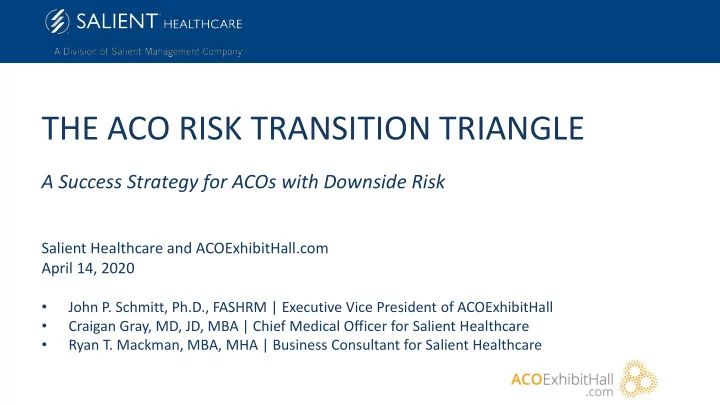
THE ACO RISK TRANSITION TRIANGLE A Success Strategy for ACOs with - - PowerPoint PPT Presentation

the aco risk transition triangle
SMART_READER_LITE
LIVE PREVIEW

THE ACO RISK TRANSITION TRIANGLE A Success Strategy for ACOs with - - PowerPoint PPT Presentation

THE ACO RISK TRANSITION TRIANGLE A Success Strategy for ACOs with Downside Risk Salient Healthcare and ACOExhibitHall.com April 14, 2020 John P. Schmitt, Ph.D., FASHRM | Executive Vice President of ACOExhibitHall Craigan Gray, MD, JD,


slide-1
SLIDE 1

THE ACO RISK TRANSITION TRIANGLE

A Success Strategy for ACOs with Downside Risk

Salient Healthcare and ACOExhibitHall.com April 14, 2020

  • John P. Schmitt, Ph.D., FASHRM | Executive Vice President of ACOExhibitHall
  • Craigan Gray, MD, JD, MBA | Chief Medical Officer for Salient Healthcare
  • Ryan T. Mackman, MBA, MHA | Business Consultant for Salient Healthcare
slide-2
SLIDE 2

2

The ACO Growth Conundrum:

“… Our [CMS] redesign of the program [MSSP], now known as “Pathways to Success,” puts ACOs on a quicker path to taking on real risk… Savings tend to increase as health care providers take on more risk, but even high levels of risk do not guarantee that a model will result in overall savings. ”

(Source: Seema Verma, “Number of ACOs Taking Downside Risk Doubles Under ‘Pathways To Success’, Health Affairs Blog, January 10, 2020)

CMS “PATHWAYS” TO RISK

slide-3
SLIDE 3

3

ACO GROWTH MODEL: THE RISK TRANSITION TRIANGLE

slide-4
SLIDE 4

ATTRIBUTION METHODOLOGY

4

PLURALITY PROSPECTIVE

PROSPECTIVE WITH RETROSPECTIVE RECONCILIATION

slide-5
SLIDE 5

POPULATION ATTRIBUTION

Use data analytics to assess risk readiness based on attribution KPIs

5

slide-6
SLIDE 6

POPULATION ATTRIBUTION

6

Use data analytics to assess risk readiness based on attribution KPIs

% Seen on a Quarterly Basis

slide-7
SLIDE 7

POPULATION ATTRIBUTION

7

Use data analytics to assess risk readiness based on attribution KPIs IF YOU CAN’T MEET THESE EXPECTATIONS, YOU’RE NOT READY TO MOVE DOWN THE GLIDE PATH

slide-8
SLIDE 8

MANAGING & GROWING MARKET SHARE

8

BEING PROACTIVE ADDING TINs ASSIGNABLES

slide-9
SLIDE 9

9

ACO GROWTH MODEL: THE RISK TRANSITION TRIANGLE

slide-10
SLIDE 10

10

5 ESSENTIAL STEPS OF ACO RISK MANAGEMENT

  • 1. Risk

Identification

  • Identify loss exposures and limits
  • 2. Risk

Avoidance

  • Deal with physician member risk avoidance
  • 3. Risk

Prevention

  • Develop action plans to reduce likelihood of losses
  • 4. Risk

Reduction

  • Assess risk readiness and development needs
  • 5. Risk Transfer
  • Acquire reinsurance and captive protection
slide-11
SLIDE 11

11

STEP 1: RISK IDENTIFICATION | MEDICARE ACO LOSS EXPOSURES & LIMITS

COMPARISON OF BASIC TRACK AND ENHANCED TRACK CHARACTERISTICS

ACO Type Shared Loss Rate Loss Sharing Limit Shared Savings Rate-Once MSR is Met Performance Payment Benchmark Limit

LEVEL A & B N/A N/A 40% 10% LEVEL C 30%; Lessor of: 1% of benchmark, cap: 2% of revenue 50% 10% LEVEL D 30% Lesser of 2% of benchmark, cap: 4% of revenue 50% 10% LEVEL E 30% Not to exceed % of revenue- based QPP amount; cap: 1%

  • f benchmark risk amt

50% 10% ENHANCED (1 – final sharing rate) 40% min and 75% max: cap: 15% of benchmark 75% 20%

slide-12
SLIDE 12

12

STEP 2: RISK AVOIDANCE | PHYSICIAN MEMBER RISK CULTURE CHANGE

DETRACTORS NEGATIVE POSITIVE CHAMPIONS

# of ACO CO Ph Physici sician ans PCMH Recep eptiv tivit ity

# of ACO Physicians Risk Readiness

PHYSICIAN CULTURE CHANGE (ENGAGEMENT & COMMITMENT)

Representation: Governance / Board of directors Membership: Medical committees Appointments: CMOs, regional MD directors, MD department chairs Participation: Operational meetings & conference calls Commitment: Culture change (risk readiness & incentive compensation)

slide-13
SLIDE 13

13

STEP 3: RISK PREVENTION | EXAMPLE ACTION PLANS TO PREVENT LIKLIHOOD OF LOSSES

CENTRALIZED TRANSFER CENTER

Concept

  • Centralized Patient

Transfer center with one call acceptance of patients based on specialty/ hospitalist pre-defined criteria.

  • Improved transfer

capture will replace bed day capacity created by integrated inpatient management.

  • Preliminary Financial

Impact: $5.6 million based

  • n an average revenue

estimate of $3,000 per admission.

Population

  • Regional opportunity is

preliminarily estimated at

  • ver 1,000 transfers

annually.

  • Based on limited data,

1,800 estimate is supported.

Key Elements

  • Regional number with
  • ne-call acceptance.
  • Pre-defined criteria for

acceptance that hospitalists/specialists will support.

  • Coordinate/dispatch

transportation.

  • Offer to all regional

hospitals including coordination of transfers to other hospitals.

  • Significant marketing

effort required.

  • All regional transfers

managed through Centralized Transfer.

Potential Risks/Barriers

  • Inability to secure

hospitalist/specialist agreement on acceptance policies.

  • Objections by other

hospitals.

  • Have to “get it right” or

no second chances with hospitals.

  • Unwillingness of regional

(unaffiliated) hospitals to use ACO center because of existing relationships.

slide-14
SLIDE 14

14

STEP 4: RISK REDUCTION BY READINESS ASSESSMENTS

ACO RISK READINESS ASSESSMENT CRITERIA

Governance/Leadership Organizational Culture - Communication Relationships with Providers Claims Access IT System Clinical Med Management System Financial Risk Management Ability to Risk-Share with Providers

slide-15
SLIDE 15

15

STEP 4: RISK REDUCTION BY READINESS ASSESSMENTS

ACO RISK READINESS ASSESSMENT EXAMPLE

CRITIERIA Development Required Limited Capabilities In-Place: Performance Evident Financial Risk Management Medical service expense (MSE) management capabilities Processes to assess financial risk Cost accounting capabilities across episodes Provider-health plan partnerships

slide-16
SLIDE 16

16

STEP 5: RISK TRANSFER | FUNDING OPTIONS

Funding Reserves: Options

  • Joint ventures
  • Shared savings retention
  • Private equity investment
  • Line of credit
  • Surety bond
  • Other
slide-17
SLIDE 17

17

STEP 5: RISK TRANSFER | AGGREGATE STOP-LOSS

Example: How an aggregate stop loss policy can provide financial protection to an ACO

ACO Type MSSP-BASIC TRACK E Assigned Beneficiaries 10,000 Performance Year Benchmark - PMPY $10,500 Performance Year Benchmark - Annualized $105,000,000 Loss Sharing Limit as a Percentage of Benchmark 8% Loss Sharing Limit in Dollars $8,400,000 Aggregate Stop Loss Attachment Point as a Percentage of Benchmark 103.0% Aggregate Stop Loss Attachment Point in Dollars $108,150,000 Actual Expenditure - PMPY $11,214 Actual Expenditure - Annualized $112,140,000 Actual Expenditure as a percentage of Benchmark 106.8% ACO Loss Share Rate 30.0% ACO's Liability to CMS $2,142,000 Amount Insured through Aggregate Stop Loss $1,197,000 ACO's Liability Net of Stop Loss Recovery $945,000

slide-18
SLIDE 18

18

ACO GROWTH MODEL: THE RISK TRANSITION TRIANGLE

slide-19
SLIDE 19

19

PERFORMANCE RESULTS | TRIPLE AIM

slide-20
SLIDE 20

20

ACO GROWTH: THE RISK TRANSITION TRIANGLE

slide-21
SLIDE 21

21

CONCLUSION

Need Data Analytics Keep Up on How Your ACO is Performing Understand Attribution & Risk Comes 1st If you can’t do it on your own, there’s help!

slide-22
SLIDE 22

22

QUESTIONS & DISCUSSION

slide-23
SLIDE 23

23

STOP BY OUR ACO EXHIBIT HALL VIRTUAL BOOTH

https://www.acoexhibithall.com/vendor-booth/salient-healthcare/population-health-ii-software-tools-data-analytics/117/

slide-24
SLIDE 24

24

THANK YOU

Ryan T. Mackman, MBA, MHA | Business Consultant

  • Mobile: 954.270.0692
  • E-Mail: rmackman@salient.com

John P. Schmitt, Ph.D., FASHRM | Executive VP

  • Mobile: 423.304.4343
  • E-Mail: jschmitt@ACOExhibitHall.com

www.acoexhibithall.com | www.salienthealthcare.com

Craigan Gray, MD, MBA, JD | Chief Medical Officer

  • Mobile: 919.602.6150
  • E-Mail: cgray@salient.com