
SLIDE 1
2/28/2014 1
The ACA and What It Means for Black Americans
Presented by the Kaiser Family Foundation Tuesday, February 25, 2014 12:30 p.m. ET – 1:30 p.m. ET
The ACA and What It Means for Black Americans Presented by the - - PDF document
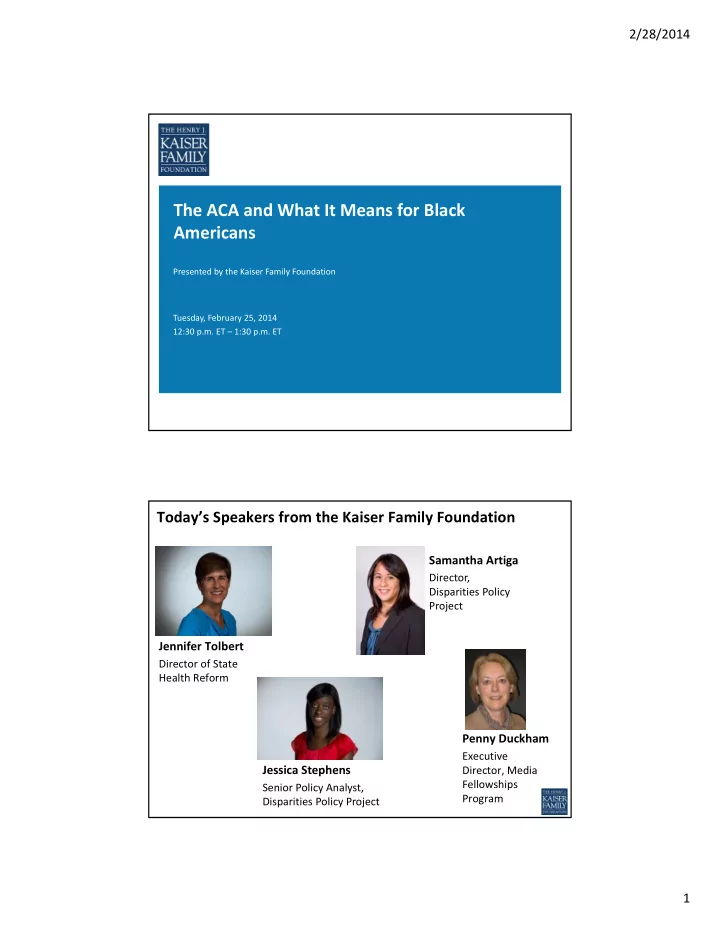
2/28/2014 The ACA and What It Means for Black Americans Presented by the Kaiser Family Foundation Tuesday, February 25, 2014 12:30 p.m. ET 1:30 p.m. ET Todays Speakers from the Kaiser Family Foundation Samantha Artiga Director, Disparities
Presented by the Kaiser Family Foundation Tuesday, February 25, 2014 12:30 p.m. ET – 1:30 p.m. ET
18% 21% 6% 56%
*Medicaid also includes other public programs: CHIP, other state programs, Medicare and military‐related coverage. The federal poverty level for a family of three in 2012 was $19,090. Numbers may not add to 100% due to rounding. SOURCE: KCMU/Urban Institute analysis of 2013 ASEC Supplement to the CPS.
47.3 Million Uninsured 266.9 Million Nonelderly
Employer‐Sponsored Coverage Uninsured Medicaid* Private Non‐Group Health Insurance Coverage of the Nonelderly, 2012 Income
≤138% FPL (51%) 139‐399% FPL (39%) ≥400% FPL (10%) Source: Health Insurance Marketplace: February Enrollment Report, Department of Health and Human Services, February 12, 2014.
Number of Individuals Who Have Selected a QHP
PA FL TX
Total Number of Individuals = 3.3 million
MT NM WY IA SD ND MS WV VT NH MA DE RI DC ID NV OR UT KS NE MN OK AR LA ME MD AZ CO IL WI MO WA AL IN TN VA KY OH SC NJ CT TX CA FL GA MI PA NY NC AK HI* <10,000 10,001-40,000 40,001-100,000 >100,000
3.1% 4.3% 4.5% 5.3% 5.5% 5.8% 6.0% 6.2% 6.5% 6.6% 6.6% 6.7% 6.8% 6.9% 7.4% 7.5% 7.9% 8.2% 8.4% 8.5% 8.7% 8.9% 9.0% 9.1% 9.1% 9.3% 9.5% 9.5% 9.5% 9.6% 9.6% 9.7% 10.0% 10.3% 11.7% 11.7% 12.3% 12.3% 13.0% 13.7% 14.9% 15.5% 16.1% 16.3% 16.7% 16.8% 17.5% 22.1% 22.5% 22.5% 43.5%
0% 5% 10% 15% 20% 25% 30% 35% 40% 45% 50%
Massachusetts South Dakota Iowa North Dakota Oklahoma Mississippi New Mexico Hawaii Alaska Texas Wyoming Louisiana West Virginia Maryland Ohio Kansas Arizona Missouri South Carolina Nebraska New Jersey Utah Virginia Indiana Nevada Tennessee Alabama Georgia Illinois Arkansas Minnesota Pennsylvania Oregon Delaware Florida Wisconsin Montana New Hampshire District of Columbia Colorado North Carolina Michigan Kentucky Idaho New York Maine Washington California Connecticut Rhode Island Vermont
SOURCE: Based on data from Health Insurance Marketplace: January Enrollment Report, Department of Health and Human Services, January 13, 2014 and State‐by‐State Estimates of the Number of People Eligible for Premium Tax Credits Under the Affordable Care Act, Kaiser Family Foundation, November 5, 2013.
Marketplace Enrollment as a Share of the Potential Marketplace Population
State‐based Marketplace Federally‐Facilitated Marketplace 65.1% 66.1% 70.5% 71.3% 72.8% 75.1% 84.4% 87.3% 87.9% 115.7%
0% 20% 40% 60% 80% 100% 120% 140%
Idaho Virginia Arkansas South Carolina Georgia Texas Oregon Louisiana Florida Mississippi SOURCE: Based on data from Health Insurance Marketplace: February Enrollment Report, Department of Health and Human Services, February 12, 2014 and Health Insurance Marketplace: January Enrollment Report, Department of Health and Human Services, January 13, 2014.
*138% FPL = $15,856 for an individual and $26,951 for a family of three in 2013.
Adults Elderly & Persons with Disabilities Parents Pregnant Women Children
Extends to Adults ≤138% FPL*
Medicaid Eligibility Today
Medicaid Eligibility in 2014
Limited to Specific Low‐Income Groups Extends to Adults ≤138% FPL*
Dear ______, You are eligible for… Data Hub
$
Multiple Ways to Enroll Use of Electronic Data to Verify Eligibility Single Application for Multiple Programs Real‐Time Eligibility Determinations
Medicaid CHIP Marketplace HEALTH INSURANCE
Simplified Enrollment and Renewal in All States Expands Eligibility in States that Implement Expansion Increased Outreach and Enrollment Previously Eligible but Not Enrolled in All States Newly Eligible in States that Implement the Expansion Stability and Continuity of Coverage in All States “No Wrong Door” Enrollment in All States Changes in Medicaid under the ACA Expected Impacts on Medicaid Enrollment Medicaid Coverage Uninsured
enrollment in Medicaid with the Marketplaces.
– Data are new and subject to gaps and limitations. – Quality and completeness will improve over time.
enrollment for the Marketplaces began in October 2013.
– Between October‐December 2013, state Medicaid and CHIP agencies and state‐based Marketplaces made
– As of February 1, 2014, 3.2 million individuals determined or assessed eligible for Medicaid or CHIP by the Marketplaces (1.2 million by FFM in 36 states; 2 million by SBMs in 15 states).
enrollment options and transitions from early expansion programs.
experiences of individuals who gain coverage.
NOTES: Data are as of January 28, 2014. *AR and IA have approved waivers for Medicaid expansion; MI has an approved waiver for expansion and plans to implement in Apr. 2014; IN and PA have pending waivers for alternative Medicaid expansions; WI amended its Medicaid state plan and existing waiver to cover adults up to 100% FPL, but did not adopt the expansion. SOURCES: States implementing in 2014 and not moving forward at this time are based on data from CMS here States noted as “Open Debate” are based on KCMU analysis of State of the State Addresses, recent public statements made by the Governor, issuance of waiver proposals or passage of a Medicaid expansion bill in at least one chamber of the legislature.
WY WI* WV WA VA VT UT TX TN SD SC RI PA* OR OK OH ND NC NY NM NJ NH NV NE MT MO MS MN MI* MA MD ME LA KY KS IA* IN* IL ID HI GA FL DC DE CT CO CA AR* AZ AK AL Implementing Expansion in 2014 (26 States including DC) Open Debate (6 States) Not Moving Forward at this Time (19 States)
255% 203% 138% 138% 47% 0%
NOTE: Includes the five percentage point of income disregard. SOURCE: Based on data from the Centers for Medicare and Medicaid Services, available at: http://medicaid.gov/AffordableCareAct/Medicaid‐Moving‐Forward‐2014/Medicaid‐and‐CHIP‐Eligibility‐Levels/medicaid‐chip‐ eligibility‐levels.html as of November 15, 2013.
Children Pregnant Women
Not Moving Forward With Expansion (25 States) Moving Forward With Expansion (26 states)
Parents
Not Moving Forward With Expansion (25 states)
Childless Adults
Moving Forward With Expansion (26 States)
Median Medicaid/CHIP Eligibility Thresholds as a Percent of the Federal Poverty Level, January 2014
NOTE: Applies to states that do not expand Medicaid. In most states not moving forward with the expansion, adults without children are ineligible for Medicaid. Based on state Medicaid expansion decisions as of 2014.
47% FPL Parents Median Medicaid Eligibility Limits as of Jan. 2014 0% FPL Childless Adults
4.8 Million Adults
30% 29% 40% 24% 21% 30%
Total Whites Blacks Hispanics Other People of Color
NOTES: Excludes legal immigrants who have been in the country for five years or less and undocumented immigrants. The poverty level is $19,530 for a family of three and $11,490 for an individual in 2013. SOURCE: Kaiser Family Foundation analysis based on 2014 Medicaid eligibility levels and 2012‐2013 Current Population Survey.
Share of Nonelderly Uninsured Adults <138% FPL in the Coverage Gap by Race/Ethnicity:
4.8 M 1.0 M 1.3 M 2.2 M 2.6 M 0.3 M
39% 40% 47% 67% 71% 30% 32% 32% 15% 15% 32% 27% 21% 18% 13%
Hispanic American Indian Black Asian White Uninsured Medicaid /Other Public Employer/Other Private
Insurance Coverage of Nonelderly in the U.S. by Race/Ethnicity, 2011:
SOURCE: KCMU/ Urban Institute analysis of 2012 ASEC Supplement to the CPS.
161.6 M 14.7 M 1.9 M 33.5 M 49.2 M
http://greaterthan.org/campaign/obamacare/
http://greaterthan.org/empowered/
kff.org/health‐reform/faq/health‐reform‐frequently‐asked‐questions/
– Seven fact sheets on how the ACA affects people if they: