THAOS: TranstHyretin Amyloidosis Outcomes Survey: an international - - PowerPoint PPT Presentation

thaos transthyretin amyloidosis outcomes survey an
SMART_READER_LITE
LIVE PREVIEW

THAOS: TranstHyretin Amyloidosis Outcomes Survey: an international - - PowerPoint PPT Presentation

Clinical trial and registry Update II THAOS: TranstHyretin Amyloidosis Outcomes Survey: an international Registry Presenter: Prof Claudio Rapezzi Discussant: Dr Philippe Charron Centre de Rfrence pour les Maladies cardiaques hrditaires,


slide-1
SLIDE 1

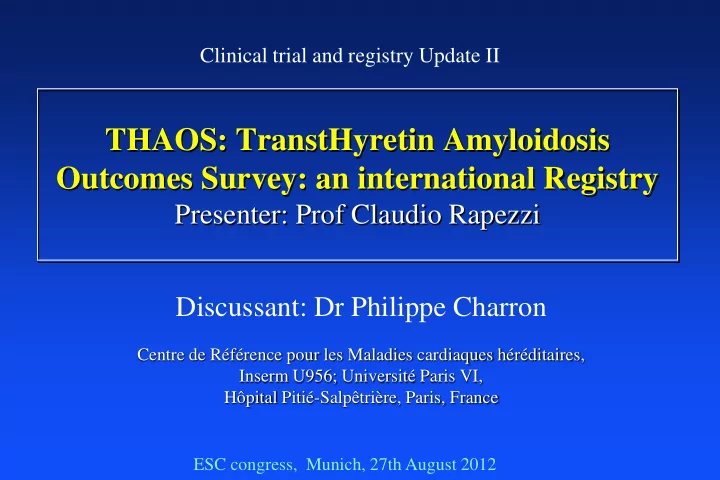
THAOS: TranstHyretin Amyloidosis Outcomes Survey: an international Registry

Presenter: Prof Claudio Rapezzi Discussant: Dr Philippe Charron

Centre de Référence pour les Maladies cardiaques héréditaires, Inserm U956; Université Paris VI, Hôpital Pitié-Salpêtrière, Paris, France ESC congress, Munich, 27th August 2012

Clinical trial and registry Update II

slide-2
SLIDE 2

Disclosure slide for potential conflicts of interest

Relationships with Industry

  • Research funding (grant):
  • To me: no / To my institution: yes (Genzyme, Actelion)
  • Consulting/advising fees: no
  • Stockholder of a healthcare company: no
  • Royalties for intelectual properties: no
  • Patents: no with Industry (but patent with Iserm-transfert institution)
  • Speaker fees: no
  • Advisory board fees: no
slide-3
SLIDE 3

Context

(hereditary form of) transthyretin-related amyloidosis (ATTR)

  • Rare disease (but quite prevalent in Portugal, Sweden, Japan)
  • Underdiagnosed or delayed diagnosis
  • Fatal condition (at least for neurodegenerative disorders)
  • Natural history, and determinants, are poorly understood
  • No specific / effective treatment currently available

regarding heart impairement (orthotopic liver transplantation for

neurologic forms)

Rapezzi et al., Nat Rev Cardiol 2010; Dungu et al, Heart 2012

slide-4
SLIDE 4

Main findings of THAOS registry

  • The largest collection of patients reported so far: 1219 subjects

with validated data (108 with WT ATTR & 1111 with hereditary ATTR)

  • Description of TTR mutations spectrum: 51 mutations, 9

predominant, Val30Met as the most frequent one (75%), 4 mutations with exclusive/main cardiac phenotype (Val122Ile, Leu111Met, Thr60Ala, Ile68Leu)

  • Features suggestive of hereditary ATTR: symmetric left

ventricular hypertrophy (LVH), normal diastolic LV volume, mildly depressed LVEF, male gender and age > 60

  • Determinant of age at onset: gender of the patient, gender of the

transmitting parent, type of mutation and (for V30M) by geographic area.

slide-5
SLIDE 5

Potential weaknesses and limitations (1)

  • Design and potential bias: Role of funding (Pfizer)?

Selection bias? Measurement bias? Information bias? Missing information? → More information on the design of the registry and data analysis (ex: Echographic data for 227 patients only?)

  • Features suggestive of hereditary ATTR: based on a

limited population (<100 patients?) and lack of comparison → clarify the population and suggest comparison with AL amyloidosis, wt ATTR and sarcomeric HCM

slide-6
SLIDE 6

Potential weaknesses and limitations (2)

  • Determinant of age at onset: only univariate analyses are

reported → suggest multivariate analyses

  • Statistical analyses: potential impact on phenotype of specific

mutations and respective « weight » of families (large/small) → suggest to take into account such co-variates

  • No data on severity/complications at baseline and no

follow-up: → additional analyses pending?

slide-7
SLIDE 7

Conclusion

  • THAOS registry offers a unique opportunity to assess the

phenotypic and genotypic spectrum and correlations in ATTR and can represent a model for the study of rare diseases with worldwide impact.

  • Preliminary results are very promising. Additional analyses are

suggested

  • This registry will facilitate comprehension of the natural history
  • f the disease and offer the potential to evaluate novel

therapeutic modalities (tafamidis? diflunisal? siRNA?) in diverse patient subpopulations.