Thank you! Apply for larger grant to follow-up on findings Survey - - PowerPoint PPT Presentation

thank you
SMART_READER_LITE
LIVE PREVIEW

Thank you! Apply for larger grant to follow-up on findings Survey - - PowerPoint PPT Presentation

6/9/2017 M ANDATORY B REAST D ENSITY D ISCLOSURES AND R EPORTING : P ATIENT A CKNOWLEDGEMENTS U NDERSTANDING AND E FFECTS ON I have no disclosures to report M AMMOGRAPHY S CREENING , R ISK Robert Wood Johnson Foundation Health and P


slide-1
SLIDE 1

6/9/2017 1 MANDATORY BREAST DENSITY REPORTING: PATIENT UNDERSTANDING AND EFFECTS ON MAMMOGRAPHY SCREENING, RISK PERCEPTION AND WORRY

Erica T. Warner, ScD MPH Massachusetts General Hospital Harvard Medical School 8th International Breast Densitometry and Breast Cancer Risk Workshop June 8, 2017

DISCLOSURES AND ACKNOWLEDGEMENTS

I have no disclosures to report Robert Wood Johnson Foundation Health and

Society Scholars Seed Grant

Co-Investigators Rulla M. Tamimi, BWH Andy S. Tan, DFCI Robyn Birdwell, BWH (retired) DFCI Survey Data Management Core Nora Sporn Anna Revette Participant Recruitment Madeline Schuck

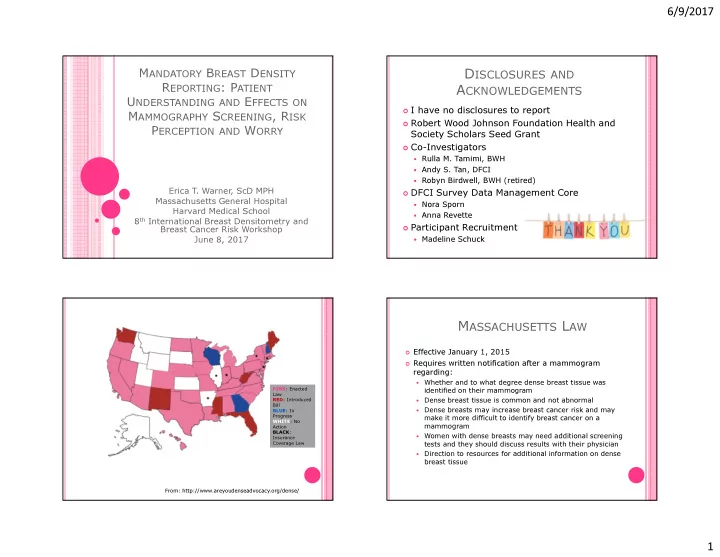
From: http://www.areyoudenseadvocacy.org/dense/

PINK: Enacted Law RED: Introduced Bill BLUE: In Progress WHITE: No Action BLACK: Insurance Coverage Law

MASSACHUSETTS LAW

Effective January 1, 2015 Requires written notification after a mammogram

regarding:

Whether and to what degree dense breast tissue was

identified on their mammogram

Dense breast tissue is common and not abnormal Dense breasts may increase breast cancer risk and may

make it more difficult to identify breast cancer on a mammogram

Women with dense breasts may need additional screening

tests and they should discuss results with their physician

Direction to resources for additional information on dense

breast tissue

slide-2
SLIDE 2

6/9/2017 2

RATIONALE

Known difficulties understanding

mammography reports and abnormal results

Evidence from other states Reports from local radiologists of

patients misunderstanding the term “dense” to mean “stupid”

STUDY AIMS

Aim 1: Using qualitative methods, assess

women’s beliefs and knowledge about breast density, comprehension of mammography reports, and their interactions with health professionals regarding breast density

Aim 2: Evaluate the effect of breast density

notification on breast cancer screening, perceived breast cancer risk, and worry

STUDY POPULATION AND ELIGIBILITY CRITERIA

Boston Mammography Cohort Study (BMCS) 2787 women receiving routine screening mammograms at

Brigham and Women’s or Massachusetts General Hospital

Eligibility criteria for qualitative density notification study Highest category of Volpara density grade (VDG) No personal history of breast cancer Had a mammogram at Brigham and Women’s since Jan 1, 2015 English speaking Semi-structured phone interviews with 20 women 60 minutes or less

INTERVIEW GUIDE

Mammography beliefs, breast cancer risk factor

awareness and risk perception

Purpose of mammograms, who gets them, personal

motivations Breast density knowledge and awareness

What is breast density, how did they learn about density,

have they talked about density with a healthcare provider Mammogram report review

Comprehension, readability, need for more information

Intentions for future screening Density debriefing

  • Review fact sheet from Susan G. Komen Foundation
slide-3
SLIDE 3

6/9/2017 3

RESULTS: PARTICIPANT CHARACTERISTICS

Characteristic Mean SD Age 59.7 8.3 Age at first birth 31.2 6.7 BMI 24.2 4.6 N % Race White 15 75% Black or African-American 5 25% Family history of breast cancer 5 25% Ashkenazi Jewish heritage 2 10% Nulliparous 5 25% Age at Menarche ≤12 4 20%

RESULTS: DEFINITION OF DENSITY

Most women defined density as related to

breast tissue composition

Masking The majority of the participants (17)

expressed some degree of doubt about their definition

Unsure or guessing about the definitions they

provided

One participant had not heard of breast

density before

RESULTS: DEFINITION OF DENSITY

“I think it’s just like fatty tissue or something

that makes it difficult to see, um... through the thick tissue?”

“Um, um, well, there’s a lot of tissue in there,

and if it’s a lot of dense tissue, and it’s harder, there could be hidden, um, cancers behind the tissue that they can’t see everything… is

  • ne thing, and, um, I just have dense breasts,

dense tissue in my breasts.”

RESULTS: INTERACTIONS WITH HEALTHCARE PROVIDERS

Nine participants had spoken with their doctor or

  • ther healthcare professional about breast

density

  • Seven specified that they had spoken with a breast

technician

Eight participants had not spoken with their

doctor about breast density

Three participants could not remember if they

had spoken with anyone about breast density

slide-4
SLIDE 4

6/9/2017 4

RESULTS: INTERACTIONS WITH HEALTHCARE PROVIDERS

“Through the series of mammograms that I’ve

had, it was always mentioned … They almost always mention it. Not just … It wasn’t just mentioned when I had the biopsy, it’s mentioned, you know, usually almost every time that I get a mammogram.

Interviewer: Is this by the radiologist who completes

the mammogram, who talks to you about it?

”You don’t ever see the radiologist. Have you had

  • ne of these lately? … the technician, a well-

trained excellent technician. The radiologist then reviews it and you meet with the radiologist, I guess, if you have something.”

RESULTS: INTERACTIONS WITH HEALTHCARE PROVIDERS

“You know, this is something that they

SHOULD go over with you, be telling you that, you know, “These are the things that you need to...” that we’re talking about. I know... I know my doctor didn’t go over it with me.”

RESULTS: AWARENESS AND EFFECTS OF NOTIFICATION

Eleven participants said they had been notified

about having dense breasts

Two were aware of the state law Participants’ feelings about breast density

notification largely fit into three main categories

No significant feelings about it Concern or stress about the notification Increased awareness or appreciation of breast screening

RESULTS: NOTIFICATION AWARENESS

“You don’t get notification. They’re doing it

[the mammogram] and they tell you [about breast density]. I don’t know – I mean, you don’t sound like you’ve been for a mammography

  • lately. [Participant then finds the letter she

received after her last mammogram] “You should be calling the people who get it to see what they

  • think. Oh, here, I’ve got something in my folder

called breast density information for patients, mammogram bill of rights, I don’t even read that stuff.”

slide-5
SLIDE 5

6/9/2017 5

RESULTS: NOTIFICATION AWARENESS

“... I know I have dense breasts, just

because I think a letter I get every year SAYS that I do…But, no one’s ever talked to me about it … Yeah, like for, I’ve been going to the Brigham for maybe five years? And, you know, they usually just send a letter saying “everything is fine,” and on that letter it says, like, it has a whole big thing it says about breast density, but ... I know it says that I have dense

  • breasts. And, that’s, that’s the only place I

ever remember seeing anything about it.”

RESULTS: EFFECTS OF NOTIFICATION

“Um, hm, well, at first it was like, it was

like, “Oh.” And then, um, I mean, it doesn’t, it doesn’t bother me. It didn’t make me feel, it didn’t really make me feel one way or the other. Just knowledge, you know.”

RESULTS: EFFECTS OF NOTIFICATION

“…And just learning, on top of the previous

concerns, learning that, “Yes, you DO have dense breasts, and that can be, one of these risk factors.” I wouldn’t say the, it’s exclusively having dense breasts? It’s that, alongside of the

  • ther things that we’ve been talking about, that
  • nly makes you more, um, affirmed in your,

wanting to have this [mammogram] done every year.”

slide-6
SLIDE 6

6/9/2017 6

RESULTS: MAMMOGRAM REPORT FEEDBACK

Women were generally pretty positive about the

layout, amount of information and readability of the report

Among the women that provided critiques common

responses were:

Too much technical jargon Needs section headings Density notification too far down the page—easy to miss Even split between too much/too little information

RESULTS: MAMMOGRAM REPORT FEEDBACK

“Um, so you go back to the first page where

you say negative or benign findings, if you checked that off, um, that would be the end of it for me. And yet, there probably should be something on here about breast density … I don’t think there’s anything on here about - - on this page about breast density…what reason would I have to go to the second page? I didn’t even know there was a backside to this.”

RESULTS: USE OF SUPPLEMENTAL SCREENING

15 were familiar with supplemental screening

  • ptions

Five only knew about one supplemental screening

  • ption

Doctor recommendation or previous screening by MRI or

ultrasound

Other information sources: friends/family, internet,

medical journals

Four women were not familiar with supplemental

screening options

All of the participants would consider the

additional screening options

If they had an issue or a problem (10) Doctor’s recommendation (7) Would consider supplemental screening but had some

concerns (4)

slide-7
SLIDE 7

6/9/2017 7

RESULTS: USE OF SUPPLEMENTAL SCREENING

“I WOULD, knowing that, you know,

mammography is not the best thing for dense breasts. Sure. If someone said, you know, “You have to have this, why don’t we do THIS, instead of that,” I would HAVE the other…Definitely… If it was recommended and they said, “Okay, we’re gonna set you up to do this,” I would go have it done!”

SUMMARY

Most participants defined density as something

related to breast fatness or thickness

Masking, not necessarily as a risk factor Most women had not discussed or could not recall

discussing breast density with a healthcare provider

Breast technicians were a key information source Just 11 of 20 recalled receiving notification Most did not refer to the written notice Only three participants recalled the report Most were satisfied with the report

STRENGTHS AND LIMITATIONS

Time since last mammogram varied across

participants

Some challenges with recall Participants had been getting mammograms

for many years

Had some awareness of their density before

mandatory notification

Single institution Nested within a cohort with access to other

information about participants

DISCUSSION

What is the purpose of density

notification?

Is that met with the current

process?

Women directed to talk with their

doctors if they have concerns

When and how?

slide-8
SLIDE 8

6/9/2017 8

NEXT STEPS

Apply for larger grant to follow-up on

findings

Survey in cohort Provider perspectives, training, and education Randomized trial of different notification

approaches

Interviews/surveys of healthcare providers to

gauge their understanding of breast density and how they are currently educating their patients

Thank you!

ewarner@mgh.harvard.edu @ewarner_12