Thank you! You may use this feature to ask questions during the - - PDF document

thank you
SMART_READER_LITE
LIVE PREVIEW

Thank you! You may use this feature to ask questions during the - - PDF document

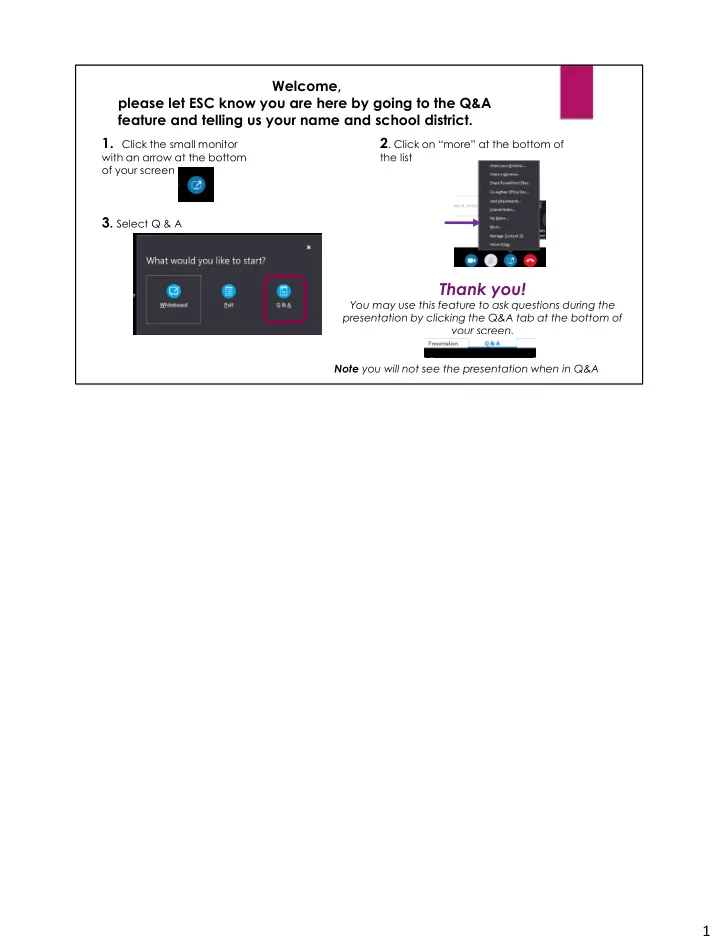
Welcome, please let ESC know you are here by going to the Q&A feature and telling us your name and school district. 1. Click the small monitor 2 . Click on more at the bottom of with an arrow at the bottom the list of your screen 3 .


slide-1
SLIDE 1

Welcome, please let ESC know you are here by going to the Q&A feature and telling us your name and school district.

  • 1. Click the small monitor

with an arrow at the bottom

  • f your screen
  • 2. Click on “more” at the bottom of

the list

  • 3. Select Q & A

Thank you!

You may use this feature to ask questions during the presentation by clicking the Q&A tab at the bottom of your screen. Note you will not see the presentation when in Q&A

1

slide-2
SLIDE 2

MANUAL Work History Adjustments

2

slide-3
SLIDE 3

✓Learn what an adjustment is and how it is used ✓How to determine if you need an adjustment and when to submit one ✓How to create, validate and submit an adjustment

✓ Learn what an adjustment is and how it is used ✓ How to determine if you need an adjustment and when to submit one ✓ How to create, validate and submit an adjustment ✓ By the end of this training you should be able to submit a manual adjustment and correct any errors or exceptions that may occur 3

slide-4
SLIDE 4

An adjustment is different from a work report?

Unlike the information reported on a Work Report, and Adjustment represents the difference between what was reported and what should have been reported to PSERS. This means the adjustment values may be positive or negative. Adjustments reflect amounts reported for a school year and not for a specific month as work reports do. EXAMPLE If you submit a Work Report Record for January that listed an employee’s salary as $1,000, but the employee really earned $1,700. You will need to correct this with an Adjustment . You will report the difference in wages under the BASE field as $700, making the net amount in the employee’s account $1,700. When doing a salary or wage adjustment always include the corresponding member contributions-unless no member contributions were withheld. Also, identify WHY this error

  • ccurred, so it can be avoided in the future.

4

slide-5
SLIDE 5

When should I Submit a Work History Adjustment?

How do you determine when to submit an adjustment? Adjustments should be submitted;

  • If an error was made in a previous work report that can’t be corrected on your next work

report

  • If A Member’s Purchase of Service installment payments were reported incorrectly or an
  • verpayment was made
  • If Service time (days/hours) has been reported incorrectly or omitted on a previous report, or

for the fiscal year.

  • If one or more employee records have dropped from your work report due to uncorrected

errors or an error that occurred when the work report file was processed.

  • If you discovered an error in reporting for a previous fiscal year.
  • If a retroactive lump sum needs to be made for an individual or group of employees after a

contract settlement.

  • Finally, if an arbitration or court awarded settlement is reached.

5

slide-6
SLIDE 6

RULE OF THUMB:

Use Work History Adjustments when an error or a correction is needed to an employee’s:

  • Salary
  • Contributions
  • Service time
  • Member Purchase of Service installments

Adjustments are used when correction cannot be done on the work report

  • r

It is from a Previous Fiscal Year 6

slide-7
SLIDE 7

Submit Work History Adjustments as soon as you become aware of an error in reporting

Submitting an adjustment timely…. ….BENEFITS YOU! How: Information will be current so you aren’t spending time researching information. Timely Adjustments help supply accurate data for your employees’ annual statements. This will reduce the number of phone calls that will be received from employees with incorrect information reported on their yearly Member Statement. Early adjustments make it easier to rectify your payroll to PSERS. Timely adjustments and reporting may cut down on the informational requests you receive from PSERS Processing Unit. Adjustments made to member accounts after a member has refunded or retired creates additional administrative work for PSERS to balance the member account. If retired, the member may end up with a lower monthly benefit amount if you over-reported money into the system and must do an adjustment to remove wages and contributions. It is much easier to fix incorrect data now, than to try and fill in the gaps years later. If adjustments are made quickly, PSERS can process benefit applications faster for your employees.

7

slide-8
SLIDE 8

cross reference - hours/days, total salary, contributions, wages no contributions “WNC” reported

Information on how to generate a summary report can be found on the PSERS Public Web Site/Employer/Employer News/2018 Spring Workshop/ beginning slide 13

Generate and export a SUMMARY REPORT using the Quick Links on Home tab

How do you know if you have an error? PSERS recommends you run a Summary Report each month following the release

  • f your work report . You can run this report from the Home page on your Quick

Links. The Summary report gives you a total of your work reports and adjustments that have been released to date. It is a live report so if a work report is released this afternoon it will show in the Summary Report. In light of Act 5, and the addition of the defined contribution component which relies on timely and accurate reporting this makes it a great tool to reconcile your payroll to PSERS reporting. Once you have reconciled - Determine if correction is needed - Submit an adjustment. 8

slide-9
SLIDE 9

You submitted a work report and there are rows that were not processed due to errors

Rows with errors “drop off” your work report because the system cannot accept a row with “fatal” errors

You must correct all “fatal” error rows BEFORE processing your work report to avoid having rows drop off your work report. If an employee is left with an error on the work report, when the report is processed that employee will become invalid. This means that the monthly reporting information for that employee did not post to their account in PSERS. With that being said, there is one type of error/invalid that occurs only after you have Processed your Work Report. If an employee has two lines on your work report, with the same wage type in the same fiscal year, one of the lines will become invalid only after the work report is processed. One of this employee’s lines has now “dropped off” your work report and you will now have to do an adjustment to add the dropped information into the member’s account.

9

slide-10
SLIDE 10

From the Exception Filter- use drop down - click on type of error – these files were not processed and did not go to PSERS

This record did not go to PSERS and an adjustment should be submitted after member contract is created.

From the Account Tab, select File History. This page shows all reports uploaded to the ESS system. If you scroll to the right, you will see how many rows were imported, how many were processed and if there were any invalids or exceptions. If there were: Click Actions to the left of the work report you would like to review and select Details. Use the drop down menu on the Exception Filter and select an error message. If the error was corrected at the time the report was processed, no employees will display. If the error was not corrected, employees with that error will populate. These are the employees who will need adjustments submitted.

10

slide-11
SLIDE 11

PSERS, an employee, your payroll provider, or another source alerts you to an error from a previous fiscal year

  • r earlier in this

fiscal year.

.

You may become aware of an error in an employee’s salary, contributions, service units or Purchase of Service Installments through an audit, an employee bringing it to your attention, or any other means. If the errors are in previous fiscal years an adjustment is the only way to correct these errors. Although you can make adjustments to past fiscal years, if you find an error that you feel must be corrected more than 3 fiscal years ago, please contact your ESC Representative for

  • assistance. The error may have already been corrected by PSERS processing.

If you have only a handful of employees’ accounts to adjust, selecting Manual Adjustment will be the best choice to make these corrections. 11

slide-12
SLIDE 12

You have been given information regarding a court award or arbitration settlement agreement

Another reason to do an adjustment is because of a court awarded or arbitration settlement. All settlements or salary from arbitration must be reviewed by PSERS on a case-by-case basis to determine that the award is considered Retirement Covered Compensation. Before any credit or debit can be released to an employer’s or employee’s account. Award information must be sent in writing to PSERS including a copy of the court award or arbitration agreement. The agreement must state what the settlement and salary payment represent in detail. It is best to wait to make the adjustment until PSERS advises the award or settlement is retirement covered compensation. If you report a settlement payment prior to PSERS determination you may have to correct an additional error. Once approved as RCC, Report only the amount representing the employee's reinstated full contract salary (awards may have included interest or punitive damages) The employee’s contract record must be corrected to reflect continuous school service as though the disputed personnel action did not occur.

12

slide-13
SLIDE 13

For examples and detailed adjustment information refer to the Employer’s Reference Manual Chapter 11

http://www.psers.pa.gov/Employers/Pages/EmployerManual.aspx

PSERS has information available to you on our Public Web Site. We strongly recommend you visit the site and explore the Employer Tab to become familiar with the resources available.

13

slide-14
SLIDE 14

Now you know you have to do an adjustment…. So how do you submit an adjustment in the new system?

14

slide-15
SLIDE 15

2 Ways to Submit A WORK HISTORY ADJUSTMENT File Upload Manual Report

There are two ways to submit Adjustments depending on the number of records that need to be corrected. File Upload is used for a batch of employees:

You will be uploading a file that was exported from your payroll/HR software system.

Today we are discussing Manual Adjustments. Manual adjustments as used for an

individual or small group of employees; You will be entering records one at a time. 15

slide-16
SLIDE 16

To begin, navigate to the ACCOUNT Tab in ESS 16

slide-17
SLIDE 17

❖ From the Account Tab Click the Manual Report Button ❖ Select Adjustment

Click the Manual Report Button From the drop down menu select Adjustment

***** IMPORTANT! ****** If you select Work Report, in error, and submit adjustment information as a work report- this will be the district’s next month’s work report.

17

slide-18
SLIDE 18

Name Adjustment

❖Click in the identifier box to RENAME the Identifier to your preference The name you give your adjustment will be how it appears on your monthly statement ❖ After you have named your adjustment click “Generate”

The identifier will automatically be named Billing Rpt. Rename your adjustment to something that will identify this adjustment when you see the name. This is the name that will appear on the main account tab table and your monthly statement. Click in the box and type your new name for the adjustment. Click generate once you have entered your new identifier.

18

slide-19
SLIDE 19

Begin Adjustment

❖Click the ADD Member button to create your first adjustment row

When you begin a manual adjustment you are automatically in edit mode meaning you are able to make changes. You can tell if you are in edit mode by the “Save, Apply, Cancel” at the top left corner of the screen. Begin adding your employees by clicking the “Add Member’ button. 19

slide-20
SLIDE 20

Identify Employee

❖Double Click under the “Name/SSN” Header in the row you are adding ❖Enter the employee’s entire Social Security Number – hit “Enter”

Once you have clicked add member a row will populate – borders are not clearly visible. It is important to double click directly under the Name/SS column header, in the empty box. Type the complete Social Security number for your first employee on the adjustment.

  • Tab. This will auto fill employee Name/SS/and DOB.

20

slide-21
SLIDE 21

Error Message

❖Clicking in this area will generate an error – make sure you are double clicking UNDER the Title row

If you missed the area to double click and have clicked on the Header instead, you will receive this error message. Click Ok and double click in the empty box.

21

slide-22
SLIDE 22

Mandatory Fields

❖Fields are listed in the same order as Work Reports ❖The first six fields are REQUIRED – remaining fields are used if adjustment includes these values

Review the employee name and Social Security number to make sure you are adjusting the correct employee. Now you are ready to begin completing the fields for the adjustment. Fields are listed in the same order as Work Reports. The first six fields are required.

22

slide-23
SLIDE 23

Reason Code

❖Mandatory fields include a drop down menu – except the FY ❖Highlight appropriate reason code for your adjustment For explanation of Reason codes refer to Employer Reference Manual Chapter 11 page 8

Mandatory fields have a drop down for convenience. Fiscal Year requires you to type in the four digit year the adjustment is to apply. Remember you may only have one fiscal year per row. If an employee has corrections for several fiscal years, a new row must be created for each fiscal year. The most common reason codes are payroll correction and service adjustment.

If there are several reasons for making this adjustment, select the most important reason. 23

slide-24
SLIDE 24

REASON CODES

REASON CODES are very important and identify why you are creating an adjustment

Explanations are found in your Employer Reference Manual – Chapter 11

To review some of the reason codes… Payroll Correction: Use this code if you are correcting any salary/wages and associated contributions. Service Adjustment: Use this code if you are only adjusting an employee’s service credit-either adding or subtracting days/hours. Service adjustments are the most common adjustment type employers make when reviewing the year end Summary Report. Salaried employees that terminate with the district mid-year are typically missing service. The reason for this is, the June work report is the only work report that requires service for salaried employees-so if they did not have reported wages in the June work report-no service is posted. Employees with an hourly or per diem wage type are required to have service reported on a monthly basis. Lump Sum / Retro Pay Adjustment: Use this code if the employee receives a non-court awarded adjustment, such as a contract settlement, that needs to be applied to a prior fiscal year or cannot be reported in a Work Report Record for some other reason. Remember If the non-court awarded adjustment spans fiscal years and/or contribution periods, then you must create a row for each fiscal year with the corresponding salary and service reported in each. POS Correction: Use this code if you are correcting Member Purchase of Service Installment information that was previously reported to PSERS. This could mean that an overpayment toward a POS was applied or that payments were not reported to PSERS at all. Uncredited School Service: Use this code if, due to an administrative error, member contributions were not withheld from a qualified member. This reason will automatically create a POS for these wages. Both the employee and the employer will receive a bill for their respective portion

  • f the contributions due for those wages.

24

slide-25
SLIDE 25

Wage Indicator Field

❖Wage Indicator field is asking if you paid the employee during the fiscal year you are correcting/ not necessarily the period for this adjustment

YES – Salary/Wages were

earned and paid in the fiscal year for which you are doing the adjustment

No – Salary/Wages were

earned in a prior fiscal year but were paid in the current fiscal year

Wage indicator field wants to know if Yes wages were earned and paid the fiscal year for this adjustment

  • r

NO wages were earned in a previous fiscal year but paid the fiscal year of this adjustment

25

slide-26
SLIDE 26

Contributions Withheld Field

❖Contributions Withheld field is asking if you withheld contributions from the Salary/Wages being reported in this adjustment – regardless of FY earned or paid

Yes contributions were withheld or no they were not.

26

slide-27
SLIDE 27

Fiscal Year Field

❖Fiscal Year Field is the fiscal year the money/service was earned and not the year it was paid – there is no drop down you will need to type the year

Note – a fiscal

year runs from July 1 to June 30 Example: School YR 2017/2018 would be FY 2018

Fiscal year will be typed in using the four digit number and will be the year the employee earned the money or service not the year paid.

27

slide-28
SLIDE 28

Wage Type Field

❖Wage Type Field must match the wage type of the contract record when the employee performed the service, not necessarily the current Wage Type for the employee

Remember you are matching the Wage type to the year the wages or service were earned not when they were paid. Wage type must match the active contract for the employee at that time.

28

slide-29
SLIDE 29

Work Status Field

❖Work Status Field must match the wage type when the service was performed, not necessarily employee’s current Work Status

Most

  • f the time

the Work Status will be

ACTIVE

Work Status is just like Wage Type it will need to match the contract for the employee when the money or service was earned.

29

slide-30
SLIDE 30

Saving adjustment row

❖Once you have completed the first employee’s adjustment – scroll back to the top left of the page and click “Apply”

Once you have completed the employee’s row click “Apply”. if you have additional employees to add click the Add Member button and start all over with the next employee.

30

slide-31
SLIDE 31

Saving Adjustment

❖When you are finished adding employees click “Save”

After all employees have been entered into the adjustment click save.

31

slide-32
SLIDE 32

Error/Exception Warning

❖If your Adjustment has errors/ exceptions a pop up window will inform you – click OK to proceed

After clicking save, if your adjustment has errors or exceptions you will get a pop up message requesting you review your file.

32

slide-33
SLIDE 33

Error/Exception Indicators

❖There are three error/exception Indicators you may see on a manual adjustment Red indicates a fatal error has

  • ccurred and

this row will drop out of your adjustment

In reviewing your file, you may see three types of indicators beside the Actions button of each record. The red fatal error indicator means the error must be corrected in order to submit the

  • record. To see what the error is, click the red bubble. An error window will open,

displaying the error message.

33

slide-34
SLIDE 34

Error/Exception Indicators

❖There are three error/exception Indicators you may see on a manual adjustment Yellow indicates there is an exception or warning

Yellow is an exception and the record will submit. PSERS recommends you review the exception and correct it if possible. Click the yellow warning bubble to review the exception.

34

slide-35
SLIDE 35

Error/Exception Indicators

❖There are three error/exception Indicators you may see on a manual adjustment Blue indicates row is successfully validated

Blue indicates your row is ready for a successful submission. Once you have all blue indicators, you are ready to submit.

35

slide-36
SLIDE 36

Correcting Errors/ Exceptions

❖ Double click inside the field on the row of the column which needs corrected ❖ Use drop down menu or type correction

To correct your error or exception: First make sure you are in edit mode. You should see Save Apply Cancel on the top left of the screen. Double click inside the field to be corrected. Either type a new entry or use the drop down menu to select the correct option.

36

slide-37
SLIDE 37

Validating Corrections

❖When you are finished correction - click “Apply” ❖Repeat until all errors are corrected

You can click Apply after each correction or make all corrections and select Apply. Ensure that all errors and exceptions have been reviewed and corrected.

37

slide-38
SLIDE 38

SAVE !

❖When you are finished all corrections and comments – click “Save” which will return you to the Account Tab

Always click Save before you leave a manual Adjustment. If you do not click save any uncorrected rows will need to be entered again. The adjustment will not save rows with errors unless you tell it to by hitting save. Example you are called away and must return to the adjustment later...make sure you click SAVE. 38

slide-39
SLIDE 39

Returning to Adjustment

❖click the “Actions” and select “EDIT”

In order to return to your adjustment you will again go to the Account tab and locate your adjustment Click Actions/ select Edit.

Note : Your adjustment will still be in the “Initial” status. Remember records previously saved without errors will display - any unsaved or invalid records will have disappeared. Continue correcting or re-entering adjustment records till everything is correct. Don’t forget to SAVE once you have finished! 39

slide-40
SLIDE 40

Submit Adjustment

❖ Select “Submit” to approve and submit your adjustment

Once you have clicked save you will be back on the Account Tab where you can submit your manual adjustment. Click Actions and Submit.

40

slide-41
SLIDE 41

Success indicator

❖A Success message will pop up indicating your Work history Report Adjustment has been submitted successfully and is now in “Pending” Status ❖Click “OK” to move on to your Next Transaction

You have successfully pended your adjustment. Once PSERS uploads the file the adjustment will be released. Work reports and adjustments are released twice a day. Once over lunch and once overnight. Don’t forget: If you did an adjustment or have one in “Pending” or “Initial” status for an employee as of today, you must wait to submit another adjustment or work report including that employee until all reports containing that employee are released. 41

slide-42
SLIDE 42

❖Things to keep in mind as you are doing your adjustments:

  • It is OK for Fields to remain blank
  • If adjustment has Salary reported use Payroll Correction Reason Code

even if service or POS is also included in the adjustment

  • When submitting WNC there must be days/hours associated with the

earnings

  • When reporting days/hours where wages were already reported in

WNC, you must enter 1 cent into the WNC field for the adjustment

  • Contributions must be entered if there are amounts in the BASE, SUP, OT or URCC fields
  • If you withheld contributions at an incorrect rate, you will not need to do an

adjustment, PSERS posts the correct amount to the employer’s account and charges/credits the difference to your account

Some things to keep in mind as you are doing your adjustments: It is OK for fields to remain blank. Anytime there is salary being reported use Payroll Correction Reason Code even if there are additional fields in the adjustment being corrected, such as service or POS information. WNC wages must have service time associated. If you have forgotten to associate service with the wages reported in the WNC column, you will need to do an adjustment to add the service. In order for the service to appropriately associate with the wages in WNC, you must put a penny in the WNC column. If you are entering Base, Supplemental, Overtime, or Unreported retirement covered compensation there must be contributions associated with the entry. Contributions that were withheld at the wrong rate will be posted correctly and charges/credits will show on the employer account.

42
slide-43
SLIDE 43

For a complete understanding

  • f

Work History Adjustments read

Employer’s Reference Manual Chapter 11

Additional Information

For more information refer to the Employer’s Reference Manual Chapter 11. The Employers’ Reference Manual is located on the PSERS public Website under the Employers Tab. We will now go into the LIVE Demonstration of submitting a MANUAL ADJUSTMENT. It may take a few moments until we are set up, please bear with us.

43

slide-44
SLIDE 44

Thank ank you u for r joining ining us us!

FOR ADDITIONAL TRAINING CONTACT YOUR PSERS ESC RETIREMENT REPRESENTATIVE

Thank you for joining us today! If you would like additional training or information contact your ESC Representative.

44