Testing Hadronisation Models with the CEPC A (small) selection of - - PowerPoint PPT Presentation

testing hadronisation models with the cepc
SMART_READER_LITE
LIVE PREVIEW

Testing Hadronisation Models with the CEPC A (small) selection of - - PowerPoint PPT Presentation

Testing Hadronisation Models with the CEPC A (small) selection of topics Peter Skands (Monash U) Nonperturbative QFT remains among the most fundamental problems in physics A day will come when someone (claims to) have a solution, or at least a


slide-1
SLIDE 1

Testing Hadronisation Models with the CEPC

Peter Skands (Monash U)

CEPC Workshop November 2018, IHEP, Beijing

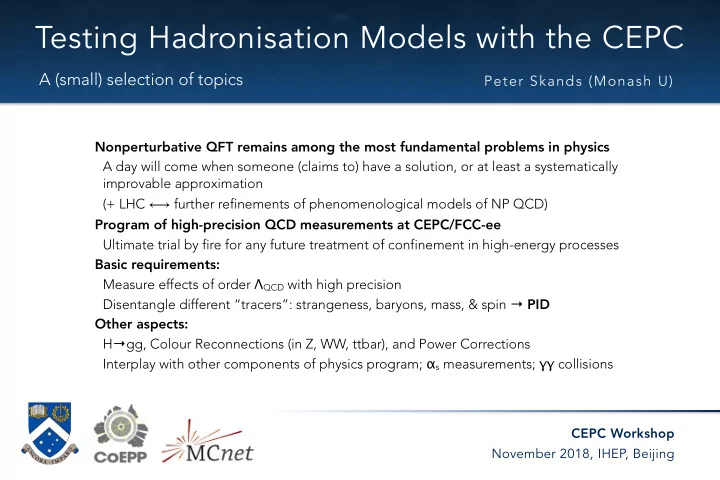
Nonperturbative QFT remains among the most fundamental problems in physics A day will come when someone (claims to) have a solution, or at least a systematically improvable approximation (+ LHC ⟷ further refinements of phenomenological models of NP QCD) Program of high-precision QCD measurements at CEPC/FCC-ee Ultimate trial by fire for any future treatment of confinement in high-energy processes Basic requirements: Measure effects of order ΛQCD with high precision Disentangle different “tracers”: strangeness, baryons, mass, & spin → PID Other aspects: H→gg, Colour Reconnections (in Z, WW, ttbar), and Power Corrections Interplay with other components of physics program; αs measurements; γγ collisions

A (small) selection of topics

slide-2
SLIDE 2

QCD THEMES @ CEPC

TESTI N G H A DR ONISATION MO D E L S W IT H T HE CEPC

  • 2
  • P. S KAN DS - M O N ASH U.
๏Measure alphaS
  • High-Precision Z (and W) widths
  • High-Precision Event Shapes, Jet Rates, … (IR safe observables sensitive to alphaS)
๏Single-Inclusive Hadron Production and Decays
  • Fragmentation Functions; Hadron Spectra; (+ polarisation)
  • Exotic /rare hadrons, rare decays, …
  • + Interplay with flavour studies (+ Interplay with DM annihilation)
๏Understanding Confinement (Multi-hadronic / Exclusive)
  • In high-energy processes → hadronisation
  • Hadron correlations, properties with respect to global (“string”) axes
  • Dependence on (global and local) environment (distance to jets, hadronic density, flavours)
๏Power Corrections / Hadronisation Corrections
  • Interplay with high-pT physics program
  • Low-Q region of event shapes, jet rates, jet substructure; jet flavour tagging, …
  • Crucial for alphaS measurements; also for jet calibration?
slide-3
SLIDE 3

THE FUNDAMENTAL PARAMETER OF (NON-PERTURBATIVE) QCD

TESTI N G H A DR ONISATION MO D E L S W IT H T HE CEPC

  • 3
  • P. S KAN DS - M O N ASH U.
๏The “string tension” κ ~ 1 GeV/fm ~ 0.2 GeV2 ~ (0.45 GeV)2
  • Can be extracted from hadron spectroscopy
  • Also: lattice quark-antiquark potential
  • 46

STATIC QUARK-ANTIQUARK POTENTIAL:

  • SCALING. . .

2641

Scaling plot

2GeV-

1 GeV—

2

I

  • 2

k,

t

0.5

1.

5

1 fm

2.5

l~

RK

B= 6.0, L=16 B= 6.0, L=32 B= 6.2, L=24 B= 6.4, L-24

B = 6.4, L=32

3.

5

~ 'V ~ ~ I ~ A I

4 2'

  • FIG. 4. All potential

data of the five lattices have been scaled to a universal

curve by subtracting

Vo and measuring

energies and

distances

in appropriate

units of &E. The dashed curve correspond

to V(R)=R —

~/12R. Physical units are calculated

by exploit- ing the relation &cr =420 MeV.

AM~a=46. 1A~ &235(2)(13) MeV .

Needless

to say, this value does not necessarily

apply to

full QCD.

In addition

to the long-range

behavior of the confining potential it is of considerable interest to investigate its ul- traviolet

structure. As we proceed into the weak cou-

pling regime lattice simulations

are expected to meet per-

turbative results. Although

we are aware that our lattice

resolution is not yet really

suScient,

we might

dare to

previe~

the continuum behavior

  • f the

Coulomb-like term from our results.

In Fig. 6(a) [6(b)] we visualize the

confidence regions

in the K-e plane from fits to various

  • n- and off-axis potentials
  • n the 32

lattices at P=6.0

[6.4]. We observe that the impact of lattice discretization

  • n e decreases by a factor 2, as we step up from P=6.0 to

150 140

Barkai '84

  • MTC

'90

Our results:---

130-

120-

110-

100-

80—

5.6 5.8

6.2 6.4

  • FIG. 5. The on-axis string tension

[in units of the quantity

c =&E /(a AL )] as a function of P. Our results are combined

with pre-

vious values obtained by the MTc collaboration

[10]and Barkai, Moriarty,

and Rebbi [11].

0.6 0.4 0.2

  • 0.2
  • 0.4
  • 0.6

1.6 1.4 1.2 1.0 0.8 [E(r) - 2 mB]/GeV r/fm nf = 2 + 1 2mB 2mBs state |1> state |2>

V (r) = −e 1 r − 1 rc

  • + σ (r − rc)
  • G. BALI AND K. SCHILLING, “STATIC QUARK - ANTI-QUARK

POTENTIAL: SCALING BEHAVIOR AND FINITE SIZE EFFECTS IN SU(3) LATTICE GAUGE THEORY,” PHYS.REV. D46 (1992) 2636

(without string breaking)

SESAM COLLABORATION “OBSERVATION OF STRING BREAKING IN QCD,” PHYS.REV. D71 (2005) 114513

(with string breaking)
slide-4
SLIDE 4

I CAN’T — SCHWINGER COULD

TESTI N G H A DR ONISATION MO D E L S W IT H T HE CEPC

  • 4
  • P. S KAN DS - M O N ASH U.
๏Schwinger (1951)
  • Non-perturbative pair creation of e+e- pairs in a strong external

electric field

Schwinger Effect + ÷ Non-perturbative creation

  • f e+e- pairs in a strong

external Electric field

~ E

e- e+

P ∝ exp ✓−m2 − p2

κ/π ◆

Probability from Tunneling Factor

(κ is the string tension equivalent)

(Not observed experimentally yet, but may happen soon)

  • J. S. SCHWINGER, “ON GAUGE INVARIANCE AND VACUUM POLARIZATION,” PHYS. REV. 82 (1951) 664–679.
  • G. V. DUNNE, “NEW STRONG-FIELD QED EFFECTS AT ELI: NONPERTURBATIVE VACUUM PAIR PRODUCTION,” EUR. PHYS. J. D55 (2009) 327–340, 0812.3163.
slide-5
SLIDE 5

I CAN’T — SCHWINGER COULD

TESTI N G H A DR ONISATION MO D E L S W IT H T HE CEPC

  • 5
  • P. S KAN DS - M O N ASH U.
๏Schwinger (1951)
  • Non-perturbative pair creation of e+e- pairs in a strong external

electric field

Schwinger Effect + ÷ Non-perturbative creation

  • f e+e- pairs in a strong

external Electric field

~ E

e- e+

P ∝ exp ✓−m2 − p2

κ/π ◆

Probability from Tunneling Factor

(κ is the string tension equivalent)

(Not observed experimentally yet, but may happen soon)

Several groups found same form for QCD at successive levels of modeling/approximation

  • J. S. SCHWINGER, “ON GAUGE INVARIANCE AND VACUUM POLARIZATION,” PHYS. REV. 82 (1951) 664–679.

Generic prediction: Neglecting perturbative effects, hadrons produced from a QCD string stretched between a quark and antiquark should have a universal (flavour-independent) pT spectrum, with

So this is an interesting scale!

(modified by perturbative effects + hadron decays)

⌦ p2

meson ∼ 2

⌦ p2

quark ∼ 2κ

π ∼ (0.35 GeV)2

<latexit sha1_base64="HqaEV6u+WmjbKkU8tA6AW46qFGc=">ACdHichVFNbxMxEPVuC7ThKy0HDvRgiCqVS7QbQOVQoQoOcCwSvF6crzCZWbK+xZ5Gi1f6C/jtu/AwunOukW6m0SIxk6em9N/LMm9wq6TFJfkXxua9+w+2tjsPHz1+8rS7szvyZeUEDEWpSneWcw9KGhiRAVn1gHXuYLTfPFpZ/+AOdlab7h0sJE85mRhRQcA5V1L5iCAo+ozZgFZ8HlDk5m+OHjGmOc6drDb40DWVeahrU/9m/V9wtWjsrHBf1gC24tbypmZWtcJD037xj9LrnM4ya1+eDrNtL+sm6F2QtqBH2jrJuj/ZtBSVBoNCce/HaWJxUnOHUihoOqzyYLlY8BmMAzQ87DKp16E1dD8wU1qULjyDdM3e7Ki59n6p8+BcjelvayvyX9q4wuL9pJbGVghGXH1UVIpiSVcXoFPpQKBaBsCFk2FWKuY8JIXhTp0Qnp75btgNOinAX92zv+2MaxRV6QV+SApOSQHJMv5IQMiSC/o+cRjV5Gf+K9uBfvX1njqO15Rv6quH8J6C298w=</latexit><latexit sha1_base64="HqaEV6u+WmjbKkU8tA6AW46qFGc=">ACdHichVFNbxMxEPVuC7ThKy0HDvRgiCqVS7QbQOVQoQoOcCwSvF6crzCZWbK+xZ5Gi1f6C/jtu/AwunOukW6m0SIxk6em9N/LMm9wq6TFJfkXxua9+w+2tjsPHz1+8rS7szvyZeUEDEWpSneWcw9KGhiRAVn1gHXuYLTfPFpZ/+AOdlab7h0sJE85mRhRQcA5V1L5iCAo+ozZgFZ8HlDk5m+OHjGmOc6drDb40DWVeahrU/9m/V9wtWjsrHBf1gC24tbypmZWtcJD037xj9LrnM4ya1+eDrNtL+sm6F2QtqBH2jrJuj/ZtBSVBoNCce/HaWJxUnOHUihoOqzyYLlY8BmMAzQ87DKp16E1dD8wU1qULjyDdM3e7Ki59n6p8+BcjelvayvyX9q4wuL9pJbGVghGXH1UVIpiSVcXoFPpQKBaBsCFk2FWKuY8JIXhTp0Qnp75btgNOinAX92zv+2MaxRV6QV+SApOSQHJMv5IQMiSC/o+cRjV5Gf+K9uBfvX1njqO15Rv6quH8J6C298w=</latexit><latexit sha1_base64="HqaEV6u+WmjbKkU8tA6AW46qFGc=">ACdHichVFNbxMxEPVuC7ThKy0HDvRgiCqVS7QbQOVQoQoOcCwSvF6crzCZWbK+xZ5Gi1f6C/jtu/AwunOukW6m0SIxk6em9N/LMm9wq6TFJfkXxua9+w+2tjsPHz1+8rS7szvyZeUEDEWpSneWcw9KGhiRAVn1gHXuYLTfPFpZ/+AOdlab7h0sJE85mRhRQcA5V1L5iCAo+ozZgFZ8HlDk5m+OHjGmOc6drDb40DWVeahrU/9m/V9wtWjsrHBf1gC24tbypmZWtcJD037xj9LrnM4ya1+eDrNtL+sm6F2QtqBH2jrJuj/ZtBSVBoNCce/HaWJxUnOHUihoOqzyYLlY8BmMAzQ87DKp16E1dD8wU1qULjyDdM3e7Ki59n6p8+BcjelvayvyX9q4wuL9pJbGVghGXH1UVIpiSVcXoFPpQKBaBsCFk2FWKuY8JIXhTp0Qnp75btgNOinAX92zv+2MaxRV6QV+SApOSQHJMv5IQMiSC/o+cRjV5Gf+K9uBfvX1njqO15Rv6quH8J6C298w=</latexit><latexit sha1_base64="HqaEV6u+WmjbKkU8tA6AW46qFGc=">ACdHichVFNbxMxEPVuC7ThKy0HDvRgiCqVS7QbQOVQoQoOcCwSvF6crzCZWbK+xZ5Gi1f6C/jtu/AwunOukW6m0SIxk6em9N/LMm9wq6TFJfkXxua9+w+2tjsPHz1+8rS7szvyZeUEDEWpSneWcw9KGhiRAVn1gHXuYLTfPFpZ/+AOdlab7h0sJE85mRhRQcA5V1L5iCAo+ozZgFZ8HlDk5m+OHjGmOc6drDb40DWVeahrU/9m/V9wtWjsrHBf1gC24tbypmZWtcJD037xj9LrnM4ya1+eDrNtL+sm6F2QtqBH2jrJuj/ZtBSVBoNCce/HaWJxUnOHUihoOqzyYLlY8BmMAzQ87DKp16E1dD8wU1qULjyDdM3e7Ki59n6p8+BcjelvayvyX9q4wuL9pJbGVghGXH1UVIpiSVcXoFPpQKBaBsCFk2FWKuY8JIXhTp0Qnp75btgNOinAX92zv+2MaxRV6QV+SApOSQHJMv5IQMiSC/o+cRjV5Gf+K9uBfvX1njqO15Rv6quH8J6C298w=</latexit>
slide-6
SLIDE 6

TRANSVERSE FRAGMENTATION

TESTI N G H A DR ONISATION MO D E L S W IT H T HE CEPC

  • 6
  • P. S KAN DS - M O N ASH U.
๏Hadron pT spectra, transverse to dominant event axis

q

<latexit sha1_base64="VfTMvcm6LIULdTBFvjKstksZA0=">AB6HicdVDJSgNBEO2JW4xb1KOXxiB4GmZCksncgl48JmAWSIbQ06lJWnsWu3uEMOQLvHhQxKuf5M2/sbMIKvqg4PFeFVX1/IQzqSzrw8itrW9sbuW3Czu7e/sHxcOjoxTQaFNYx6Lnk8kcBZBWzHFoZcIKHPoevfXs797j0IyeLoWk0T8EIyjljAKFat0NiyXLrJbrFcfFlmu1ipVRxPHcl23hm3TWqCEVmgOi+DUzTECJFOZGyb1uJ8jIiFKMcZoVBKiEh9JaMoa9pREKQXrY4dIbPtDLCQSx0RQov1O8TGQmlnIa+7gyJmsjf3lz8y+unKqh7GYuSVEFEl4uClGMV4/nXeMQEUMWnmhAqmL4V0wkRhCqdTUGH8PUp/p90yqateatSalys4sijE3SKzpGNHNRAV6iJ2ogiQA/oCT0bN8aj8WK8LltzxmrmGP2A8fYJcd+NXQ=</latexit><latexit sha1_base64="VfTMvcm6LIULdTBFvjKstksZA0=">AB6HicdVDJSgNBEO2JW4xb1KOXxiB4GmZCksncgl48JmAWSIbQ06lJWnsWu3uEMOQLvHhQxKuf5M2/sbMIKvqg4PFeFVX1/IQzqSzrw8itrW9sbuW3Czu7e/sHxcOjoxTQaFNYx6Lnk8kcBZBWzHFoZcIKHPoevfXs797j0IyeLoWk0T8EIyjljAKFat0NiyXLrJbrFcfFlmu1ipVRxPHcl23hm3TWqCEVmgOi+DUzTECJFOZGyb1uJ8jIiFKMcZoVBKiEh9JaMoa9pREKQXrY4dIbPtDLCQSx0RQov1O8TGQmlnIa+7gyJmsjf3lz8y+unKqh7GYuSVEFEl4uClGMV4/nXeMQEUMWnmhAqmL4V0wkRhCqdTUGH8PUp/p90yqateatSalys4sijE3SKzpGNHNRAV6iJ2ogiQA/oCT0bN8aj8WK8LltzxmrmGP2A8fYJcd+NXQ=</latexit><latexit sha1_base64="VfTMvcm6LIULdTBFvjKstksZA0=">AB6HicdVDJSgNBEO2JW4xb1KOXxiB4GmZCksncgl48JmAWSIbQ06lJWnsWu3uEMOQLvHhQxKuf5M2/sbMIKvqg4PFeFVX1/IQzqSzrw8itrW9sbuW3Czu7e/sHxcOjoxTQaFNYx6Lnk8kcBZBWzHFoZcIKHPoevfXs797j0IyeLoWk0T8EIyjljAKFat0NiyXLrJbrFcfFlmu1ipVRxPHcl23hm3TWqCEVmgOi+DUzTECJFOZGyb1uJ8jIiFKMcZoVBKiEh9JaMoa9pREKQXrY4dIbPtDLCQSx0RQov1O8TGQmlnIa+7gyJmsjf3lz8y+unKqh7GYuSVEFEl4uClGMV4/nXeMQEUMWnmhAqmL4V0wkRhCqdTUGH8PUp/p90yqateatSalys4sijE3SKzpGNHNRAV6iJ2ogiQA/oCT0bN8aj8WK8LltzxmrmGP2A8fYJcd+NXQ=</latexit><latexit sha1_base64="VfTMvcm6LIULdTBFvjKstksZA0=">AB6HicdVDJSgNBEO2JW4xb1KOXxiB4GmZCksncgl48JmAWSIbQ06lJWnsWu3uEMOQLvHhQxKuf5M2/sbMIKvqg4PFeFVX1/IQzqSzrw8itrW9sbuW3Czu7e/sHxcOjoxTQaFNYx6Lnk8kcBZBWzHFoZcIKHPoevfXs797j0IyeLoWk0T8EIyjljAKFat0NiyXLrJbrFcfFlmu1ipVRxPHcl23hm3TWqCEVmgOi+DUzTECJFOZGyb1uJ8jIiFKMcZoVBKiEh9JaMoa9pREKQXrY4dIbPtDLCQSx0RQov1O8TGQmlnIa+7gyJmsjf3lz8y+unKqh7GYuSVEFEl4uClGMV4/nXeMQEUMWnmhAqmL4V0wkRhCqdTUGH8PUp/p90yqateatSalys4sijE3SKzpGNHNRAV6iJ2ogiQA/oCT0bN8aj8WK8LltzxmrmGP2A8fYJcd+NXQ=</latexit>

¯ q

<latexit sha1_base64="RTjzUEDgN4I9WSmsocn38UuZ74I=">AB7nicdVDLSsNAFL3xWeur6tLNYBFchbS0TbMrunFZwT6gDWUynbRDJ5M4MxFK6Ee4caGIW7/HnX/j9CGo6IELh3Pu5d57goQzpR3nw1pb39jc2s7t5Hf39g8OC0fHbRWnktAWiXksuwFWlDNBW5pTruJpDgKO0Ek6u537mnUrFY3OpQv0IjwQLGcHaSJ1+gGV2NxsUio5dLdcrocu1ytVaquIa7jeV4NlWxngSKs0BwU3vDmKQRFZpwrFSv5CTaz7DUjHA6y/dTRNMJnhEe4YKHFHlZ4tzZ+jcKEMUxtKU0Gihfp/IcKTUNApMZ4T1WP325uJfXi/VYd3PmEhSTQVZLgpTjnSM5r+jIZOUaD41BPJzK2IjLHERJuE8iaEr0/R/6RdtkuG31SKjctVHDk4hTO4gBK40IBraEILCEzgAZ7g2UqsR+vFel2rlmrmRP4AevtEy+XkCI=</latexit><latexit sha1_base64="RTjzUEDgN4I9WSmsocn38UuZ74I=">AB7nicdVDLSsNAFL3xWeur6tLNYBFchbS0TbMrunFZwT6gDWUynbRDJ5M4MxFK6Ee4caGIW7/HnX/j9CGo6IELh3Pu5d57goQzpR3nw1pb39jc2s7t5Hf39g8OC0fHbRWnktAWiXksuwFWlDNBW5pTruJpDgKO0Ek6u537mnUrFY3OpQv0IjwQLGcHaSJ1+gGV2NxsUio5dLdcrocu1ytVaquIa7jeV4NlWxngSKs0BwU3vDmKQRFZpwrFSv5CTaz7DUjHA6y/dTRNMJnhEe4YKHFHlZ4tzZ+jcKEMUxtKU0Gihfp/IcKTUNApMZ4T1WP325uJfXi/VYd3PmEhSTQVZLgpTjnSM5r+jIZOUaD41BPJzK2IjLHERJuE8iaEr0/R/6RdtkuG31SKjctVHDk4hTO4gBK40IBraEILCEzgAZ7g2UqsR+vFel2rlmrmRP4AevtEy+XkCI=</latexit><latexit sha1_base64="RTjzUEDgN4I9WSmsocn38UuZ74I=">AB7nicdVDLSsNAFL3xWeur6tLNYBFchbS0TbMrunFZwT6gDWUynbRDJ5M4MxFK6Ee4caGIW7/HnX/j9CGo6IELh3Pu5d57goQzpR3nw1pb39jc2s7t5Hf39g8OC0fHbRWnktAWiXksuwFWlDNBW5pTruJpDgKO0Ek6u537mnUrFY3OpQv0IjwQLGcHaSJ1+gGV2NxsUio5dLdcrocu1ytVaquIa7jeV4NlWxngSKs0BwU3vDmKQRFZpwrFSv5CTaz7DUjHA6y/dTRNMJnhEe4YKHFHlZ4tzZ+jcKEMUxtKU0Gihfp/IcKTUNApMZ4T1WP325uJfXi/VYd3PmEhSTQVZLgpTjnSM5r+jIZOUaD41BPJzK2IjLHERJuE8iaEr0/R/6RdtkuG31SKjctVHDk4hTO4gBK40IBraEILCEzgAZ7g2UqsR+vFel2rlmrmRP4AevtEy+XkCI=</latexit><latexit sha1_base64="RTjzUEDgN4I9WSmsocn38UuZ74I=">AB7nicdVDLSsNAFL3xWeur6tLNYBFchbS0TbMrunFZwT6gDWUynbRDJ5M4MxFK6Ee4caGIW7/HnX/j9CGo6IELh3Pu5d57goQzpR3nw1pb39jc2s7t5Hf39g8OC0fHbRWnktAWiXksuwFWlDNBW5pTruJpDgKO0Ek6u537mnUrFY3OpQv0IjwQLGcHaSJ1+gGV2NxsUio5dLdcrocu1ytVaquIa7jeV4NlWxngSKs0BwU3vDmKQRFZpwrFSv5CTaz7DUjHA6y/dTRNMJnhEe4YKHFHlZ4tzZ+jcKEMUxtKU0Gihfp/IcKTUNApMZ4T1WP325uJfXi/VYd3PmEhSTQVZLgpTjnSM5r+jIZOUaD41BPJzK2IjLHERJuE8iaEr0/R/6RdtkuG31SKjctVHDk4hTO4gBK40IBraEILCEzgAZ7g2UqsR+vFel2rlmrmRP4AevtEy+XkCI=</latexit>

Linearised sphericity axis, thrust axis, 2-jet axis, …

0.5 1 1.5 2

T

/dp

ch

> dn

ch

1/<n

(vs Linearised Ch+Neu Sphericity Axis)

T

Charged p

=300MeV

q

σ +5%

  • 5%

91.2 GeV q q → Z

0.2 0.4 0.6 0.8 1

T

p 0.96 0.98 1 1.02 1.04 Ratio

Toy Example 5% variations of string-breaking pT Can we see this?

0.5 1 1.5 2

T

/dp

ch

> dn

ch

1/<n

(with |p| > 0.2 GeV)

T

Charged p

=300MeV

q

σ +5%

  • 5%

91.2 GeV q q → Z

0.2 0.4 0.6 0.8 1

T

p 0.96 0.98 1 1.02 1.04 Ratio

With cut |p|>200 MeV Differences survive

Perturbatively dominated power-law tail

slide-7
SLIDE 7

SCHWINGER VS HAWKING

TESTI N G H A DR ONISATION MO D E L S W IT H T HE CEPC

  • 7
  • P. S KAN DS - M O N ASH U.
๏Schwinger vs Hawking?
  • Hawking radiation: another example of spontaneous pair creation in

a strong external field. This one has a horizon ⟷ confinement?

Schwinger Effect + ÷ Non-perturbative creation

  • f e+e- pairs in a strong

external Electric field

~ E

e- e+

P ∝ exp ✓−m2 − p2

κ/π ◆

Probability from Tunneling Factor

(κ is the string tension equivalent)

Hawking Radiation M

~ g

Non-perturbative creation

  • f radiation quanta in a

strong gravitational field

HORIZON HORIZON

Thermal (Boltzmann) Factor

P ∝ exp ✓ −E kBTH ◆

Linear Energy Exponent

ALTERNATIVE?

Some empirical success fitting thermal spectra (Tsallis fits) to particle spectra (+ some theoretical motivations) Mainly we just see <pT>; tail to high pT dominated by perturbative power law; need to measure soft pions

slide-8
SLIDE 8

EFFECTS OF ORDER ΛQCD

TESTI N G H A DR ONISATION MO D E L S W IT H T HE CEPC

  • 8
  • P. S KAN DS - M O N ASH U.
๏pT kicks from hadronisation: Gaussian

pT distribution with width ~ 300 MeV (+ ρ decays)

๏Difficult for any hadron to have |p| <

300 MeV.

  • Can you make a pion stand still?
  • Non-relativistic pions
๏Data from both LEP and LHC indicate

softer pion spectrum

๏Cut at |p| = 200 MeV makes this a bit

tough to examine clearly

  • 3 hits down to ~ 50 MeV ?
  • Special runs / setups with lower

thresholds?

)|

p

/d|Ln(x

ch

> dn

ch

1/<n

  • 3

10

  • 2

10

  • 1

10 1 10 Charged Momentum Fraction (udsc)

Pythia 8.183 Data from Phys.Rept. 399 (2004) 71

L3 PY8 (Monash) PY8 (Default) PY8 (Fischer)

bins

/N

2 5%

χ 0.0 ± 0.9 0.0 ± 0.5 0.0 ± 0.5

V I N C I A R O O T

)|

p

|Ln(x

2 4 6 8

Theory/Data 0.6 0.8 1 1.2 1.4

200 MeV 150 MeV

Example from LEP

slide-9
SLIDE 9

➠ FRAGMENTATION FUNCTIONS

TESTI N G H A DR ONISATION MO D E L S W IT H T HE CEPC

  • 9
  • P. S KAN DS - M O N ASH U.
๏FFs from Belle to FCC-ee [A. Vossen]
  • Precision of TH and EXP big advantage

Complementary to pp and SIDIS

  • FF Evolution:

Belle has CEPC-like stats at 10 GeV.

CEPC? very fine binning all the way to z=1 with <1% |p| resolution (expected)

  • Flavour structure for FFs of hyperons

and other hadrons that are difficult to reconstruct in pp and SIDIS.

➠ Particle Identification capabilities.

  • Low Z: Higher ee energy (than Belle) → smaller mass effects at low z.

3 tracker hits down to 30-40 MeV allows to reach z = 10-3 (ln(z) = -7)

Kluth: if needed, could get O(LEP) sample in ~ 1 minute running with lower B-field

  • gluon FFs, heavy-quark FFs, pT dependence in hadron + jet,

polarisation,…

z

0.1 0.2 0.3 0.4 0.5 0.6 0.7 0.8 0.9 1

) s c( × /dz σ d

tot.had.

σ 1/

1 10

2

10

3

10

4

10

5

10

6

10

7

10

8

10

9

10

10

10

11

10

12

10

13

10

+X Production

±

π →

  • e

+

World Data (Sel.) for e

)

9

10 × 3 × ALEPH 91GeV ( 150) × ARGUS 9GeV, 10GeV ( 3000) × CLEO 10GeV ( )

10

10 × 5 × DELPHI 91GeV ( 1 ) × R

  • n

a n e t a l . 3 G e V ( )

12

10 × SLD 91GeV ( )

7

10 × 7 × TASSO 34GeV, 44GeV ( )

6

10 × 2 × TPC 29GeV ( 0.04) × this meas., Belle 11 GeV (

+X Production

±

π →

  • e

+

World Data (Sel.) for e

CEPC/FCC-ee?

Evolution Scaling

  • S. Moch (& others): field now moving towards NNLO accuracy: 1% errors (or better)

(see FCC-ee QCD workshops & writeups)

slide-10
SLIDE 10

➠ HADRON CORRELATIONS

TESTI N G H A DR ONISATION MO D E L S W IT H T HE CEPC

  • 10
  • P. S KAN DS - M O N ASH U.
๏Further precision non-perturbative aspects
  • Baryon-Antibaryon correlations: how local is hadronisation?

Kluth: both OPAL measurements were statistics-limited; would reach OPAL systematics at 108 Z decays (→ 109 with improved systematics?)

  • + Strangeness correlations, pT, spin/helicity correlations (“screwiness”?)
  • Bose-Einstein Correlations & Fermi-Dirac Correlations

Identical baryons! (pp, ΛΛ) ; highly non-local in string picture

  • W. Metzger: remaining Fermi-Dirac radius puzzle: correlations at LEP across multiple experiments & for both pp and

ΛΛ → 0.1 fm << rp (MC dependent? Were pΛ cross checks ever done? see EPJC 52 (2007) 113 )

Leading baryons in g jets? (discriminates between string/cluster models) high-|p| baryons Octet neutralisation? (zero-charge gluon jet with rapidity gaps) → neutrals Colour reconnections, glueballs, …

q ¯ q qq ¯ q¯ q s ¯ s q ¯ q q ¯ q q ¯ q

How local? How local? How local? (see FCC-ee QCD workshops & writeups)

slide-11
SLIDE 11

STRANGENESS ENHANCEMENTS (IN PP)

TESTI N G H A DR ONISATION MO D E L S W IT H T HE CEPC

  • 11
  • P. S KAN DS - M O N ASH U.
๏ALICE: clear enhancement of

strangeness with (pp) event multiplicity

  • Especially for multi-strange baryons

No corresponding enhancement for protons (not shown here but is in ALICE paper)

→ must really be a strangeness effect

  • Measurements of phi now underway
๏Jet universality: jets at LHC modelled

the same as jets at LEP

  • → Flat line ! (cf PYTHIA)
  • Some models anticipated the effect!

DIPSY (high-tension overlapping strings)

EPOS (thermal hydrodynamic “core”)

  • Is it thermal? Or stringy? (or both?)
  • Basic check in ee→WW: two strings

D.D. Chinellato – 38th International Conference on High

|< 0.5 η |

〉 η /d

ch

N d 〈

10

2

10

3

10

)

+

π +

π Ratio of yields to (

3 −

10

2 −

10

1 −

10

16) × (

+

Ω +

Ω 6) × (

+

Ξ +

Ξ 2) × ( Λ + Λ

S

2K ALICE = 7 TeV s pp, = 5.02 TeV

NN

s p-Pb, = 2.76 TeV

NN

s Pb-Pb,

PYTHIA8 DIPSY EPOS LHC ALICE, arXiv:1606.07424

S

2K 2) × ( Λ + Λ 6) × (

+

Ξ +

Ξ 16) × (

+

Ω +

Ω [1] [2] [3] D.D. Chinellato – 38th International Conference on High Energy Physics

(LEP: total Ω rate only known to ± 20%)

slide-12
SLIDE 12

COLOUR RECONNECTIONS

TESTI N G H A DR ONISATION MO D E L S W IT H T HE CEPC

  • 12
  • P. S KAN DS - M O N ASH U.
๏At LEP 2: hot topic (by QCD standards): ’string drag’ effect on W mass
  • Non-zero effect convincingly demonstrated at LEP-2

No-CR excluded at 99.5% CL [Phys.Rept. 532 (2013) 119]

But not much detailed (differential) information

  • Thousand times more WW at CEPC / FCC-ee
  • Turn the W mass problem around; use threshold scan +

huge sample of semi-leptonic events to measure mW

  • → input as constraint to measure CR in hadronic WW
๏Has become even hotter topic at LHC
  • It appears jet universality is under heavy attack.

Fundamental to understanding & modeling hadronisation

Follow-up studies now underway at LHC.

๏High-stats ee → other side of story
  • Also relevant in (hadronic) ee→tt, and Z→4 jets
  • T. Sjöstrand, W. Metzger, S. Kluth, C. Bierlich

LC CR

ΓW ΛQCD

W W + Overlaps → interactions? increased tensions (strangeness)? breakdown of string picture? ∼O ✓ 1 N 2

C

◆ ⊗ kinematics

O (1)

Overviews of recent models: arXiv:1507.02091 , arXiv:1603.05298

(see FCC-ee QCD workshops & writeups)

slide-13
SLIDE 13

JET (SUB)STRUCTURE : PARTON SHOWERS

TESTI N G H A DR ONISATION MO D E L S W IT H T HE CEPC

  • 13
  • P. S KAN DS - M O N ASH U.
๏Multi-jet events
  • At LEP: kicked off the subfield of matrix-element matching & merging

Transformed QCD collider phenomenology from being one of fixed-order vs Monte Carlo calculations to being fixed-order + Monte Carlo.

  • Blazed the trail for LHC state of the art: Multi-jet NLO merging

For the first time in many years more work on the accuracy of the parton-shower algorithms. Needed as we go to higher accuracy for the matrix elements. 1/Nc (Pl¨

atzer, Sj¨

  • dahl JHEP 1207 (2012) 042), (Nagy, Soper, JHEP 1507 (2015) 119)

Subleading logs (Li, Skands, arXiv:1611.00013) This is the area where there is probably the greatest potential for improvement. If we can consistently improve the logarithmic accuracy.

P Richardson (parton showers since LEP)

Expect 2nd-order showers within the next decade, screaming for “2nd-order” validations.

slide-14
SLIDE 14

QUARKS AND GLUONS

TESTI N G H A DR ONISATION MO D E L S W IT H T HE CEPC

  • 14
  • P. S KAN DS - M O N ASH U.
๏Handles to split degeneracies
  • H→gg vs Z→qq

Can we get a sample of H→gg pure enough for QCD studies?

Requires good H→gg vs H→bb;

Driven by Higgs studies requirements?

  • Z→bbg vs Z→qq(g)

g in one hemisphere recoils against b-jets in

  • ther hemisphere: b tagging
  • Study differential shape(s): Nch (+low-R calo)

(R ~ 0.1 also useful for jet substructure)

๏Scaling: radiative events → Forward Boosted
  • Scaling is slow, logarithmic → prefer large lever arm

ECM > EBelle ~ 10 GeV [~ 10 events / GeV at LEP];

Useful benchmarks could be ECM ~ 10 (cross checks with Belle), 20, 30 (geom. mean between Belle and mZ), 45 GeV (=mZ/2) and 80 GeV = mW

  • G. SOYEZ, K. HAMACHER, G. RAUCO, S. TOKAR, Y. SAKAKI

(Also useful for FFs & general scaling studies)

Eg = 40 GeV Eq = 45 GeV (see FCC-ee QCD workshops & writeups)

slide-15
SLIDE 15

SUMMARY / OUTLOOK

TESTI N G H A DR ONISATION MO D E L S W IT H T HE CEPC

  • 15
  • P. S KAN DS - M O N ASH U.

Jet Substructure Event Shapes AlphaS Extractions Heavy Quarks QCD Resummation Colour Reconnections Particle Spectra Hadronisation Jet Calibrations Jet Algorithms Fragmentation Functions Perturbative QCD Interplay with EW, H, BSM @ FCC-ee Interplay with future pp Particle Correlations MC

๏QCD: (the only) unbroken Yang-Mills theory that can be compared directly with
  • experiment. Rich structure.
  • CEPC / FCC-ee have tremendous potential to

make decisive & detailed measurements.

  • End of era of testing SU(3)C → Precision

determinations of αs

  • Theory still evolving and new questions

highlighted by LHC

  • Confinement is still hard
  • LEP precision finally exhausted, almost 20

years after shutdown.

Current generation of theory models show few (albeit some) discrepancies with LEP

  • Within next decade: expect significant

perturbative advances and next-generation hadronisation models.

  • + QCD in γγ collisions, interplay with EW, H,

BSM, Precision Legacy for future pp collider