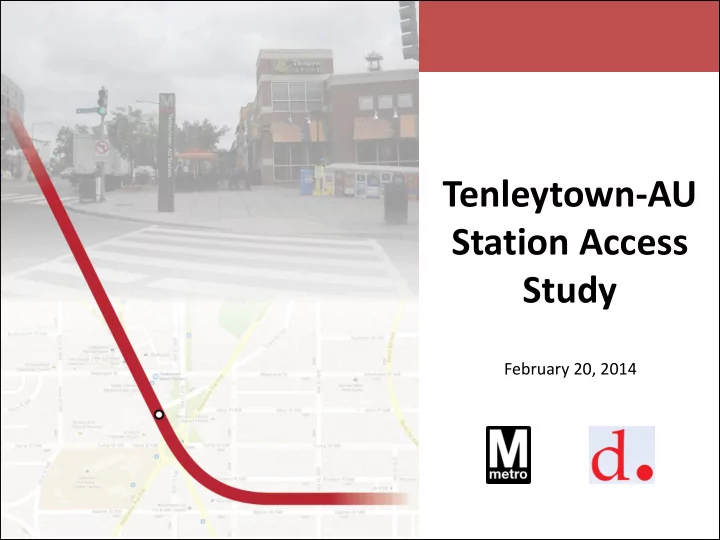
Tenleytown-AU Station Access Study February 20, 2014 Project - - PowerPoint PPT Presentation

tenleytown au
SMART_READER_LITE
LIVE PREVIEW

Tenleytown-AU Station Access Study February 20, 2014 Project - - PowerPoint PPT Presentation

Tenleytown-AU Station Access Study February 20, 2014 Project Purpose and Process Analyze current conditions and develop improvement concepts on WMATA owned property to accommodate all modes of access to the Tenleytown-AU Metrorail Station.


slide-1
SLIDE 1

Tenleytown-AU Station Access Study

February 20, 2014
slide-2
SLIDE 2

Project Purpose and Process

2

Analyze current conditions and develop improvement concepts

  • n WMATA owned property to accommodate all modes of access

to the Tenleytown-AU Metrorail Station. Major project phases include:

  • Existing Conditions and Issues Identification
  • Design Framework
  • Alternatives Development and Refinement
  • Evaluation of Concepts
  • Conclusions and Next Steps

Important to note: This is the first step in a multi-phased process to redesign the current facility.

slide-3
SLIDE 3

Station Area

3

N

slide-4
SLIDE 4

WMATA Property Lines

4

N

slide-5
SLIDE 5

Existing Transit Services

5

Route Existing Peak Hour Buses Using 40th St/Fort Dr 96 3 M4 4 H2, H3, H4 10 X3 2 W45/W47 2 Sibley Shuttle 1 AU 1 6 AU 2 6 Total 34

slide-6
SLIDE 6

Station Area Needs

6

  • Public realm enhancements
  • Pedestrian safety improvements
  • Bicycle accommodations and supportive

infrastructure

  • Transit user waiting areas and amenities;

bus layover areas

  • Intersection geometry improvements
slide-7
SLIDE 7

Concept Designs

7

  • Designed to address the identified concerns and station area

needs

  • Planned to address and maximize future multimodal station access

(5% bicycle mode share, future Metrobus ridership growth)

  • Coordination with WMATA and DDOT engineers and planners
  • Developed three (3) concepts with vary levels of disturbance to the

existing infrastructure; low, medium, and high

  • Concepts limited to publicly owned Right-of-Way
slide-8
SLIDE 8

Concept A

8

  • Short-term, Low Disturbance
  • Improved pedestrian desire

lines

  • Decreased pedestrian-auto

conflicts

  • Improved bicycle facilities
  • Additional bus shelter and

layover areas

  • On-street parking is preserved
slide-9
SLIDE 9

Concept B

9

  • Long-term, Medium

Disturbance

  • Improved pedestrian desire

lines

  • Expanded ped/community

space

  • Decreased pedestrian-auto

conflicts

  • Improved bicycle facilities
  • Additional bus shelter and

layover areas

  • Improved intersection

geometry

  • Loss of 31 on-street metered

parking spaces

slide-10
SLIDE 10

Concept C

10

  • Long-term, High Disturbance
  • Improved pedestrian desire

lines

  • Expanded ped/community

space

  • Decreased pedestrian-auto

conflicts

  • Improved bicycle facilities
  • Additional bus shelter and

layover areas

  • Improved intersection

geometry

  • Loss of 24 on-street metered

parking spaces

slide-11
SLIDE 11

Capital Cost Estimates

11

Concept Capital Cost Estimate Concept A – Low Disturbance $2.4M Concept B – Medium Disturbance $4.6M Concept C – High Disturbance $7.6M

  • Includes site preparation, modifications to curb lines, and design

elements featured in each design concept.

  • Includes 10% Preliminary Engineering/Plan Review, 25% Contingency, and

15% Engineering Overhead.

  • Capital costs estimates takes into account money already programmed in

WMATA’s Capital Improvement Program for station canopy.

  • Right-of-way costs are not included.
slide-12
SLIDE 12

Feedback

Question / Answer

12

slide-13
SLIDE 13

Contact Information

WMATA John Magarelli Senior Civil/Transit Engineer Office of Real Estate and Station Planning jmagarelli@wmata.com AECOM Tim Brulle Transportation Planner timothy.brulle@aecom.com

13